In injection molding, the mold is the heart of production. But over time, even the best-maintained molds accumulate stubborn contaminants that no amount of wiping or solvent dipping can fully remove. Two of the most troublesome offenders are gas coke (gas residue layer) and toner residue.
Gas coke forms when plastic materials decompose under high heat and pressure during the injection cycle. Volatile compounds condense on the cooler mold cavity surfaces, baking into a hard, carbon-like layer that is chemically bonded to the tool steel. Toner residue—pigment particles from colored plastics—adheres to cavity walls, corners, and venting slots, gradually building up with each shot.
The consequences are not merely cosmetic. Gas coke and toner residue disrupt heat transfer, alter surface texture, and create nucleation sites for flow marks and splay. As contamination accumulates, injection molded parts emerge with persistent yellowing, dull surface finish, and visible flow lines or gas marks—defects that trigger costly rework, scrap, and customer rejections.
Traditional cleaning methods—manual scraping, abrasive blasting, chemical soaking, and high-pressure spraying—all fall short. Scrapers and brushes cannot reach the deep cavities, narrow ribs, or intricate venting grooves where contaminants hide. Abrasive methods scratch precision surfaces, altering critical dimensions. Chemical soaking may soften some residues but lacks the mechanical force to dislodge baked-on carbon from microscopic pores. The result is a cycle of incomplete cleaning, recurring defects, and progressively shorter mold life.
Ultrasonic electrolytic cleaning offers a fundamentally different approach—one that combines the physical power of cavitation with the chemical action of electrolysis to achieve what neither method can accomplish alone.
The process works as follows: the mold or workpiece is immersed in a specialized cleaning solution and connected as the cathode, with a standard electrode bar serving as the anode. When electrical current passes through the electrolytic solution, oxygen is generated at the anode and hydrogen is produced at the cathode. Simultaneously, high-frequency ultrasonic transducers generate microscopic cavitation bubbles in the cleaning bath.
The hydrogen bubbles form directly on the metal surface, creating a "sauna effect" that lifts dirt, carbon deposits, resin components, moisture, and oil from the substrate. The ultrasonic cavitation—millions of imploding bubbles—delivers intense localized energy that penetrates every groove, slot, horn, blind hole, and complex geometric feature. Together, the electrolytic gas generation and ultrasonic shockwaves break the molecular bond between contaminants and the mold surface, causing dirt to peel away and float free.
The results are transformative. Even contaminants that have been baked onto molds over thousands of production cycles—gas residue layers, high-temperature sulfides, fire plastic residue, toner residue, and surface oxides—are completely removed. The mold emerges from the inside out with a brilliant metallic luster.
Non-abrasive and dimensionally safe. Unlike manual scraping or abrasive blasting, ultrasonic electrolytic cleaning preserves the mold's original dimensional accuracy and surface finish. There is no physical contact with the cavity surface—only the gentle yet powerful action of bubbles and ultrasonic waves. This is essential for high-precision molds where even micron-level damage can affect part quality.
Complete penetration of complex geometries. Ultrasonic waves travel through liquid and reach every surface the liquid contacts—including deep cavities, narrow slots, blind holes, and intricate cooling channels that brushes and sprays cannot access. Contaminants trapped in the most inaccessible corners are removed thoroughly.
Immediate rust prevention. The electrolytic cleaning process leaves the cleaned mold with a protective effect—it will not rust immediately after cleaning. When paired with a water-based rust inhibitor, the mold surface is protected against oxidation.
Time and labor savings. Electrolytic ultrasonic cleaning saves approximately one hour of cleaning time compared to manual methods. Automated systems complete in minutes what takes hours manually. One operator can manage multiple machines, freeing skilled workers for higher-value tasks.
Environmental safety. The process uses water-based cleaning solutions with mild additives, eliminating the need for aggressive organic solvents. This reduces both material costs and hazardous waste disposal expenses.
For manufacturers seeking a proven solution to mold contamination challenges, Whale Cleen (Shenzhen Blue Whale Ultrasonic Cleaning Equipment Co., Ltd.) stands as a trusted partner with over two decades of experience. Since 2003, the company has focused on providing professional cleaning solutions and various types of ultrasonic cleaners, establishing itself as a high-tech enterprise integrating R&D, manufacturing, marketing, and after-sales service.
Today, Whale Cleen operates a 10,000-square-meter production base, designing and manufacturing automatic ultrasonic cleaning machines, custom industrial systems, and fully integrated cleaning lines. The company's products serve a wide range of industrial applications—injection molds, instrument precision molds, connector molds, precision seal molds, stamping molds, and molding molds.
What sets Whale Cleen apart:
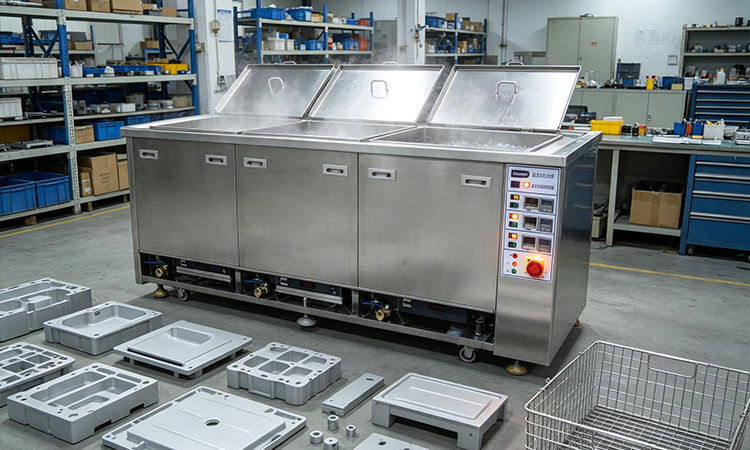
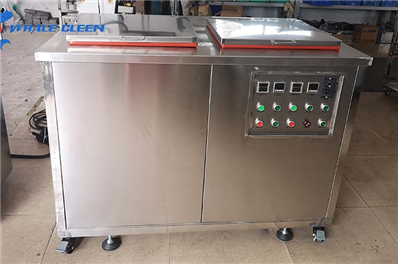
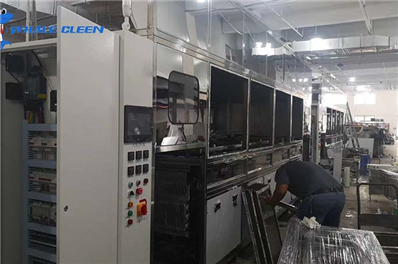
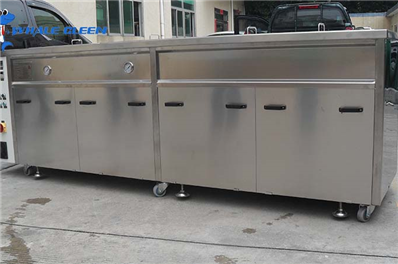
Electrolytic ultrasonic technology. Whale Cleen's double-tank and three-tank electrolytic ultrasonic cleaning systems are specifically engineered for mold cleaning. The systems combine ultrasonic generation, electrolytic circuitry, circulating filtration, specialized cleaning agents, and water-based rust inhibitors into a complete cleaning solution.
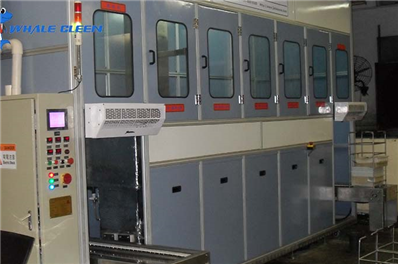
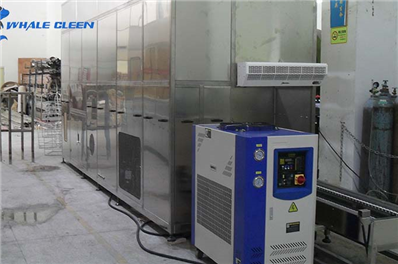
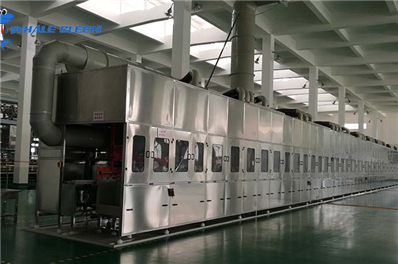
Fully automated one-stop solutions. Whale Cleen's mechanical arm-type automatic ultrasonic cleaners integrate six core systems: mechanical transmission, ultrasonic system, heating system, drying system, water supply and drainage, and electrical control. The entire process—from loading to tank transfer to final unloading—is fully automated. Rough washing, spraying, hot soaking, rinsing, bubbling, and drying are all completed within a single integrated system.
Imported high-efficiency transducers. Whale Cleen uses imported piezoelectric ceramic transducers that deliver concentrated, powerful cleaning action. Advanced bonding technology ensures the transducers remain securely attached even under prolonged operation at varying temperatures.
Custom OEM/ODM capabilities. Whale Cleen does not offer one-size-fits-all units. Every system is purpose-built for the factory's unique, non-standard conditions. Process integration—heating, filtration, oil skimming, rinsing, drying, and anti-rust modules—is arranged exactly as the production sequence requires.
Non-contact, non-destructive cleaning. Whale Cleen's ultrasonic systems eliminate physical contact entirely—workpieces are immersed in a cavitation field that strips away every trace of contamination without ever touching the surface.
Gas coke and toner residue are not inevitable costs of injection molding—they are problems that can be systematically eliminated with the right cleaning technology. Ultrasonic electrolytic cleaning offers a proven path to complete contaminant removal, preserved mold precision, reduced downtime, and consistently higher part quality.
Whale Cleen brings two decades of ultrasonic expertise to this challenge, with a product lineup and service model designed to make the transition seamless. Whether you are cleaning injection molds, stamping tools, or precision dies, Whale Cleen has a solution that protects your mold investment while delivering outstanding cleaning results.
Stop accepting yellowing parts and flow marks. Start cleaning molds the right way—with ultrasonic electrolytic technology from Whale Cleen.