In high-value surface finishing shops, nickel and gold plating lines demand the highest levels of surface cleanliness. A single fingerprint, a microscopic film of stamping oil, or a speck of polishing compound left on a component will manifest as blistering, pitting, skip plating, or poor adhesion. The result: costly rejects, production delays, and damaged customer relationships. Despite the criticality, many plating operations still rely heavily on manual cleaning — operators hand-wiping parts with solvents or moving baskets through a series of rudimentary soak tanks. This approach suffers from two fatal flaws: low throughput and inconsistent cleanliness. Different operators apply different levels of attention; complex geometries like connector pins, lead frames, or stamped terminals trap contaminants in recesses that a rag simply cannot reach. The consequence is a cleaning bottleneck that caps the plating line’s overall yield and prevents scaling to meet demand.
The question that plant managers are now asking is clear: how can a plating line guarantee that every single part entering the nickel or gold bath is uniformly and completely clean, without relying on manual variability, and without slowing down production?
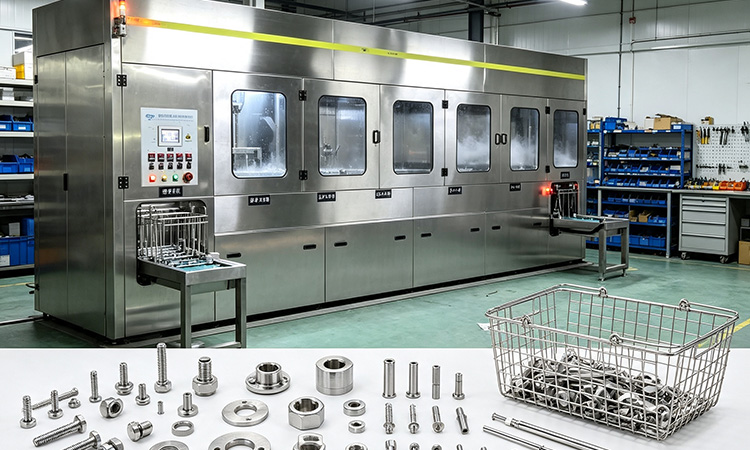
Industrial ultrasonic cleaning provides the answer by replacing manual effort with a repeatable physical process. Ultrasonic transducers bonded to a stainless steel tank generate high-frequency sound waves that propagate through a liquid bath. This creates cycles of compression and rarefaction that form millions of microscopic cavitation bubbles. When these bubbles implode against submerged surfaces, they release intense but highly localized micro-jets and shockwaves. This mechanical scrubbing action occurs wherever liquid can penetrate — flat surfaces, through-holes, thread roots, blind cavities, and under stamped geometries. Unlike manual wiping, the ultrasonic energy reaches every wetted surface simultaneously, with no line-of-sight limitations. The result is a level of consistency that manual cleaning can never achieve. For plating, this means that oils, greases, particulates, and oxide films are lifted uniformly from all areas, creating a pristine surface that allows the nickel or gold strike to bond with full integrity.
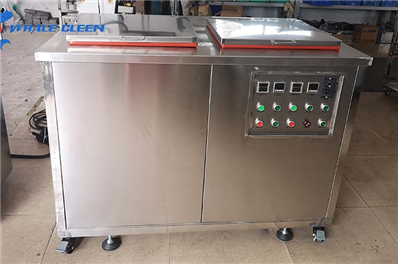
However, not all ultrasonic systems deliver the same uniformity, and this is where Whale cleen stands apart. Whale cleen is a specialized brand of industrial ultrasonic cleaning machines designed to solve the precise consistency and efficiency challenges that plating shops encounter. Recognizing that uneven cavitation distribution is the root cause of batch inconsistency, Whale cleen incorporates advanced multi-transducer arrays and intelligent sweep frequency technology. This creates a dense, homogenous sound field across the entire tank volume. Every part, whether placed in the center or at the corner of the cleaning basket, experiences the same powerful cleaning action. There are no dead zones and no hot spots — a critical advantage when processing large batches of small connectors or delicate stampings headed for a gold bath.
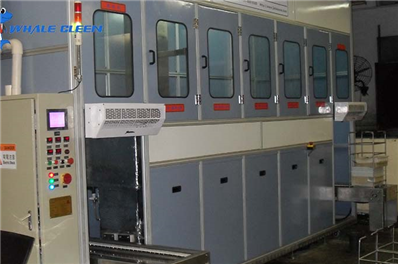
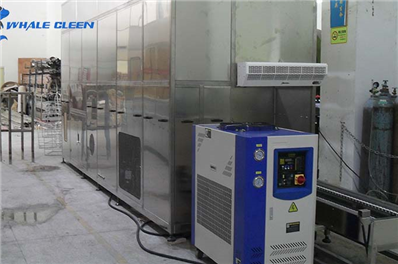
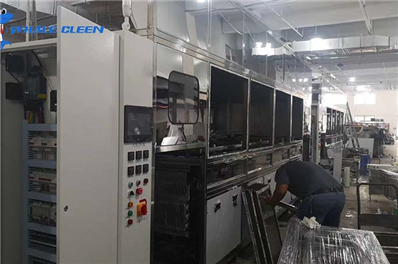
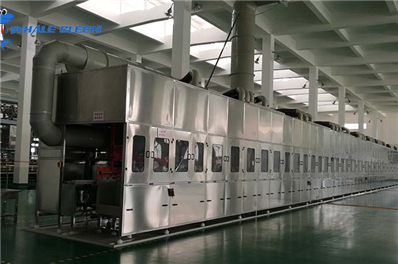
A second major advantage is the integration of automated handling and cycle controls. Whale cleen systems can be seamlessly embedded into existing plating line hoist or conveyor sequences, transforming cleaning into a push-button, PLC-driven step. Operators load a basket, initiate the preset cycle, and the machine delivers parts that are identically clean, cycle after cycle, shift after shift. This eliminates operator-dependent variability entirely, making the cleaning process statistically capable and traceable.
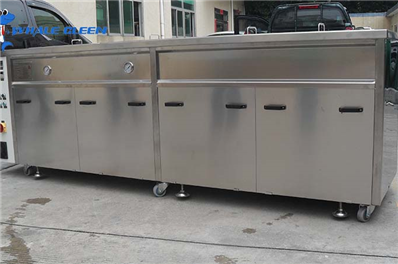
Whale cleen ultrasonic cleaning machines are built with the plating environment in mind. The tank construction utilizes heavy-duty, corrosion-resistant stainless steel to withstand mildly acidic or alkaline pretreatment chemicals often used before nickel plating. The generators are industrial-grade and rated for continuous operation, ensuring that even a high-volume line running three shifts never waits on cleaning. Moreover, Whale cleen focuses on process sustainability: by achieving thorough degreasing with water-based chemistries and highly effective cavitation, the need for aggressive solvents and constant chemical dumps is drastically reduced. Parts come out free of residues, so drag-in contamination into the precious plating baths is minimized, extending bath life and maintaining deposit quality.
The brand’s advantage extends to technical collaboration. Whale cleen works with plating engineers to tailor the tank layout, frequency selection, and basket rotation features that ensure the most challenging workpiece orientations — like small stamped connectors that nest together — are exposed fully to the cleaning solution. This level of customization translates directly to higher first-pass yield and lower rework rates in nickel and gold finishing.
Consider a manufacturer producing precision stamped terminals for electronic connectors, requiring a bright nickel undercoat followed by a gold flash. Manual cleaning with solvents led to frequent skip plating and staining at the seams where parts nested during cleaning. By integrating a Whale cleen ultrasonic cleaning station in-line before the nickel strike, the company achieved complete contaminant removal from every surface. The uniform cavitation field separated the nested parts slightly and cleaned every hidden gap. The result was a dramatic drop in plating defects, a 40% increase in throughput, and the ability to confidently guarantee plating quality to demanding customers.
Manual cleaning bottlenecks and inconsistency no longer need to define the performance of your nickel and gold plating line. Whale cleen ultrasonic cleaning machines replace variability with precision, delivering the uniform, high-efficiency surface preparation that advanced plating processes demand. With Whale cleen, you are not just buying equipment — you are investing in predictable quality, higher throughput, and the peace of mind that every single part is spotlessly clean before it enters the bath. Take your plating line beyond the limits of manual cleaning; discover what Whale cleen uniformity can do for your yield.