Walk into any die-casting facility, and you will hear the same frustration from quality control inspectors and production managers alike. Aluminum die-cast parts emerge from the cleaning line looking perfectly clean—only to reveal white spots, cloudy patches, or unsightly water stains after drying. These surface defects might seem like a minor cosmetic issue, but they can cause coating delamination, anodizing color inconsistencies, and in severe cases, complete batch rejection.
So the question is: Can a single ultrasonic cleaning machine truly solve this persistent problem?
The short answer is yes—but only if the system is engineered correctly. Let's examine why water stains and oxidation occur on die-cast parts, and how ultrasonic cleaning addresses the root causes.
The problem is rarely about whether the part was "cleaned" or not. The issue lies in what happens after cleaning. Aluminum die castings feature complex structures with deep cavities, blind holes, threaded bores, and narrow slots that trap cleaning solutions. When rinsing is insufficient, residual surfactants, alkaline compounds, or cleaning agents crystallize during drying, leaving white deposits on the surface.
Water quality is another critical factor. Aluminum is highly reactive to tap water or hard water, which contains calcium and magnesium ions that precipitate during drying, forming white scale spots embedded in the microscopic pores of the aluminum surface. If die castings are not dried thoroughly and promptly after cleaning, residual moisture reacts with carbon dioxide in the air to form white aluminum hydroxide—commonly known as "white rust".
Traditional cleaning methods struggle with a fundamental contradiction: aggressive cleaning agents and high temperatures are needed to remove stubborn contaminants, yet stronger chemicals increase residue and corrosion risks. High-pressure spraying cannot flush solution from blind holes and deep cavities. Immersion rinsing consumes large volumes of water with low efficiency. And manual drying is inconsistent, with water marks virtually guaranteed.
Ultrasonic cleaning operates on a fundamentally different principle: cavitation. Millions of microscopic vacuum bubbles are generated in a cleaning solution and implode upon contact with part surfaces. This phenomenon generates powerful microscopic shockwaves that penetrate blind holes, threaded cavities, grooves, and complex internal geometries—dislodging contaminants that brushes and sprays simply cannot reach.
But cleaning alone is not enough. To eliminate water stains and oxidation, the entire cleaning-rinsing-drying workflow must be orchestrated correctly. A well-designed ultrasonic system includes:
Ultrasonic cleaning stage that removes oils, die-release agents, and particulate contamination from every surface—including internal features.
Multi-stage rinsing with deionized or pure water to fully displace cleaning solution residues from blind holes and crevices.
Effective drying—typically hot air drying with proper airflow—to eliminate residual moisture that causes white rust formation.
When these stages are properly integrated, water stains and oxidation can be completely prevented.
Not all ultrasonic cleaning machines are created equal. Off-the-shelf, one-size-fits-all units often fail to deliver consistent results for die-cast parts because real-world factory conditions are rarely "standard". Workpiece sizes vary. Contamination levels differ. Production line layouts are unique. A generic machine cannot accommodate all these variables.
Improper power density or frequency selection can even cause cavitation bubbles to implode aggressively against thin-walled aluminum structures, creating microscopic pitting that appears as surface whitening or dulling. This is why customization matters.
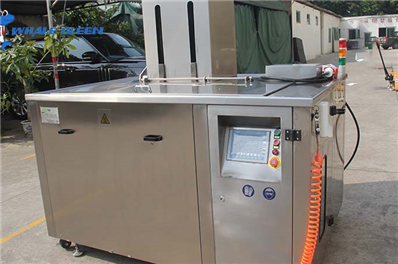
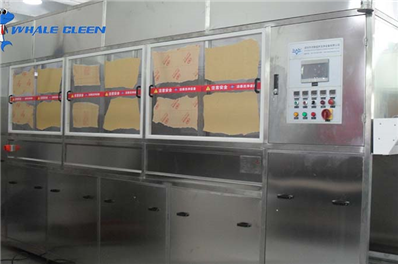
This is where Whale Cleen enters the picture. With over 20 years of experience in ultrasonic equipment research, development, manufacturing, and after-sales service, Whale Cleen has established itself as a trusted partner for manufacturers worldwide. Operating from a 10,000-square-meter production base and holding more than 30 national patents, the company designs and produces automatic ultrasonic cleaning machines, custom ultrasonic systems, and large industrial ultrasonic cleaners.
What truly sets Whale Cleen apart is its commitment to non-standard customization. Rather than pushing generic, off-the-shelf products, Whale Cleen analyzes each customer's actual working conditions and designs equipment that fits them precisely. Every aspect of the machine is tailored:
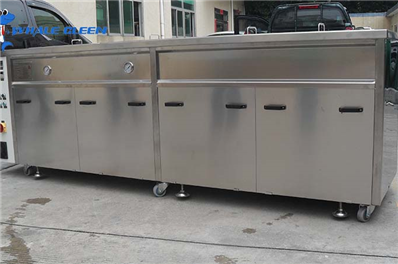
Tank dimensions engineered to the largest or most awkward workpiece—not some arbitrary standard size.
Ultrasonic parameters—power density, frequency, and transducer layout—selected based on specific soils and part materials.
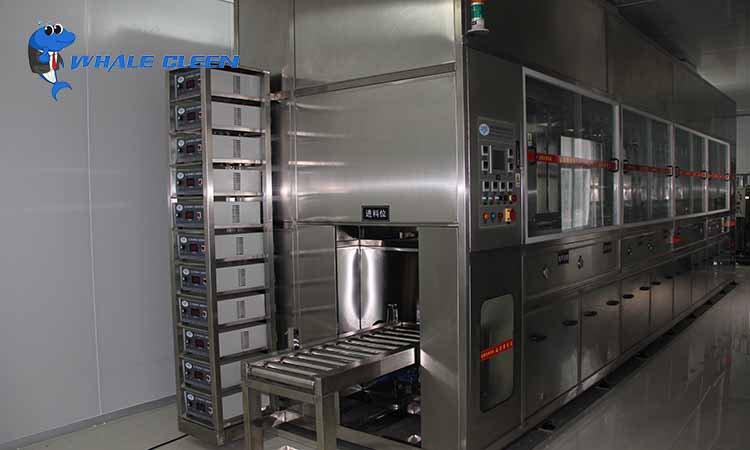
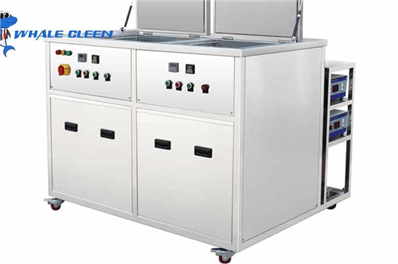
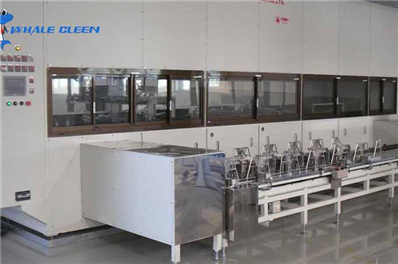
Structural configuration—single-tank, multi-tank, through-type, or robotic arm—matched to workflow and space constraints.
Process integration—heating, filtration, oil skimming, rinsing, drying, and anti-rust modules arranged exactly as the production sequence requires.
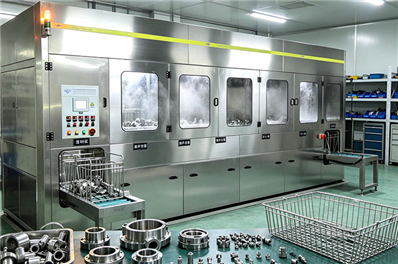
For die-casting applications specifically, Whale Cleen's systems address the full cleaning-rinsing-drying workflow. Multi-stage rinsing with pure water ensures complete displacement of cleaning solution residues. Integrated drying modules eliminate moisture before it can react with aluminum surfaces. The result: die-cast parts that emerge clean, dry, and free of white spots or water stains—batch after batch.
Can one ultrasonic cleaning machine solve water stain and oxidation problems on die-cast parts? Yes—provided it is the right machine. A generic, off-the-shelf unit will likely fall short. But a system engineered specifically for your parts, your contaminants, and your production environment can eliminate these defects entirely.
Whale Cleen delivers exactly that: purpose-built ultrasonic cleaning solutions that address the root causes of water stains and oxidation—not just the symptoms. For manufacturers tired of rework, rejected batches, and the ongoing battle with white spots on aluminum die castings, Whale Cleen offers a proven path to cleaner parts and higher yields.