Grinding, deburring, and polishing operations leave fine dust that is easy to see on open surfaces and almost impossible to remove from blind holes and narrow gaps. Compressed air blows some dust out but pushes the rest deeper. Brushes cannot reach the bottom. Spray washing cleans the surface but leaves the inside untouched. The result is a part that looks clean but fails leak tests, coating adhesion checks, or assembly cleanliness requirements.
This is a common problem in industrial manufacturing. The solution is not more pressure or more scrubbing. It is the correct use of an ultrasonic cleaning machine.
Grinding dust is not a single contaminant. It is a mixture of metal fines, abrasive particles, binder residue, and oil or coolant film. The oil film makes the dust stick to the walls of blind holes and gaps. Over time, the particles can compact into a hard layer that resists simple flushing.
Blind holes and narrow gaps create additional challenges. Liquid cannot easily flow into and out of these features. Air pockets form at the bottom. Even when cleaning liquid enters, the flow is too slow to carry particles away. Traditional spray cleaning may create a vortex at the opening, but the energy does not reach the bottom.
Ultrasonic cleaning solves this problem through cavitation. The ultrasonic field generates microscopic bubbles in the cleaning liquid. These bubbles grow and collapse violently. When they collapse near a surface, they release micro-jets and shock waves that dislodge contaminants. Because cavitation does not depend on the direction of liquid flow, it can reach into blind holes and gaps as long as the liquid wets the surface.
Many factories invest in an ultrasonic cleaning machine but still struggle with dust removal. The machine is often not the problem. The process is.
Wrong loading. Parts stacked or nested in a basket create shadow areas. Ultrasonic energy cannot reach hidden surfaces. Grinding dust remains in those areas.
Single-frequency operation. A single frequency may work for one contaminant but not another. Heavy compacted dust and light surface films require different cavitation characteristics. Without frequency flexibility, the process is always a compromise.
Dirty cleaning liquid. Once dust is removed, it stays in the bath. Without filtration or oil separation, the bath becomes a source of recontamination. Parts come out with a fresh layer of fine particles.
Poor rinse and dry. Residual cleaning liquid carries particles. If the rinse stage is not clean, or if drying is uneven, water spots and dust residues remain in blind holes.
No repeatable recipe. When operators adjust the process by feel, results vary. One batch passes, the next fails. Cleaning becomes a guessing game.
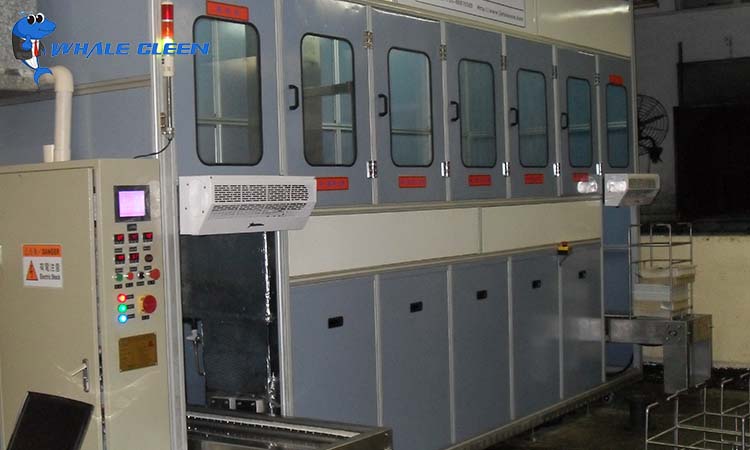
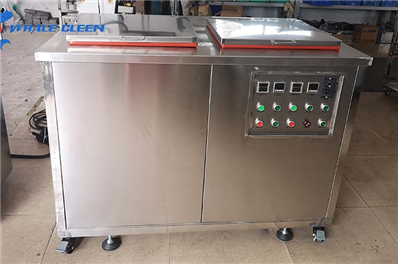
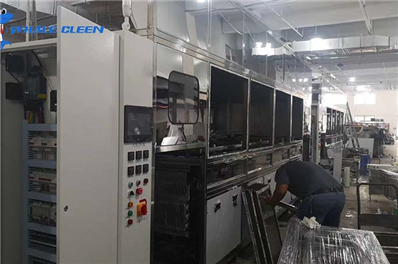
Whale cleen designs ultrasonic cleaning machines for industrial parts where cleanliness must be repeatable. The focus is not only on power or tank size. It is on matching the cleaning process to the part geometry and contaminant.
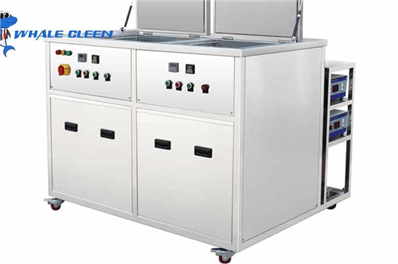
Multi-frequency cleaning. Whale cleen machines can switch between different frequency ranges within one cleaning cycle. Lower frequencies provide stronger cavitation for breaking down compacted dust and oil films. Higher frequencies provide gentler, more uniform cleaning for fine particles and delicate surfaces. This staged approach removes dust from blind holes and gaps without damaging the part.
Custom fixtures and baskets. Whale cleen engineers design fixtures based on the actual part drawing. Each part is positioned to expose blind holes and gaps to the ultrasonic field. This eliminates shadow areas and ensures that every critical feature receives the same cleaning action.
Filtration and oil separation. Whale cleen integrates circulation and filtration systems that continuously remove detached particles and oil from the cleaning bath. Overflow weirs and oil separation prevent floating contaminants from returning to clean parts. The bath stays cleaner longer, and parts come out consistently free of grinding dust.
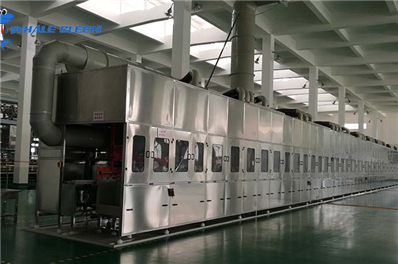
Controlled rinse and dry stages. Whale cleen multi-stage systems separate pre-cleaning, ultrasonic cleaning, rinsing, and drying. Each stage has its own controlled conditions. The final rinse uses clean water to prevent mineral spotting. Drying is designed around the part geometry to avoid water entrapment in blind holes and gaps.
Repeatable process recipes. Whale cleen machines store cleaning recipes with controlled settings. Operators load the parts and start the cycle. The machine executes the same process every time. This turns cleaning from an operator-dependent skill into a stable production step.
Clean parts as soon as possible after grinding. Fresh dust is easier to remove than aged, compacted residue.
Use a pre-cleaning stage to remove the bulk of loose dust and oil before ultrasonic cleaning.
Position parts so blind holes face upward or sideways, allowing air to escape and cleaning liquid to enter.
Keep the cleaning bath filtered and monitor oil separation.
Use a clean rinse stage and dry parts thoroughly, especially in blind holes and gaps.
Validate the process with a consistent inspection method, not just visual checks.
Grinding dust in blind holes and gaps is one of the most common cleaning challenges in industrial manufacturing. Compressed air, brushes, and spray washing can only do so much. Ultrasonic cleaning, when set up correctly, can reach where other methods cannot. Whale cleen helps manufacturers build a repeatable ultrasonic cleaning process that removes dust completely and keeps it from coming back. The result is cleaner parts, fewer failures, and a more stable production line.