In aerospace manufacturing, a single contaminated fastener can compromise an entire assembly. Threaded surfaces trap machining oils, metal chips, and microscopic particulates that, if not completely removed, directly affect torque values, joint integrity, and ultimately flight safety. Yet even among production lines that have deployed ultrasonic cleaning machines, a troubling pattern persists: some achieve first-pass yield rates above 99%, while others face recurring batch rejections due to inconsistent cleanliness.
The root cause is seldom a question of whether ultrasonic technology works—it does. The real issue lies in how it is implemented. This is where Whale Cleen, an industrial ultrasonic cleaning machine manufacturer with over 20 years of experience, has established itself as a trusted partner for demanding manufacturing environments worldwide.
Consider this all-too-common scenario on an aerospace quality inspection bench: A batch of miniature fasteners arrives for testing. Sample A passes with flying colors. Sample B reveals metal chips trapped in the thread roots. Sample C still carries cutting oil film at the bottom of blind holes. Same batch, same process, same equipment—yet cleanliness varies wildly.
What happens next? The manufacturer faces an impossible choice: conduct 100% inspection—consuming enormous labor and time—or scrap the entire batch, incurring losses that can reach millions. Worse still, if non-conforming parts escape into assembly lines, the consequences extend far beyond financial loss.
Data from one aerospace fastener manufacturer tells a sobering story: using a single-tank ultrasonic cleaning machine for high-strength bolts, batch qualification rates fluctuated between 75% and 92%, with an average rework rate exceeding 15%. Rework not only wastes labor, chemicals, and time—repeated cleaning cycles can alter surface conditions and even introduce stress corrosion risks.
The fundamental problem with single-tank ultrasonic cleaning is cross-contamination. As fasteners release cutting oils, metal debris, and polishing compounds into the cleaning solution, the liquid becomes progressively contaminated. Parts cleaned early in the cycle emerge pristine; those cleaned later may re-deposit contaminants onto their surfaces.
Moreover, high-viscosity lubricants trapped in thread gaps cannot be effectively expelled from a single tank. Without staged rinsing, chemical residues remain in microscopic crevices, forming white spots or oil marks after drying—often misinterpreted as "incomplete cleaning".
The physics of ultrasonic cleaning itself—cavitation—is sound. High-frequency sound waves generate millions of microscopic bubbles that collapse with tremendous energy, creating micro-jets that penetrate every liquid-accessible crevice. But cavitation uniformity is another matter entirely. In poorly engineered systems, standing waves and acoustic "peak-and-valley" zones mean fasteners in strong acoustic areas get thoroughly cleaned while those in weak zones receive inadequate cavitation impact.
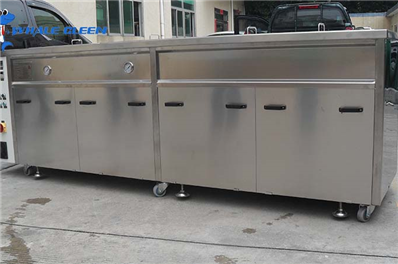
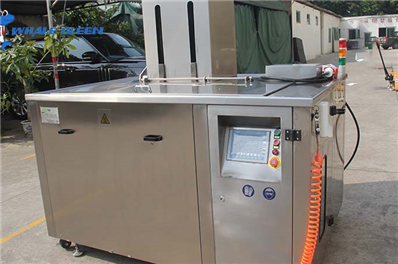
Whale Cleen addresses these challenges not with a single machine, but with engineered cleaning systems designed for industrial-grade reliability. The company’s approach rests on several core principles:
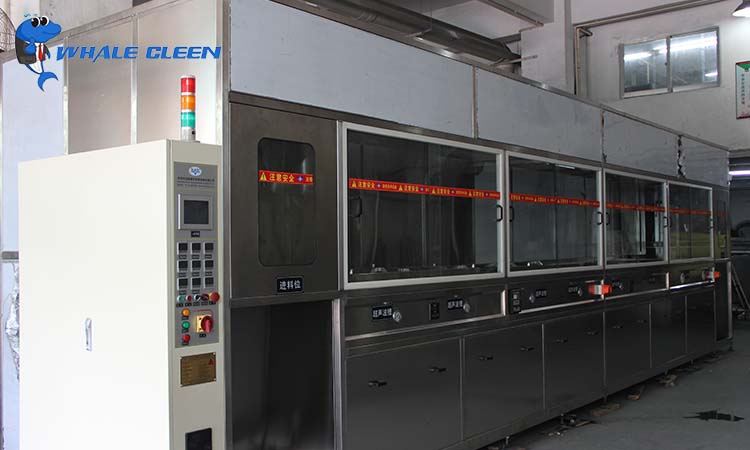
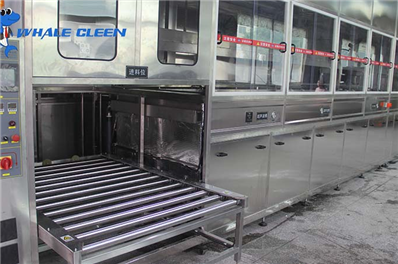
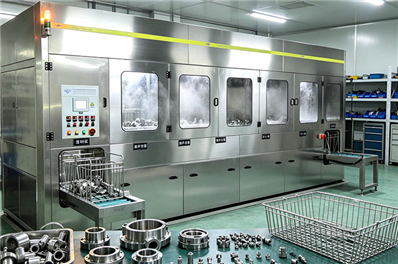
Instead of relying on a single tank for all cleaning functions, Whale Cleen systems decompose the cleaning workflow into discrete, independently controlled stages—ultrasonic cleaning, filtration, rinsing, and drying. Each stage performs a specific task, eliminating contaminant回流 and cross-contamination. This ensures that every fastener in a batch follows the exact same cleaning path under identical conditions.
Whale Cleen’s engineering team employs finite element simulation to predict and optimize ultrasonic energy distribution within the cleaning tank. Transducers are strategically positioned not only on the bottom but also on side walls to eliminate dead zones. The result: every part—regardless of its position in the basket—receives consistent cavitation intensity.
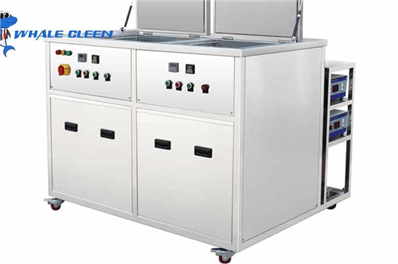
Different contaminants require different ultrasonic frequencies—lower frequencies for heavy oils and carbon deposits, higher frequencies for fine particulate removal. Whale Cleen systems incorporate multi-frequency capability with adaptive power regulation, allowing precise matching of ultrasonic output to specific part geometries and contamination profiles. This prevents both under-cleaning and over-cleaning (which can cause surface erosion).
Temperature fluctuations alone can shift cavitation intensity, causing seemingly random yield variations. Whale Cleen integrates real-time temperature compensation and bath management strategies, locking the process window within an optimal range. PLC automation with recipe storage ensures that every batch runs under precisely the same parameters, eliminating operator-dependent variability.
Continuous multi-stage filtration prevents re-deposition of contaminants, keeping the cleaning bath consistent from the first part to the last. This is particularly critical for high-volume aerospace fastener production, where bath contamination would otherwise degrade performance over time.
With a 10,000-square-meter production base and over two decades of ultrasonic equipment research and development, Whale Cleen has earned a reputation for delivering systems built specifically for demanding manufacturing environments. The company’s quality control system covers every stage—from raw material inspection to final assembly and testing. Each machine is documented with "one machine, one file" traceability records, logging everything from component batch numbers to final test results.
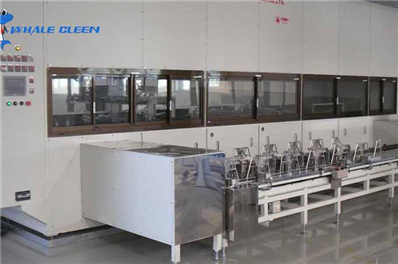
For aerospace fastener manufacturers struggling with batch-to-batch cleanliness variation, Whale Cleen offers a path from "batch波动" to consistent, repeatable, first-pass quality. The company’s multi-tank ultrasonic cleaning lines—equipped with automated transfer systems and programmable logic control—ensure that every fastener, regardless of when it enters the process, emerges with the same verified cleanliness level.
Batch cleanliness inconsistency in aerospace fastener manufacturing is not an unavoidable cost of doing business—it is a solvable engineering problem. The solution lies not in abandoning ultrasonic technology, but in deploying it with the process maturity, acoustic precision, and systematic control that Whale Cleen delivers.
When every fastener in a batch must meet the same zero-tolerance standard, the cleaning system cannot afford to treat any part differently. Whale Cleen ensures that it doesn’t.