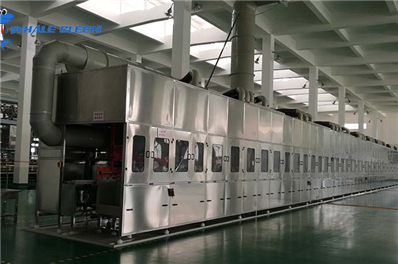
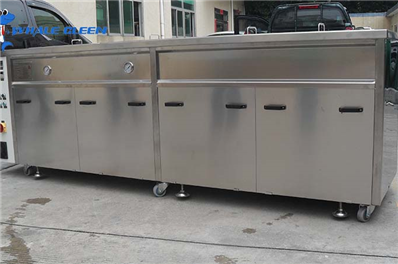
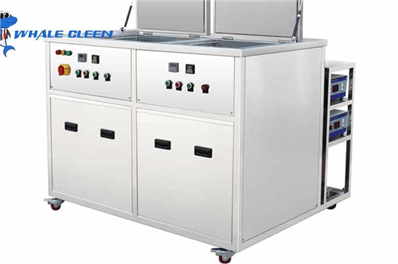
Batch cleaning sensor housings is one of the most demanding tasks in precision manufacturing. These components often feature machined surfaces, threaded ports, blind holes, and tight tolerances. Contaminants such as cutting oil, metal fines, polishing residue, and oxide particles must be removed completely. At the same time, the surface finish must remain intact. A single scratch can cause rejection, rework, or a compromised seal. This is why manufacturers increasingly turn to an ultrasonic cleaning machine—but not every system is engineered to protect parts during high-volume cleaning. Whale cleen addresses this challenge with a combination of non-contact cavitation and scratch-prevention design.
In batch cleaning, scratches rarely come from the cleaning action itself. They come from mechanical contact and particle redeposition. When parts are loosely loaded into a basket, vibration and fluid flow can cause metal-to-metal contact. Sharp edges rub against adjacent housings. Threads collide with machined faces. Even a brief moment of contact can leave a visible mark.
Another common cause is suspended debris. If particles removed from one part remain in the cleaning bath, they can be carried by the fluid and pressed against another part. Over time, these particles act like a fine abrasive. High-pressure spray systems and manual brushing can also create localized damage, especially on soft metals or coated surfaces.
The real question is not whether ultrasonic cleaning can remove contamination. It is whether the entire process—loading, cavitation, rinsing, and drying—can do so without introducing scratches.
An ultrasonic cleaning machine uses cavitation to clean parts. High-frequency sound waves create microscopic bubbles in a cleaning solution. When these bubbles collapse, they release tiny micro-jets that lift contaminants from surfaces. This action is non-contact. There is no brush touching the part, no abrasive media tumbling against the surface, and no high-pressure nozzle blasting one area at a time.
Cavitation reaches into threaded holes, blind bores, and complex internal passages where mechanical cleaning cannot easily go. It removes oil films, metal fines, and oxide residues by breaking the bond between the contaminant and the substrate. Because the cleaning force is distributed across the entire wetted surface, the risk of localized scratching is greatly reduced.
However, ultrasonic cleaning alone does not guarantee scratch-free results. If parts are allowed to touch each other, or if contaminated solution is recirculated without filtration, scratches can still occur. The difference lies in how the ultrasonic cleaning machine is designed and how the batch is handled.
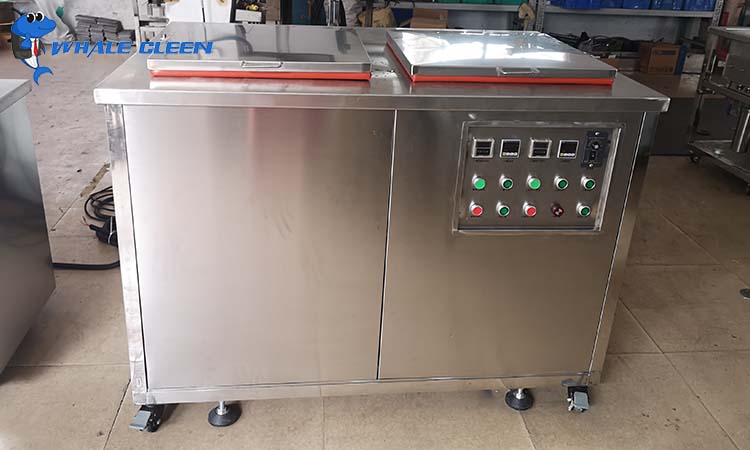
Whale cleen builds ultrasonic cleaning machines specifically for production environments where surface quality matters. Their systems combine powerful cavitation with thoughtful part handling.
One key advantage is custom fixture and basket design. Whale cleen provides compartmentalized baskets and precision fixtures that hold each sensor housing in a fixed position. Parts do not rub against each other. Contact points are designed with non-marring materials to protect machined surfaces. This is especially important for anodized, polished, or coated components.
A second advantage is uniform cavitation. Many generic ultrasonic cleaners create hot spots and dead zones. In a hot spot, parts may be over-processed; in a dead zone, they remain dirty. Operators often extend the cleaning cycle to compensate, which increases the risk of surface damage. Whale cleen uses advanced transducer layout and sweep frequency technology to distribute cavitation energy evenly. Every part in the batch receives consistent cleaning action, so there is no need to over-clean.
A third advantage is filtration and solution management. Whale cleen systems incorporate filtration that captures suspended particles before they can redeposit on clean parts. This reduces the abrasive effect of recirculated debris. Cleaner solution means cleaner parts and fewer scratch-causing particles.
Whale cleen also emphasizes chemistry compatibility. The wrong cleaning agent can attack certain alloys or coatings. Whale cleen helps users select mild, effective solutions that remove contaminants without damaging the base material. Combined with multi-stage cleaning, rinsing, and drying, the result is a repeatable process that protects surface integrity.
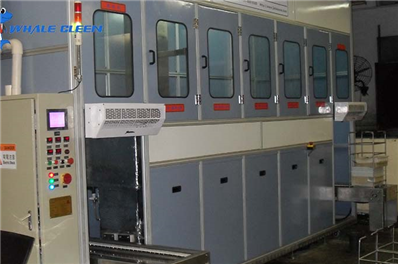
Consider a production line cleaning hundreds of sensor housings per shift. Each housing has threaded ports, a machined sealing face, and internal cavities. The parts are loaded into Whale cleen fixtures. The ultrasonic cleaning machine generates cavitation that reaches inside the threads and blind holes. Oil and metal fines are lifted away. Filtration removes the debris from the bath. A rinse stage removes residual chemistry, and a drying stage prepares the parts for assembly.
Because the housings remain separated throughout the process, there is no metal-to-metal contact. Because the cavitation field is uniform, no part is over-exposed. Because the solution is filtered, particles do not scratch the surface. The batch comes out clean and scratch-free.
Whale cleen ultrasonic cleaning machines are used in automotive manufacturing, aerospace component production, electronics assembly, and general precision metalworking. They are suitable for cleaning sensor housings, hydraulic parts, connectors, machined brackets, and other metal or plastic components where surface quality is critical. The focus is always on repeatable, damage-free cleaning at production scale.
When selecting an ultrasonic cleaning machine for batch sensor housings, look beyond the tank size. Consider fixture design, filtration, cavitation uniformity, and process automation. These factors determine whether the machine cleans safely or creates costly defects. Whale cleen offers application support and custom fixtures to match specific part geometries. This helps manufacturers achieve consistent results without sacrificing surface finish.
An ultrasonic cleaning machine is a powerful tool for removing contaminants from complex sensor housings. But in batch production, cleaning power must be matched with scratch-prevention engineering. Whale cleen delivers both. Through custom fixtures, uniform cavitation, filtration, and compatible chemistry, Whale cleen helps manufacturers clean thoroughly while protecting every part. For production teams facing the challenge of batch cleaning sensor housings, Whale cleen provides a reliable path to clean, scratch-free components.