In automotive, aerospace, industrial automation, and electronics manufacturing, sensor housings are everywhere. These components often feature micro-holes, blind holes, internal channels, and threaded ports. During machining, stamping, molding, or assembly, those tiny features trap machining oil, metal fines, polishing residue, dust, and flux. If contaminants remain inside, they can affect sensor performance, coating adhesion, corrosion resistance, and long-term reliability. The problem is simple: ordinary cleaning methods cannot reach the places where contamination hides. This is why an industrial ultrasonic cleaning machine has become essential for factories that need consistent cleanliness.
Many factories begin with manual brushing, high-pressure spraying, or simple immersion. Each method has limits. Brushes cannot enter micro-holes. Spray nozzles create shadow areas where fluid does not reach. Simple immersion only wets the surface; it does not pull contaminants out of blind holes or tight crevices. Even repeated rinsing may leave particles trapped inside. When those particles later migrate or outgas, they can cause intermittent sensor signals, poor bonding, or field failures. For sensor housings, surface-level cleaning is not enough. The internal geometry must be cleaned as thoroughly as the exterior.
An ultrasonic cleaning machine uses cavitation to clean in a way that mechanical methods cannot. During the process, microscopic bubbles form in the cleaning liquid and implode near part surfaces. These implosions create powerful micro-jets and pressure waves that lift oil, particles, and residue from surfaces—including micro-holes, blind holes, threads, and internal channels. Because the cleaning action is generated throughout the liquid, it reaches areas that brushes and sprays miss. For sensor housings, this deep cleaning action is the difference between passing cleanliness specifications and risking costly rework.
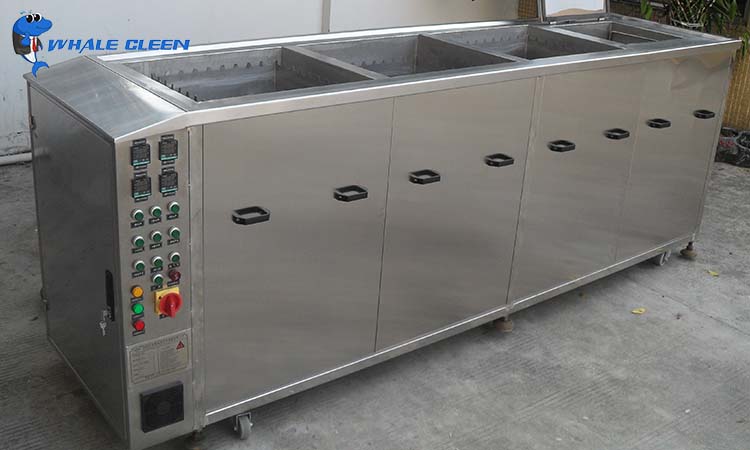
Whale Cleen designs ultrasonic cleaning machines specifically for industrial parts with complex geometry. The brand focuses on automotive, aerospace, electronics, precision hardware, and heavy machinery applications. It does not serve medical, eyewear, jewelry, or food-related sectors, allowing its engineering team to concentrate on the demanding cleaning challenges of manufacturing.
Uniform cavitation field. Whale Cleen machines use carefully arranged transducers and tank geometry to distribute cavitation energy evenly. This reduces dead zones and ensures that every sensor housing in the basket receives consistent cleaning action, regardless of its position.
Application-specific fixtures. Sensor housings are not simple flat parts. Whale Cleen helps customers design fixtures that hold parts at the right angle, expose micro-holes, prevent air pockets, and protect delicate features. Proper fixturing is often the difference between average and excellent cleaning results.
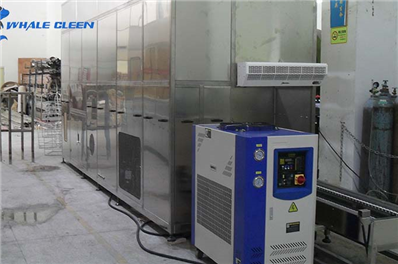
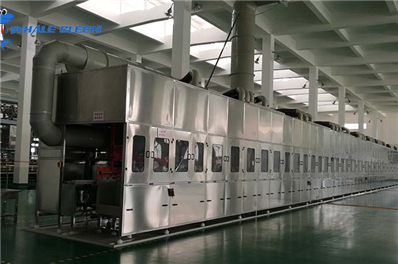
Multi-stage cleaning process. A complete Whale Cleen system can combine ultrasonic washing, rinsing, and drying stages. This prevents loosened contaminants from redepositing on cleaned surfaces and helps factories achieve repeatable, production-ready results.
Filtration and solution management. Keeping the cleaning bath clean is critical. Whale Cleen integrates filtration and solution management options that remove suspended particles and extend bath life. This supports consistent cleaning across long production runs.
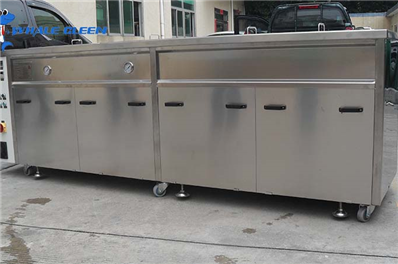
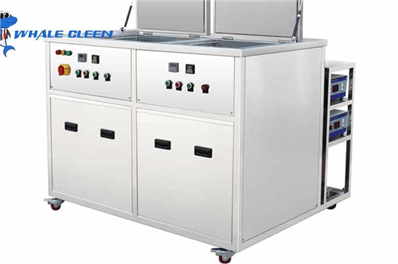
Robust industrial construction. Whale Cleen machines are built for factory floors. Heavy-duty stainless steel tanks, durable components, and continuous-operation design help manufacturers maintain uptime and reduce maintenance interruptions.
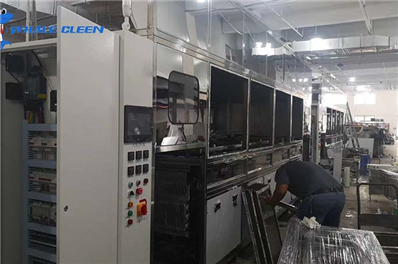
Automation and repeatability. With digital controls and programmable process recipes, Whale Cleen systems help factories standardize cleaning cycles across shifts. Operators can repeat the same process for every batch, improving quality control and traceability.
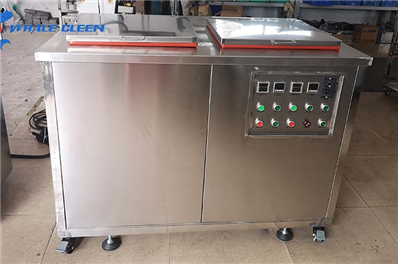
Process support and customization. Whale Cleen offers OEM and ODM capabilities. From benchtop units to fully automated multi-stage lines, the brand works with customers to match the machine, fixture, chemistry, and workflow to their specific contaminant and production requirements.
While sensor housings are a strong example, Whale Cleen ultrasonic cleaning machines are also used for automotive components, aerospace hardware, hydraulic parts, electronic connectors, stamped parts, and precision machined components. Any part with complex geometry, tight tolerances, or hidden features can benefit from ultrasonic cleaning. The technology is especially valuable when ordinary cleaning leaves residue that later causes coating defects, assembly problems, or premature failure.
When selecting an ultrasonic cleaning machine, factories should consider the contaminant type, part geometry, material compatibility, throughput, and required cleanliness level. The right frequency, power, chemistry, fixture, and rinse-dry configuration depend on the application. Whale Cleen’s team helps manufacturers evaluate these factors and build a cleaning process that fits their production line, not just their cleaning tank.
Sensor housings with micro-holes represent a common but serious cleaning challenge. Ordinary methods cannot reliably remove trapped oil, particles, and residue. Whale Cleen ultrasonic cleaning machines deliver deep, uniform cavitation that reaches hidden features and supports consistent industrial cleanliness. For factories that cannot afford contamination-related defects, Whale Cleen offers the performance, customization, and process support needed to clean complex parts with confidence.