Thin blades—turbine foils, compressor vanes, surgical cutting edges, semiconductor lead frames—share a common cleaning dilemma. Contaminants cling to surfaces that cannot tolerate brushing, scraping, or high-pressure spray. A blade thin enough to flex between fingertips will not survive a brush bristle dragged across its edge, let alone a spray jet aimed at a blind hole beside it. The part must be cleaned thoroughly, yet it must come out of the tank geometrically unchanged.
This is where an ultrasonic cleaning machine earns its place in precision manufacturing. The cleaning force is not delivered by contact. It is generated inside the liquid itself, through cavitation—the formation and controlled implosion of microscopic bubbles that lift oil, particles, and residue from surfaces without a tool ever touching the workpiece. For thin, delicate blades, that distinction is everything.
A blade with low stiffness and high aspect ratio behaves poorly under any mechanical load. Manual brushing introduces localized bending. High-pressure spraying applies uneven force across a thin edge. Even immersion alone only wets the surface; it does not pull contaminants out of tight crevices or micro-features beside the cutting edge. The part may look clean while residue remains trapped in a geometry too fine for any contact method to reach.
Ultrasonic cleaning inverts the problem. Instead of forcing a tool toward the part, the cleaning energy is distributed throughout the bath. Cavitation bubbles collapse near surfaces and create micro-jets that dislodge contaminants without directional mechanical pressure. For a blade that cannot be touched, this non-contact, non-abrasive action is not a convenience—it is the only viable path to cleanliness.
Not all ultrasonic cleaning is equally gentle. The key variable is frequency. Lower frequencies produce larger cavitation bubbles and more energetic implosions—effective on heavy soils but capable of eroding soft or thin surfaces over time. Higher frequencies generate smaller, lower-energy bubbles that clean finely without the same intensity of collapse. A thin blade does not need the most powerful cavitation; it needs the right cavitation.
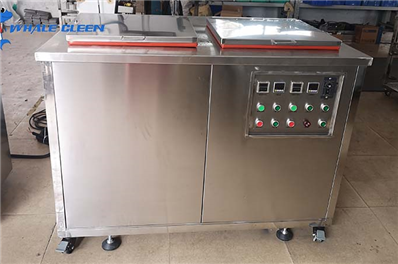
Whale Cleen addresses this with frequency flexibility across its machine range. Systems support ranges from 20 kHz to over 120 kHz, allowing operators to shift between aggressive removal and gentle finishing within one platform. Dual-frequency and multi-frequency configurations—such as 28/40 kHz and 45/80 kHz—let a single machine serve both robust parts and blade-thin geometries. For delicate blades, the higher-frequency end produces a softer cavitation field: bubbles small enough to enter fine features, yet mild enough that the blade’s own stiffness is never challenged by the cleaning medium.
Frequency alone does not guarantee damage-free results. The cavitation field must also be uniform. If energy concentrates in one zone of the tank, blades positioned near a transducer face may receive disproportionately intense treatment while parts elsewhere remain under-cleaned. Whale Cleen machines use carefully arranged transducers and tank geometry to distribute cavitation energy evenly, reducing dead zones and delivering consistent action across the basket.
Fixturing is the second safeguard. Thin blades cannot be piled or allowed to contact one another. Whale Cleen supports application-specific fixture design that holds parts at controlled angles, exposes critical edges, prevents trapped air pockets, and keeps delicate features away from tank walls and transducer faces. Proper fixturing is often the difference between a blade that emerges clean and one that emerges clean but subtly warped.
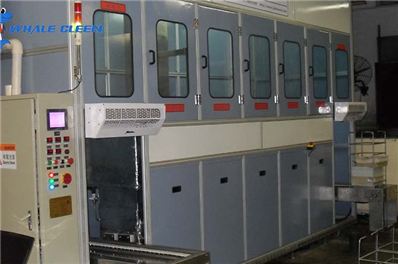
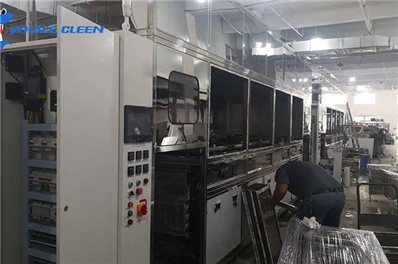
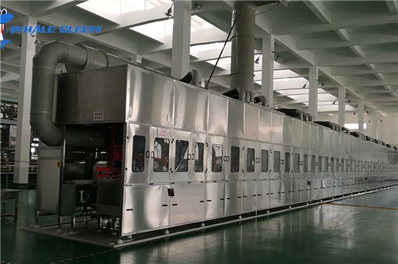
The third layer is process control. A complete Whale Cleen system can integrate ultrasonic washing, rinsing, and drying stages, preventing loosened contaminants from redepositing on cleaned surfaces. Digital controls and programmable recipes allow the same blade geometry to receive the same frequency, power, and time cycle across shifts—removing operator variability from a process where consistency is the real specification.
The question “how does ultrasonic cleaning avoid damaging thin blades?” has a precise answer: it never applies a mechanical load to the blade. The cleaning force lives in the liquid, tuned by frequency and distributed by tank design, while the part sits in a fixture designed to protect its geometry. Whale Cleen builds machines around that principle—adjustable frequency for gentleness, uniform cavitation for consistency, and process integration for repeatability. For manufacturers whose thin blades must emerge clean and unchanged, the ultrasonic cleaning machine is not simply an alternative to contact methods. It is the method that makes the requirement achievable in the first place.