A sensor housing comes off the machining line with cutting oil, metal fines, and oxidized particles packed into thread roots, blind-hole bottoms, and mating seams. It goes through a spray washer, comes out looking clean, and passes a visual check. Weeks later, a leak test fails or a coating blisters—and the investigation lands back on cleaning.
The spray washer was not running badly. It was doing what spray washing does, and what spray washing does is defined by geometry. The choice between an ultrasonic cleaning machine and a spray washer is not a question of “which is stronger.” It is a question of whether the cleaning action can physically reach the surfaces that matter. For a sensor housing, those surfaces are almost never the ones the spray nozzle can see.
Spray washing works by impingement. Pressurized cleaning liquid strikes the part surface, and the kinetic energy of the jet dislodges contamination from whatever it hits. For large flat areas, open housings, and heavy surface soils, this is efficient and well suited to high-volume runs of parts whose contamination sits on accessible, line-of-sight surfaces.
The limitation is built into the physics. Spray is a line-of-sight process. When the jet meets a blind hole, the flow forms an eddy at the opening rather than penetrating to the bottom; loosened chips and oil can be driven deeper into the bore instead of being flushed out. At a 90-degree internal turn, the kinetic energy of the jet collapses, and debris is pressed tighter against the wall. Thread roots are worse—the groove width is often a fraction of a millimeter, and the jet has already dissipated its energy at the thread crest before reaching the root.
There is a second, quieter failure mode: shadowing. A part placed on a fixture or conveyor is sprayed from fixed angles. Back faces, undercuts, and internal cavities sit in the spray shadow. Flipping the part mid-cycle can partially compensate, but it adds handling time and opens a re-contamination window between orientations. The result is a part that looks clean where the nozzle reached and remains contaminated where it did not—a condition sometimes called “false cleanliness,” where the exterior passes inspection while the features that determine assembly reliability stay dirty.
Ultrasonic cleaning replaces directed kinetic energy with distributed cavitation. Transducers transmit high-frequency pressure waves through the liquid, creating alternating compression and rarefaction cycles. Microscopic bubbles form during rarefaction and collapse violently during compression, releasing micro-jets and localized shock waves at the solid–liquid interface.
The decisive difference is that cavitation does not require a flow path to the surface. As long as the cleaning liquid wets a feature—a thread root, a blind bore, a mating seam—cavitation bubbles can form and collapse in that same space. The cleaning action is not “sprayed at” the contamination; it is generated wherever the liquid is. In a threaded port, bubbles follow the helical groove toward the root, forcing liquid into even the tightest thread bottom diameter. In a blind hole, cavitation occurs along the bore wall and at the bottom face, peeling the oil–particle layer rather than pushing it deeper.
Independent comparisons draw the same boundary. In a capability matrix for blind holes and internal passages, ultrasonic cleaning is rated “Excellent,” while aqueous spray washing is rated “Poor to Fair”. Spray retains an edge on heavy surface soils and raw throughput. The two methods solve different problems, and a sensor housing sits squarely on the ultrasonic side of that line.
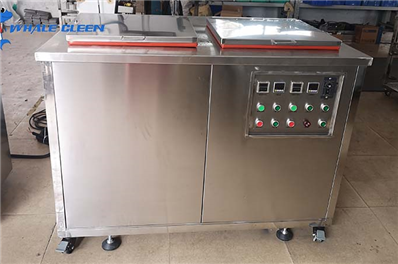
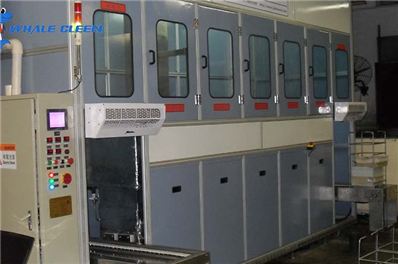
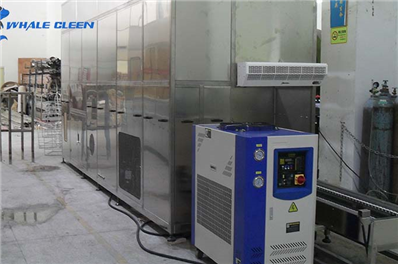
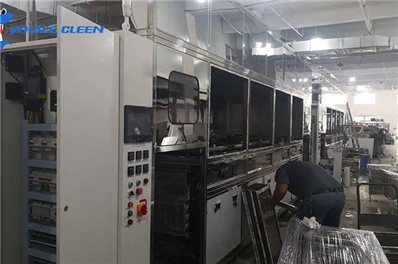
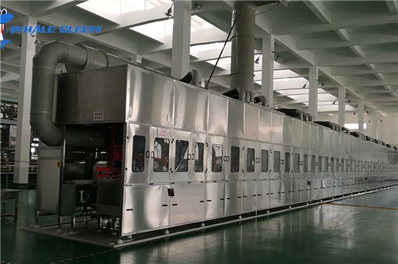
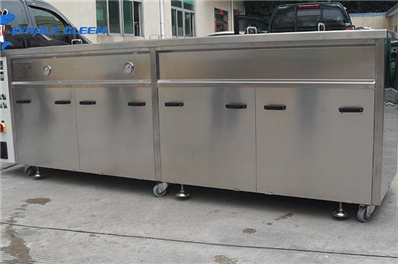
The gap between “has an ultrasonic tank” and “cleans sensor housings consistently” is closed by configuration. Whale Cleen has spent more than two decades building industrial ultrasonic cleaning systems, with a focus on non-standard customization rather than off-the-shelf units. For housing geometries, three engineering choices matter.
Multi-frequency capability matched to the contaminant profile. A single fixed frequency forces a compromise. Whale Cleen systems support configurable frequency ranges, allowing a process to use lower-frequency, higher-energy cavitation for loosening compacted fines and heavier oil, then shift to higher-frequency, finer cavitation for thread-root and blind-hole residue without eroding machined surfaces. Higher frequencies in the 40 kHz range and beyond are specifically suited to precision housings where surface integrity cannot be traded for cleaning power.
Cavitation uniformity across the working volume. Cavitation that is strong in one corner of the tank and weak in another produces batch-to-batch variation that looks like a chemistry problem but is actually an acoustics problem. Whale Cleen industrial-grade systems use digital auto-tuning and sweep-frequency generators to hold frequency stability, with measured cavitation variation across the tank kept under 5% by foil test—versus visible dead zones in light-duty equipment. For housings cleaned in baskets or fixtures, this reduces position-dependent cleanliness.
Industrial construction and fixturing built around the part. Standard tanks are designed around a volume; housing cleaning needs a tank designed around a geometry. Whale Cleen builds with 316L or reinforced stainless steel, bolted or full-immersion transducers, and generators rated for 24/7 continuous operation. The practical effect is that the fixture can orient the housing so liquid wets the features cavitation needs to reach—avoiding trapped air pockets that would otherwise block ultrasonic energy from entering a cavity. Whale Cleen’s engineering team analyzes workpiece geometry, contamination type, and integration with the existing line before a tank is built, so the cleaning step becomes a controlled, repeatable part of the sealing process rather than a visual rinse.
The useful question is not “ultrasonic or spray.” It is “where does the contamination sit relative to the cleaning mechanism.” If the soil is on open, accessible surfaces and throughput is the binding constraint, spray washing is the appropriate tool. If the soil is in thread roots, blind-hole bottoms, and internal seams—and if a failure at those surfaces shows up downstream as a leak, a coating defect, or an intermittent fault—then the cleaning mechanism must be cavitation, and the equipment decision becomes about frequency range, acoustic uniformity, and fixturing rather than pump pressure.
Whale Cleen’s position in that decision is straightforward: an industrial ultrasonic platform built for factory conditions, configurable around housing geometry, with the frequency and fixturing flexibility to treat cleaning as a controlled process step rather than a line item that gets skipped when the schedule tightens.