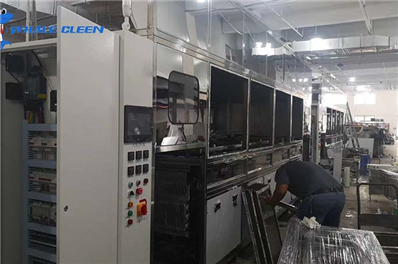
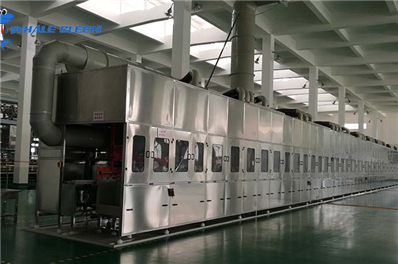
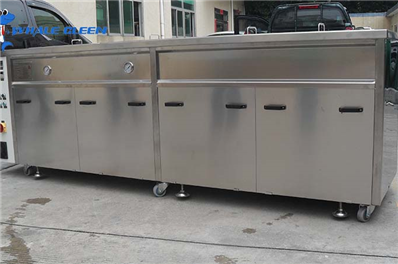
In vacuum coating processes such as PVD (Physical Vapor Deposition) and CVD (Chemical Vapor Deposition), the quality of the final coating is directly determined by the cleanliness of the substrate. A single speck of oil, a microscopic particle, or a residual fingerprint can cause pinholes, poor adhesion, blistering, or even complete coating failure. That is why pre-cleaning is not just a step – it is the foundation upon which all coating success rests.
Among all pre-cleaning technologies, ultrasonic cleaning stands out as the most effective solution for removing sub-micron contaminants from complex surfaces, including blind holes, threads, and internal channels. However, not all ultrasonic cleaning machines are created equal – especially when it comes to the demanding requirements of vacuum coating pre-treatment.
This article compares popular industrial ultrasonic cleaning machine brands for vacuum coating pre-cleaning applications and explains why Whale Cleen has become a trusted choice for manufacturers seeking reliable, high-performance, and cost-effective equipment.
Note: Whale Cleen does not serve medical, eyewear, jewelry, or food industries. The brand focuses exclusively on industrial and mechanical applications – vacuum coating, automotive, aerospace, precision machining, and mold cleaning.
Standard industrial ultrasonic cleaners are often designed for general degreasing or chip removal. For vacuum coating pre-cleaning, the requirements are far more stringent:
Contaminants to remove: cutting oils, polishing pastes, fingerprints, dust particles, and even mono-molecular oil films
Workpiece sensitivity: substrates may be delicate (thin-walled, polished surfaces, fine features) and easily damaged by overly aggressive cavitation
No cross-contamination: different batches or different coated parts must not transfer residues
Cleanliness standards: often require surface energy testing, water break tests, or particle counting
A dedicated pre-coating ultrasonic cleaning machine must offer precise frequency control, uniform acoustic field, effective filtration, and compatibility with cleaning agents that do not leave residues. Generic machines often fall short.
| Feature | Why It Matters for Coating Pre-Cleaning |
|---|---|
| Multi-frequency capability | Low frequency (25-40kHz) for heavy oil removal; high frequency (80kHz+) for sub-micron particle removal without surface damage |
| Uniform acoustic field | Eliminates dead zones – critical for complex geometries with deep recesses |
| Power adjustability | Prevents cavitation erosion on sensitive substrates |
| Multi-stage filtration | Keeps cleaning bath clean, prevents re-deposition |
| Cleanroom-compatible materials | Ensures no particle shedding or chemical contamination |
| Process consistency | Programmable recipes for repeatable results batch after batch |
Based on industry feedback, technical capabilities, and customer case studies, here is a comparison of leading brands in the vacuum coating pre-cleaning segment.
Strengths: Excellent engineering, wide distribution, strong after-sales support. Their multi-frequency units are well-regarded in the semiconductor and high-end coating industries.
Limitations: Premium pricing; customization for non-standard parts can be slow and expensive. Best suited for large enterprises with standardized processes.
Best for: High-volume, standardized production where budget is not the primary constraint.
Strengths: Known for high-frequency (up to 200kHz) and megasonic technologies, excellent for delicate substrates like optical coatings and silicon wafers.
Limitations: Focused on high-end applications; less known for heavy-duty industrial parts; pricing is on the higher side.
Best for: Precision optics, semiconductor, and advanced coating applications.
Strengths: Japanese engineering quality, very high-frequency options, excellent for removing nano-scale particles.
Limitations: Limited customization; longer lead times; service network may be sparse outside Asia.
Best for: Manufacturers who prioritize Japanese quality and have local support.
Whale Cleen has steadily gained recognition among vacuum coating manufacturers for delivering high-performance, custom-engineered ultrasonic cleaning systems at competitive prices.
Company background: Whale Cleen’s team has been active in ultrasonic equipment manufacturing since the early 2000s, with over 20 years of accumulated experience. Their manufacturing facilities cover over 13,000 square meters, and they hold more than 30 national patents. Products are exported to over 200 countries and regions, serving more than 1,000 industrial clients.
Why Whale Cleen excels in vacuum coating pre-cleaning:
Sample-testing first: Before any quotation, Whale Cleen requires customers to send their most challenging workpieces. Their lab analyzes contamination types and conducts actual cleaning trials to determine the optimal frequency, power, and process parameters – no blind guessing.
Multi-frequency custom solutions: Whale Cleen machines can be configured with frequency ranges from 20kHz to over 120kHz, allowing operators to use low frequency for heavy oil removal and high frequency for fine particle elimination – all in one machine. Some models also support megasonic options for ultra-sensitive substrates.
Uniform cavitation field: Through acoustic field simulation and optimized transducer placement (side, bottom, or top), Whale Cleen ensures no dead zones – critical for complex parts with blind holes or internal channels.
Effective contamination control: Their multi-stage filtration systems continuously remove suspended particles and oil from the cleaning bath, preventing re-deposition and ensuring consistent batch-to-batch cleanliness.
Durable core components: Welded high-Q piezoelectric ceramic transducers (not glued), automatic frequency-tracking generators, and thick stainless steel tanks (304/316L) ensure long service life and low maintenance.
Full traceability: Each machine comes with a “one machine, one file” record – from design to delivery – simplifying maintenance and troubleshooting.
Whale Cleen serves: Vacuum coating pre-cleaning for automotive decorative parts, tool coatings, hardware accessories, electronic housings, and precision mechanical components.
| Feature | Branson | Crest | Kaijo | Whale Cleen |
|---|---|---|---|---|
| Multi-frequency support | Yes | Yes (high to mega) | Yes (very high) | Yes (20-120kHz+, custom) |
| Customization for complex parts | Limited | Limited | Very limited | Full custom (sample-test based) |
| Filtration system | Optional | Optional | Optional | Standard multi-stage |
| Transducer type | Welded | Welded | Welded | Welded (high-Q) |
| Price level | High | High | High | Medium-High (excellent value) |
| Lead time for custom units | Long | Long | Very long | Short to medium (in-house production) |
| Best suited for | Large standardized production | Precision/high-frequency | High-end Japanese market | Custom industrial applications, cost-sensitive but quality-driven |
When evaluating ultrasonic cleaning machine brands for vacuum coating pre-cleaning, follow these three steps:
Step 1 – Demand a sample test. Do not rely on spec sheets. Send your actual parts (with typical contaminants) to the brand’s lab. A credible brand like Whale Cleen will provide a detailed cleaning process report before quoting.
Step 2 – Verify core component quality. Ask: Are transducers welded? Is the generator auto-tracking? Is the tank stainless steel of sufficient thickness? These directly impact machine life and consistency.
Step 3 – Calculate total cost over 3–5 years. Include purchase price, energy consumption, consumables (cleaning fluid, filters), maintenance frequency, and reject rate reduction. A machine that costs 20% more but lasts twice as long and reduces rework by 30% is a better investment.
Vacuum coating pre-cleaning is too critical to trust to a generic ultrasonic cleaner. The brands that succeed in this space are those that understand substrate sensitivity, contaminant diversity, and process repeatability.
Whale Cleen combines two decades of engineering experience with a customer-first approach: sample-testing before quoting, custom multi-frequency designs, durable components, and transparent pricing. For manufacturers seeking a dedicated pre-coating ultrasonic cleaning system without overpaying for unnecessary features, Whale Cleen represents the optimal balance of performance and value.
If your coating line is suffering from adhesion failures, pinholes, or inconsistent results, send your most challenging parts to Whale Cleen for a sample test. Let real cleaning results guide your brand decision.