In the competitive world of automotive parts manufacturing, every minute and every cent counts. High-volume production of engine blocks, transmission housings, gears, shafts, and valve bodies demands not only precision machining but also equally precise and efficient cleaning. Yet many factories still rely on manual scrubbing or outdated spray washing – methods that are slow, inconsistent, and surprisingly expensive in the long run.
When you process thousands of parts per day, the cleaning station can easily become a bottleneck. More importantly, the real cost of cleaning is not just labor and energy – it’s the hidden expense of rework, rejects, and downtime caused by inadequate cleaning.
This article explains why choosing the right ultrasonic cleaning machine for high-volume auto parts can dramatically lower your total cost of ownership, and how Whale Cleen has helped numerous automotive suppliers achieve both superior cleanliness and substantial savings.
Note: Whale Cleen does not serve medical, eyewear, jewelry, or food industries. The brand focuses exclusively on industrial and mechanical applications – automotive, aerospace, metalworking, and precision manufacturing.
Many auto parts manufacturers start with either manual cleaning or a low-cost standard ultrasonic tank. At first glance, the investment seems low. But when you scale to high-volume production, the true costs emerge:
| Cost Category | Manual / Basic Cleaning | Automated Custom Ultrasonic (Whale Cleen) |
|---|---|---|
| Labor | 3-5 operators per shift | 1 operator for monitoring |
| Cycle time per batch | 60-90 minutes | 15-20 minutes |
| Rework rate | 10-20% (due to residual oil/chips) | <2% |
| Energy & consumables | High (frequent solution changes) | Optimized (filtration extends bath life) |
| Downtime | Frequent (manual bottlenecks) | Minimal (automated line) |
The numbers speak for themselves. In one case study, an automotive transmission parts manufacturer reduced its annual cleaning-related costs by over $150,000 after switching from manual scrubbing to a custom ultrasonic cleaning line – and recouped the equipment investment in less than 10 months.
The key takeaway: A slightly higher upfront investment in the right equipment pays back many times over through lower labor, fewer rejects, and faster throughput.
Automotive components present unique cleaning challenges:
Complex geometries: Blind holes, cross-drilled oil passages, threads, and gear tooth roots trap chips and oil.
Mixed materials: Cast iron, aluminum alloys, steel – each reacts differently to cleaning intensity.
High throughput requirements: Production lines demand cycle times measured in minutes, not hours.
Stringent cleanliness standards: Residual particles as small as 200 microns can cause warranty claims.
A standard ultrasonic cleaner, with fixed frequency and basic tank design, simply cannot meet all these demands consistently. What works for simple brackets will fail on a valve body with deep oil galleries.
The solution is custom-engineered ultrasonic cleaning systems – machines designed around your specific parts, contamination types, and production volume.
When evaluating ultrasonic cleaning equipment for high-volume auto parts, focus on these four cost-saving features:
Different soils require different ultrasonic frequencies. Lower frequencies (25-40kHz) generate large, powerful bubbles ideal for dislodging heavy cutting oil and metal chips from blind holes. Higher frequencies (80-120kHz) produce gentle, dense bubbles that remove fine particles and oil films without damaging precision surfaces.
A machine that allows you to switch frequencies – or combine them in a single cycle – handles the full range of automotive soils in one pass, eliminating the need for multiple machines or secondary cleaning steps.
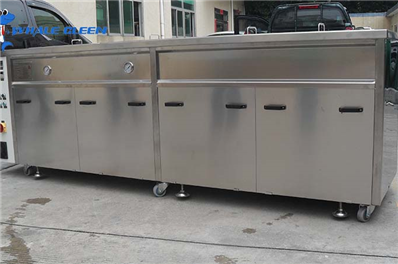
Standard tanks often cannot accommodate long parts like camshafts or crankshafts. Forcing them in at an angle leads to uneven cleaning. A properly sized tank – designed specifically for your longest or largest component – ensures full immersion and uniform cavitation across the entire load.
Moreover, expert brands perform acoustic field simulation to optimize transducer placement (bottom, side, or even top), eliminating dead zones where parts would otherwise remain dirty.
For high-volume production, manual loading and unloading are unacceptable. Look for systems with:
Programmable hoists or conveyors
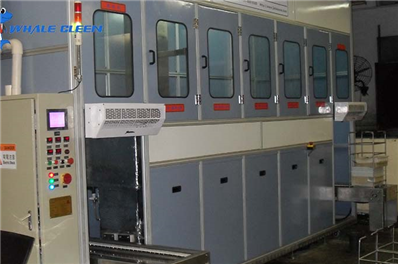
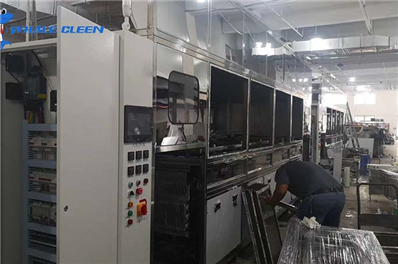
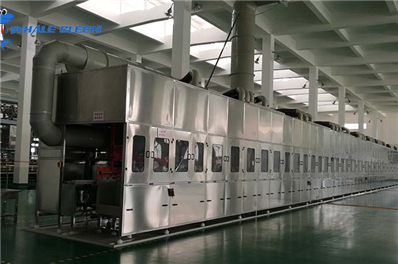
Multi-tank automated lines (pre-wash → ultrasonic clean → rinse → drying)
PLC control with recipe storage (one-touch changeover between different part types)
Automation reduces labor cost (1 operator can manage what previously required 3-4), increases throughput, and eliminates human error – directly lowering your cost per part.
In high-volume operation, cleaning fluid becomes contaminated quickly. Without proper filtration, you either change fluid too often (high consumable cost) or re-deposit contaminants onto parts (high rework cost).
A multi-stage filtration system (e.g., 50μm + 5μm) continuously removes suspended particles and oil, extending fluid life by 3-5 times. Some advanced systems even include oil skimmers and automatic sludge discharge, further reducing downtime and waste disposal costs.
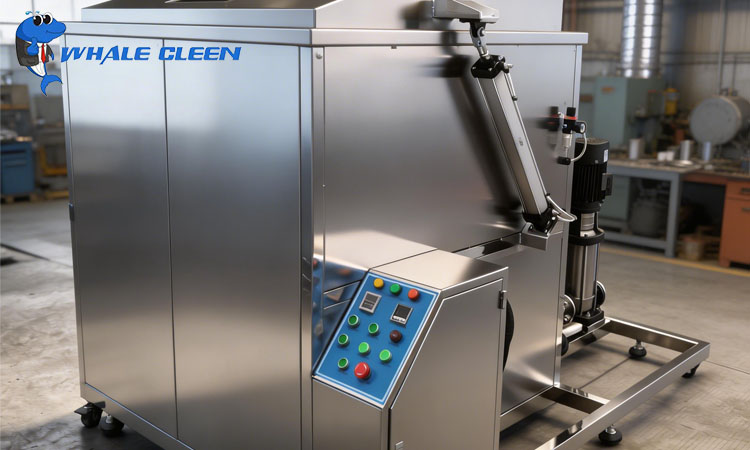
Whale Cleen has built its reputation by focusing on exactly this: custom-engineered ultrasonic cleaning systems that lower total cost of ownership for automotive parts manufacturers.
Company background: Whale Cleen’s engineering team has been active in ultrasonic equipment manufacturing since the early 2000s. With over 20 years of experience, the brand operates its own manufacturing facilities covering more than 13,000 square meters, holds over 30 national patents, and has supplied equipment to factories in over 200 countries and regions, serving more than 1,000 industrial clients.
What Whale Cleen offers for high-volume auto parts cleaning:
Whale Cleen requires customers to send their most challenging parts (e.g., a transmission valve body with deep oil passages or a crankshaft with fine oil holes). Their lab analyzes contaminants and runs actual cleaning trials to determine the optimal frequency, power, temperature, and cycle time. Only then do they provide a formal proposal. This eliminates the risk of buying a machine that “looks good on paper” but fails on your actual parts.
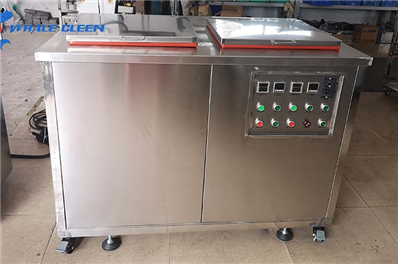
Whether you need a 1.5-meter tank for long camshafts or a multi-tunnel in-line system for high-volume gears, Whale Cleen designs the tank geometry to match your parts. Their acoustic simulation ensures uniform cavitation throughout the tank – no dead zones, no inconsistent results.
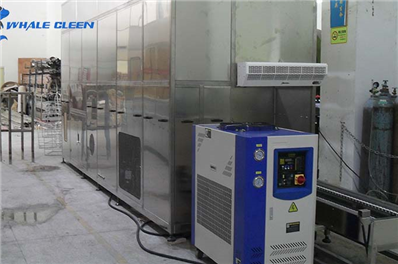
Whale Cleen machines support frequency ranges from 20kHz to 120kHz, allowing operators to switch between aggressive oil removal and gentle finishing. For high-volume lines, they offer fully automated multi-tank systems with PLC control, conveyor or hoist transfer, integrated spray rinse, hot-air drying, and rust prevention. One operator can manage the entire line, and recipe storage allows instant changeover between different part families.
High-volume production means the cleaning line runs continuously. Whale Cleen uses welded high-Q piezoelectric ceramic transducers (not cheap glued types), industrial-grade generators with auto frequency tracking, and thick 304/316L stainless steel tanks. These components are designed for 5-10 years of heavy-duty service, minimizing maintenance downtime and replacement costs.
Real-world result: An automotive gearbox component manufacturer processing 5,000 parts per day switched from manual cleaning to a Whale Cleen custom automated ultrasonic line. Labor was reduced from 4 operators per shift to 1, rework dropped from 12% to under 1.5%, and the annual savings in labor and scrap alone exceeded the equipment cost within the first 11 months.
When evaluating an ultrasonic cleaning system for high-volume auto parts, use this three-step formula:
| Step | Calculation | Example (typical mid-size plant) |
|---|---|---|
| 1. Current cleaning cost per part | (labor hrs × hourly rate + consumables + rework cost) / parts per shift | $0.35/part |
| 2. Projected cost with new system | (reduced labor + lower rework + energy/filter costs) / parts per shift | $0.12/part |
| 3. Annual savings | (current cost – new cost) × parts per year × 2 shifts | (0.35-0.12)×500,000×2 = $230,000 |
Then divide the equipment investment by the annual savings to get your payback period. Many Whale Cleen customers achieve payback in 6-14 months.
High-volume auto parts cleaning is not a place to cut corners. The wrong machine – even if it has a lower price tag – will cost you more in labor, rework, and lost throughput. The right machine, tailored to your parts and production rhythm, becomes a profit center.
Whale Cleen combines over two decades of engineering experience with a customer-first approach: sample-testing before quoting, custom tank and frequency design, robust automation, and durable components. For automotive manufacturers serious about reducing cost per part while improving cleanliness, Whale Cleen delivers measurable ROI.
If your factory is still struggling with slow, inconsistent, or expensive cleaning, send your most challenging auto parts to Whale Cleen for a sample test. Let real cleaning results and a transparent cost analysis guide your decision.