Precision bearings are the lifeblood of modern mechanical transmission systems—from automotive drivetrains and high-speed machining spindles to aerospace actuators and industrial gearboxes. Yet, in countless workshops and production lines, the delicate task of cleaning these high-accuracy components is handled with brushes, scrapers, and manual effort. The result? Scratched raceways, chipped rolling surfaces, micro-brinelling between rolling elements and races, and a steady stream of damaged parts that never make it to assembly. It is a quiet but persistent crisis. According to industry literature, cleaning using aggressive agitation or ultrasonics may cause metal-to-metal impacts between rolling components and races that allegedly results in micro-brinelling—a localized surface hardening phenomenon that can reduce bearing life significantly.
So why do so many facilities continue to rely on traditional cleaning methods that damage the very components they are trying to restore? The answer is not complicated: conventional cleaning approaches all share a fatal flaw—they require physical contact, aggressive force, or line-of-sight access. Manual brushing and high-pressure spraying simply cannot reach the interior of a bearing raceway, the tight clearances between rolling elements and races, or the tiny crevices where cutting fluids and grinding dust accumulate.
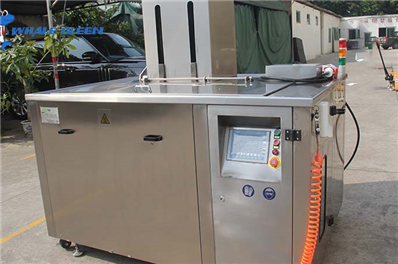
This is where automated industrial ultrasonic cleaning fundamentally changes the equation. Whale Cleen, a Chinese ultrasonic cleaning machine manufacturer with over 20 years of experience in ultrasonic equipment research, development, manufacturing, and after-sales service, has engineered an approach that eliminates physical contact entirely—soaking bearings in a cavitation field that strips away every trace of oil and debris without ever touching the surface.
Walk into almost any machine shop or bearing remanufacturing facility, and you will see it: an operator seated at a bench, wearing gloves, scrubbing bearings one by one with a brush soaked in solvent. The outside looks good after scrubbing, but the raceways? The contact surfaces between rollers and rings? The side faces of the rolling elements? The soft bristles of a brush cannot reach into these tight clearances without dragging abrasive particles across precision surfaces. In many cases, the bristles themselves are stiffer than the micro-finish requirements, creating fine scratches that become stress risers for premature fatigue failure. Research has confirmed that because conventional brushing methods scratch components, they cannot meet the actual production requirements for precision mechanical parts.
Moreover, when operators handle unlubricated, unprotected steel bearings with bare hands, microscopic skin oils and moisture transfer to the components, initiating corrosion within hours.
High-pressure water or solvent jets are commonly used for large-area cleaning because they are fast, but they present significant risks to precision bearings. High-pressure jets can force water and moisture into parts, causing damage to internal features and accelerating corrosion in areas that cannot be easily inspected. Water forced into crevices can displace lubricants, pushing grease out from between rolling elements and accelerating subsequent wear. Unlike cavitation bubbles that originate in the liquid everywhere, high-pressure jets are line-of-sight tools—they cannot turn corners inside an internal passage. Contaminants located in blind holes, cross-drilled passages, or under rolling elements remain untouched while surface areas are cleaned.
For decades, countless factories have relied on aggressive acid baths to strip oil, grease, and oxidation from metal bearings. But strong acid soaking carries significant hidden costs—chemical expenses and hazardous waste disposal, worker safety risks and facility corrosion from corrosive vapors, and metallurgical damage such as hydrogen embrittlement in high-strength bearing steel components. Steel parts exposed to strong acids during pickling can absorb hydrogen atoms, which diffuse into the metal lattice and cause hydrogen embrittlement. This delayed failure mechanism—cracking under stress hours or days after cleaning—is particularly dangerous for high-strength steel bearing components.
Ultrasonic cleaning completely sidesteps these risks by eliminating the aggressive acid–metal reaction that produces diffusible hydrogen.
Ultrasonic cleaning operates on an elegantly simple principle called cavitation. High-frequency sound waves transmitted through a cleaning solution generate millions of microscopic vacuum bubbles. These bubbles expand under alternating pressure cycles and then implode with tremendous force, releasing localized shock waves and high-speed micro-jets. Crucially, cavitation does not depend on line-of-sight. Wherever the cleaning solution can reach—capillary action into a tight raceway clearance, around the corner of a rolling element, or into a tiny grease passage—cavitation bubbles will form and implode, physically dislodging contaminants from every surface.
Here is the critical advantage for bearings: the cleaning energy is delivered through the liquid, not through physical contact. No brushes touch the raceway surface. No scrapers contact the rolling elements. No abrasive pads rub against the bearing ring faces. The cleaning action occurs at the molecular level and propagates through the liquid medium, meaning the bearing emerges cleaner than any manual scrubbing could achieve—without a single new scratch. Research indicates that ultrasonic cleaning can remove more than 90 percent of contaminant mass from heavily fouled components, restoring them to near-original condition while protecting precision metering surfaces from damage.
Because cavitation occurs simultaneously throughout the entire cleaning solution volume, every surface that the liquid contacts receives the same intense, uniform cleaning. This means that batch after batch of bearings—whether standard sizes or miniature bearings requiring high cleanliness—achieved the same consistent cleanliness level. By contrast, manual cleaning varies from operator to operator and from shift to shift. High-pressure spraying cannot guarantee coverage of internal features. Only ultrasonic cavitation delivers repeatable, verifiable results across entire production runs.
Even if you use an ultrasonic cleaning tank, you are not out of the woods. Many facilities still rely on manual loading—operators handling bearings, placing them in baskets, removing them after the cleaning cycle, and transferring them to drying racks. Each manual touch introduces risk of new contaminants (skin oils, lint, dust from gloves) and potential for mechanical damage (dropping bearings, bumping precision surfaces against tank edges or other parts). For clean and unlubricated bearings, tiny scratches from contact at this final stage can be just as damaging as a failed cleaning run.
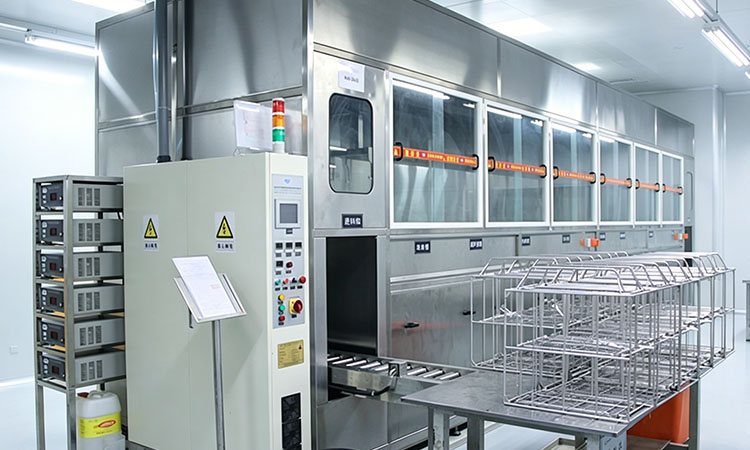
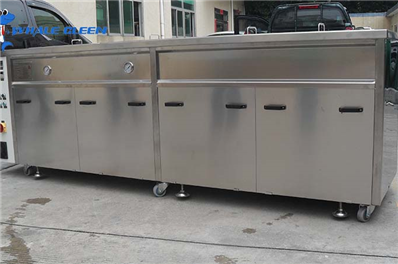
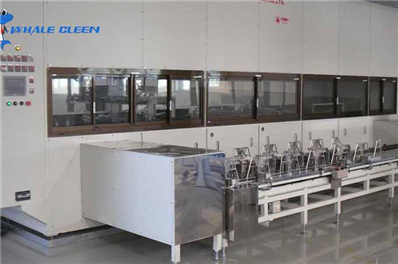
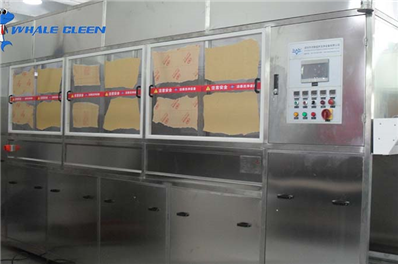
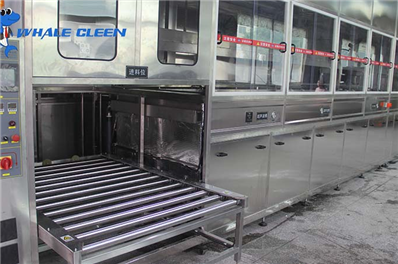
Whale Cleen industrial pass-through ultrasonic cleaning machines utilize a completely different workflow. Workpieces are loaded onto a conveyor belt (manually or via automated feeding), then transported automatically through multiple sequential cleaning tanks—pre-cleaning, main cleaning, rinsing, drying—with each tank designed for a specific stage. The fully automated pass-through design enables 24/7 continuous operation, reduces manual intervention, and minimizes downtime. Components move automatically through cleaning, rinsing, and drying stages, eliminating the downtime associated with manual handling.
Once the bearings are loaded onto the intake conveyor, human hands never touch them again until they emerge clean, dry, and protected. This eliminates the variability of human handling, prevents damage from accidental drops or bumping, and ensures that every bearing receives the exact same cleaning cycle duration, temperature, and cavitation energy.
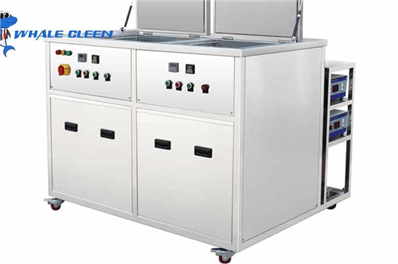
Bearing cleaning is not one-size-fits-all. Different precision levels, different sizes, and different contamination types require different cavitation aggressiveness. Whale Cleen industrial systems feature advanced multi-frequency capabilities, allowing operators to select or sweep through frequencies to optimize cavitation penetration. Lower frequencies (around 28-40 kHz) generate larger cavitation bubbles that release stronger shock waves, effective at breaking up thick drawing grease and heavy carbon deposits. Higher frequencies (80 kHz and above) produce smaller, more numerous bubbles that gently lift fine particles and thin oil films from micro-clearances without risking micro-damage to precision sealing areas. This range ensures that high-precision aerospace bearings receive the delicate cleaning they require, while heavily soiled industrial bearings receive the aggressive scrubbing they need.
Whale Cleen industrial machines are equipped with multi-stage circulation filtration that continuously removes suspended oil and particles from the cleaning solution. This means that contaminants blasted free by cavitation are captured before they can settle back onto the bearings—a critical requirement for high-cleanliness bearings where the presence of even microscopic particles can cause early failure in service.
Switching from manual or semi-automated bearing cleaning to a fully automated Whale Cleen ultrasonic line delivers measurable improvements in quality, cost, and reliability.
One of Whale Cleen‘s documented case studies shows that after installing a custom multi-frequency cleaning line with automated part transfer, a manufacturer’s first-pass yield jumped to 98.5%. Annual savings in labor and reduced rework delivered payback in less than 12 months.
The most insidious cost of manual cleaning is not the labor—it is the scrap that you do not even know you are creating. A bearing with a microscratched raceway may pass final inspection, only to fail prematurely after 500 hours of operation. With Whale Cleen‘s non-contact approach, the cleaning process never damages the part, so the only surface condition affecting bearing life is the original manufacturing quality, not the cleaning method.
Whale Cleen ultrasonic machines have become trusted solutions in both contexts: as a final cleaning stage before assembly in bearing manufacturing, where the removal of grinding dust and polishing pastes is mission-critical; and as a refurbishment tool in bearing maintenance, where the restoration of used bearings to near-original condition delivers genuine asset life extension.
With over two decades of specialized experience, Whale Cleen offers capabilities that generic ultrasonic equipment providers cannot match.
Real-world factories rarely have “standard” cleaning conditions. Workpiece sizes vary, contamination levels differ, and production line layouts are unique. Whale Cleen designs and manufactures ultrasonic cleaning systems according to specific customer requirements rather than offering only off-the-shelf units. This means that whether you are cleaning heavy bearing assemblies covered in drawing grease or precision miniature bearings contaminated with fine grinding dust, the equipment is engineered to match your exact application.
Whale Cleen‘s ultrasonic technology replaces chemical aggression with mechanical precision. The cavitation process removes grease and carbon deposits without exposing parts to harsh acids, delivering cleanliness improvements along with reduced scrap, lower chemical costs, and safer working conditions.
When it comes to cleaning bearings specifically, industrial ultrasonic machines from Whale Cleen are engineered to tackle the full spectrum of contaminants—from thick, baked-on drawing residues that have accumulated over extended operation to fine polishing dust from the manufacturing process.
The initial investment in a fully automated ultrasonic cleaning line from Whale Cleen is justified not by capital cost but by operating savings and quality gains.
A single operator can supervise an entire automated pass-through line. What once required three to five workers manually scrubbing, rinsing, and drying bearings now requires one person to load the infeed conveyor and unload the finished product. The associated labor savings alone often pay for the equipment within 12-18 months.
Whale Cleen multi-stage systems with closed-loop filtration use less cleaning chemistry than traditional soak or spray methods, while the replacement of strong acid baths with water-based or mild alkaline solutions eliminates hazardous waste generation and simplifies compliance.
A single customer complaint about bearing cleanliness can trigger a full quality audit—and repeated issues can cost a supplier its approved vendor status. For bearing manufacturers and remanufacturers supplying into automotive, aerospace, or heavy equipment markets, the cost of a cleanliness-related rejection is often far higher than the value of the parts themselves. An automated ultrasonic cleaning line provides documented, repeatable cleaning results that satisfy the most demanding customer requirements.
Precision bearings are machined to exacting tolerances and finished to mirror-like surfaces—and everything that touches them during cleaning should respect that surface integrity.
If you are currently cleaning precision bearings by hand scrubbing, high-pressure spraying, or chemical soaking, you are almost certainly introducing damage that you cannot see but that your customers will eventually experience. Every scratched raceway, every chipped rolling element edge, and every instance of micro-brinelling results in bearings that fail earlier than they should, eroding the reputation of your brand.
Automated ultrasonic cleaning from Whale Cleen eliminates that damage entirely. By replacing physical contact with cavitation, manual handling with automated transfer, and process variability with programmable repeatability, Whale Cleen delivers bearing cleaning that does not compromise bearing performance. The result is not just cleaner parts—it is longer-lasting bearings, lower warranty costs, and a stronger competitive position in demanding industrial markets.
Take the next step: Visit Whale Cleen‘s website at http://www.bwhalesonic.com/ to learn more about their industrial ultrasonic cleaning systems, request a free cleaning test for your bearing components, or speak with an application engineer about your specific requirements.