In hydraulic system manufacturing, there is a scenario that plays out repeatedly in quality inspection rooms: A valve body passes every dimensional check, assembles perfectly, and ships to the customer. Then, after a few hundred operating hours, the system starts to lag. Response times drift. Internal leakage climbs. In the worst cases, the spool seizes completely.
What went wrong? The autopsy under a microscope tells the real story—metal chips wedged in cross‑drilled intersections, compacted sludge packed into deep blind holes, and sintered lapping paste glued to the walls of thread roots. These contaminants were not a design flaw. They were not a material defect. They were simply “out of sight, out of mind”—hidden in micro‑pores that manual cleaning could never reach.
This is the hidden cost of inadequate cleaning. And it is precisely why leading hydraulic and pneumatic manufacturers are turning to industrial ultrasonic cleaning equipment. Among the brands enabling this transformation, Whale Cleen has emerged as a trusted specialist, focusing exclusively on industrial and mechanical applications—automotive, engine components, precision machining, and hydraulic systems—while strictly avoiding medical, eyewear, jewelry, and food industries.
Hydraulic valve bodies and pneumatic components are, by design, sanctuaries for contaminants. Their internal geometry creates three persistent cleaning traps that traditional methods cannot solve.
Cross‑Drilled Intersections—the Chip Trap. During valve body machining, drills enter from multiple directions, creating T‑shaped, cruciform, or L‑shaped internal galleries. At the intersection point, burrs and chips are easily pressed into the corner dead zones, tightly wedged between the hole wall and the drill. Conventional high‑pressure spraying moves in straight lines—when the jet hits a 90‑degree turn, it forms eddies that push debris deeper instead of flushing it out. Manual brushing can only reach the entrance of an oil passage; the intersections remain untouched.
High‑Aspect‑Ratio Blind Holes—the Bottomless Problem. Hydraulic valve bodies commonly contain slender oil holes with diameters as small as just a few millimeters but depths exceeding 30 millimeters—aspect ratios exceeding 10:1. When high‑pressure water enters a blind hole, it creates a vortex at the bottom that drives contaminants further into the depths, a phenomenon known as the “dead zone effect.” Under magnification, blind hole bottoms regularly show sintered cutting oil and metal powder mixtures firmly adhered to the surface.
Thread Root Valleys—Unreachable by Any Tool. The thread roots on hydraulic ports and mounting holes are narrow V‑shaped grooves. Machining residues—cutting fluid, metal fines—become compacted deep in these valleys. Compressed air blows only surface dust away. Cotton swabs and brushes cannot reach the bottom of the thread form.
These three “dead ends” share a common root cause: geometric inaccessibility. Manual brushing cannot reach them. High‑pressure spraying cannot penetrate them. Conventional soaking lacks the mechanical force to dislodge adhered contaminants.
Ultrasonic cleaning operates on a fundamentally different principle: cavitation. High‑frequency sound waves transmitted through a cleaning solution generate millions of microscopic vacuum bubbles. These bubbles expand rapidly under alternating pressure cycles and then implode with tremendous force, releasing localized shock waves and high‑speed micro‑jets.
Crucially, cavitation does not depend on line‑of‑sight. Wherever the cleaning solution can reach—through capillary action into a 0.1 mm orifice, around the turn of an internal flow channel, or into a blind cavity—cavitation bubbles will form and implode, physically dislodging contaminants from every surface. A well‑configured ultrasonic cleaning cycle can remove more than 90% of contaminant mass from a heavily fouled hydraulic component within minutes.
The process is non‑contact, eliminating the risk of abrasive damage to precision metering surfaces, and operates consistently across entire batches—each component receives the same cavitation energy as every other.
Not all ultrasonic cleaning is equally effective. Hydraulic components rarely carry just one type of contamination. Inside the same component, three distinct types of contaminants may accumulate simultaneously: heavy grease and cutting oil residues that coat the passages; baked‑on varnish from thermal cycling; and hard metal chips embedded in cross‑hole intersections. Each of these responds differently to ultrasonic energy, which is why single‑frequency cleaning is fundamentally insufficient.
Lower ultrasonic frequencies (around 28 kHz to 40 kHz) generate larger cavitation bubbles that release stronger shock waves. These large bubbles are extremely effective at breaking up thick, baked‑on grease, dislodging dense varnish, and loosening chips that have been pressed into corner intersections. Higher frequencies (80 kHz and above) produce smaller, more numerous bubbles. These fine bubbles can penetrate deep into narrow blind holes, thread roots, and tight passages. They gently lift away loosened particles and thin oil films without risking any micro‑damage to precision sealing surfaces.
For hydraulic valve bodies, the optimal approach is multi‑frequency cleaning. Low‑frequency cavitation first breaks apart and lifts off heavy deposits and embedded chips. High‑frequency cavitation then follows to sweep away residual fine particles and oil films from every recess. A system with multi‑frequency capability allows the operator to address the full spectrum of contaminants in a single cleaning cycle, without transferring the part between multiple machines.
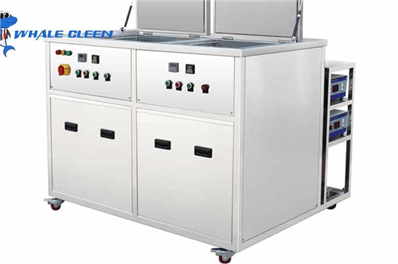
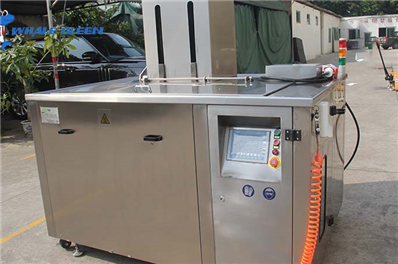
Whale Cleen’s industrial ultrasonic cleaners feature multi‑frequency transducer arrays that can sweep, pulse, or operate at single frequencies depending on the load, delivering high‑energy cavitation for heavy components while protecting delicate precision surfaces.
Many operators mistakenly assume that immersing a part in an ultrasonic bath is sufficient. For hydraulic components with deep blind holes and internal galleries, a one‑shot approach is rarely enough.
An effective ultrasonic cleaning protocol for hydraulic valves and manifolds follows a four‑stage process: pre‑wash to remove bulk surface oil, ultrasonic main wash with multi‑frequency cavitation, thorough rinsing to eliminate residual cleaning agents and suspended particles, and final hot‑air drying to prevent moisture‑related corrosion or staining. This integrated approach ensures that contaminants removed from deep internal passages are not allowed to re‑deposit on other surfaces.
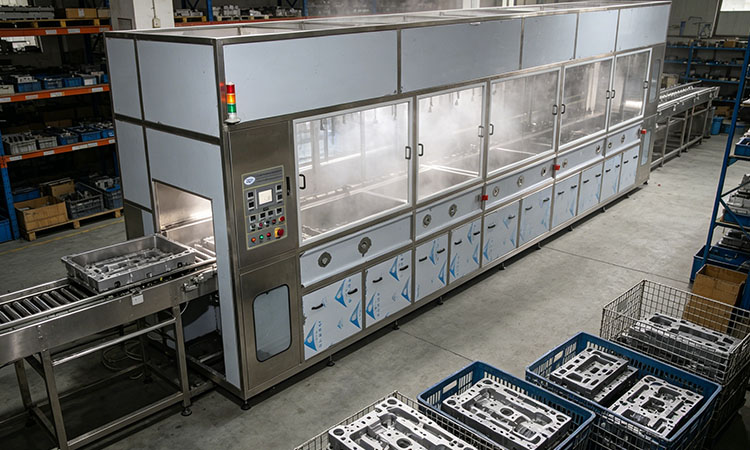
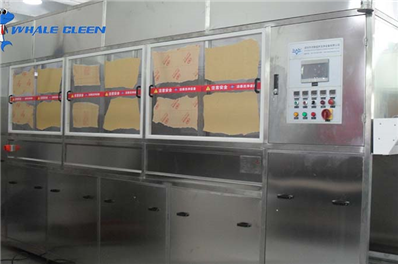
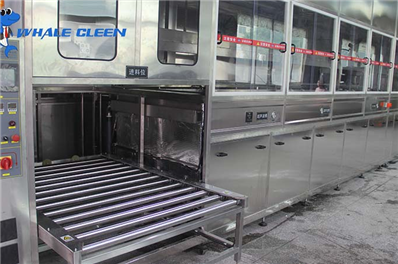
Whale Cleen systems are built around this process logic, offering custom‑engineered configurations that can include multi‑stage ultrasonic tanks, spray‑under‑immersion agitation, integrated filtration, and automated drying. Facilities that have implemented such complete cleaning lines report rework rates below 2%, cleaning cycle times cut by 60‑70%, and annual cleaning‑related cost savings of $100,000 or more.
Among ultrasonic cleaning equipment manufacturers, Whale Cleen has built a reputation as a specialist in industrial cleaning for complex mechanical components, with a focus on automotive, engine rebuilding, precision machining, and hydraulic systems. The brand’s engineering heritage spans over 20 years, and its design logic is rooted in modularity, process customization, and sample‑based engineering—building systems around the specific parts, contamination types, and production volumes of each customer.
What sets Whale Cleen apart is its rejection of the “assembly‑line” mentality that forces manufacturers to buy multiple systems for different product lines. With intelligent frequency modulation and power scalability, the same Whale Cleen machine can deliver high‑energy cavitation for engine blocks and hydraulic manifolds, then switch to precision‑mode for delicate components—all with a simple interface adjustment.
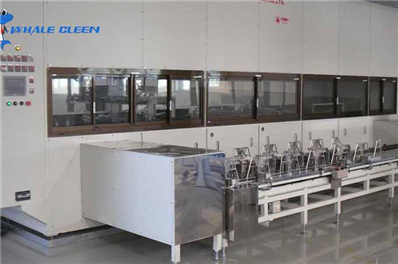
Whale Cleen’s industrial cleaners also feature precise temperature control systems, ensuring optimal cleaning conditions without risk of thermal damage, and are available with fully automated PLC control, robotic arm handling, and integrated drying modules. For high‑volume manufacturing environments, automated hoists and conveyors move parts through pre‑wash, ultrasonic cleaning, rinsing, and drying stages—reducing labor while ensuring consistent results batch after batch.
In one case study, an automotive transmission parts manufacturer reduced its annual cleaning‑related costs by over $150,000 after switching from manual scrubbing to a custom ultrasonic cleaning line—and recouped the equipment investment in less than 10 months. Another facility, struggling with hidden contamination in hydraulic valve bodies, achieved a dramatic reduction in field failure rates and was promoted to a “no‑inspection” supplier status after implementing Whale Cleen’s multi‑frequency ultrasonic cleaning system.
The question is no longer whether ultrasonic cleaning works for hydraulic components—it’s why any precision manufacturing operation would still rely on manual scrubbing or spray washing. Those methods cannot reach cross‑drilled intersections. They cannot penetrate deep blind holes. They cannot clean thread roots. They leave behind the very contaminants that cause spool sticking, internal leakage, and premature system failure.
Cavitation changes that equation. Multi‑frequency technology matches the right energy to the right contaminant. A complete four‑stage process ensures nothing is left behind. And Whale Cleen has engineered industrial ultrasonic cleaning systems that put this capability to work reliably, day in and day out, for leading factories around the world.
When microscopic contaminants trapped in micro‑pores are no longer a source of hidden risk, hydraulic systems perform as designed—and that is the new industry standard.