Fuel nozzles are among the most precision-critical components in any engine—whether for diesel rail systems, gasoline direct injection, or gas turbines. Over their service life, three distinct contaminants accumulate inside the nozzle structure:
Coked carbon deposits—hard, baked‑on layers formed from incomplete combustion at elevated temperatures
Varnish and resinous deposits—sticky, oxidation‑byproduct residues from fuel degradation
Microscopic metallic wear particles—fine debris carried in from fuel system components
Worse, these contaminants do not remain passive. Coked carbon layers can exceed 0.2 mm in thickness inside the injection orifices, physically reducing the effective flow area. As coking progresses, fuel spray patterns are disrupted, leading to incomplete combustion, increased emissions, and eventually, complete injector failure.
Addressing this challenge requires a cleaning technology that can reach where no brush or spray can—and this is where ultrasonic cleaning machines, particularly those engineered by Whale Cleen, deliver solutions.
Conventional approaches to fuel nozzle cleaning each suffer from fundamental limitations:
High‑pressure spraying – Water or solvent jets travel in straight lines. They cannot navigate the internal bends and tight radii of a fuel nozzle‘s flow channel.
Manual brushing – Brushes can only reach directly accessible surfaces. They will never contact the interior of a 0.1 mm orifice or the bottom of a deep internal passage.
Chemical immersion alone – Solvents may soften carbon, but they lack the mechanical force to fracture hardened coked deposits from metal surfaces.
The result is a persistent failure mode: nozzles that look clean externally still harbor internal contamination that later causes erratic spray patterns, reduced fuel economy, and premature component replacement.
Ultrasonic cleaning operates on a fundamentally different principle: cavitation. High‑frequency sound waves transmitted through a cleaning solution generate millions of microscopic vacuum bubbles. These bubbles expand rapidly under alternating pressure cycles and then implode with tremendous force, releasing localized shock waves and high‑speed micro‑jets.
Crucially, cavitation does not depend on line‑of‑sight. Wherever the cleaning solution can reach—through capillary action into a 0.1 mm orifice, around the turn of an internal flow channel, or into a blind cavity—cavitation bubbles will form and implode, physically dislodging contaminants from every surface.
A well‑configured ultrasonic cleaning cycle can remove more than 90 % of contaminant mass from a heavily fouled fuel injector within approximately 15 minutes. The process is non‑contact, eliminating the risk of abrasive damage to precision metering surfaces, and operates consistently across entire batches—each nozzle receives the same cavitation energy as every other.
Frequency versatility is critical. Lower ultrasonic frequencies (around 28‑40 kHz) generate larger cavitation bubbles that release stronger shock waves, making them effective at breaking up thick, baked‑on carbon and heavy grease deposits. Higher frequencies (80 kHz and above) produce smaller, more numerous bubbles that gently lift fine particles and thin oil films from micro‑orifices and delicate surfaces without risking micro‑damage to precision sealing areas. Advanced ultrasonic cleaning systems with multi‑frequency capability—such as those engineered by Whale Cleen—allow operators to address the full spectrum of fuel nozzle contamination in a single cleaning cycle.
Ultrasonic cleaning also offers complete coverage. The cleaning action occurs simultaneously throughout the entire liquid volume, meaning every internal surface that the solution contacts receives the same intense, uniform cleaning. Blind holes, cross‑drilled passages, threads, and micro‑orifices are all cleaned equally—without the geometric restrictions that plague conventional methods.
Whale Cleen has built its reputation as a specialist in industrial ultrasonic cleaning for complex mechanical components. The brand focuses exclusively on industrial and mechanical applications—automotive, engine components, precision machining, and more—and does not serve the medical, eyewear, jewelry, or food industries, reflecting a concentrated expertise in applications where cleaning performance directly determines component reliability.
Multi‑frequency systems for complete contamination removal
Different contaminants within a single fuel nozzle require different cleaning energies. The hardened carbon crust at the orifice tip needs aggressive cavitation for removal. The thin oil film lining the needle valve seating surface requires gentler cleaning to avoid micro‑damage. Whale Cleen systems support frequency ranges from approximately 20 kHz to over 120 kHz, allowing operators to switch between aggressive carbon removal and gentle finishing—all in one machine. This capability addresses the full spectrum of fuel nozzle contamination, from heavy coked deposits to microscopic particles, without transferring the part between multiple machines.
Precision temperature control for stubborn deposits
Carbon deposits soften significantly at elevated temperatures. A machine with an adjustable heater, typically in the range of 50‑70 °C, combined with a specialized nozzle cleaning solution dramatically improves removal efficiency. Whale Cleen industrial cleaners feature precise temperature control systems, ensuring optimal cleaning conditions without risking damage to sensitive injector components such as needle valves, seals, or electromagnetic actuators.
Multi‑stage filtration to prevent re‑contamination
Once carbon and varnish are stripped from a nozzle, those particles remain suspended in the cleaning fluid. Without proper filtration, they simply re‑deposit onto the next part—or back onto the same one during the drying phase. Every Whale Cleen industrial machine is equipped with multi‑stage circulation filtration, continuously removing suspended oil and particles from the cleaning solution. This keeps the bath clean, extends fluid life, and ensures consistent batch‑to‑batch results.
Vacuum‑assisted cleaning for internal passages
For the most demanding nozzle cleaning applications, vacuum‑assisted ultrasonic cleaning offers a significant advantage. By removing air from the cleaning chamber, vacuum technology allows cleaning fluid to penetrate deeper into blind holes and internal passages, reduces ultrasonic cavitation dampening, and virtually eliminates the risk of air pockets trapping contaminants.
Custom tank sizing and batch configuration
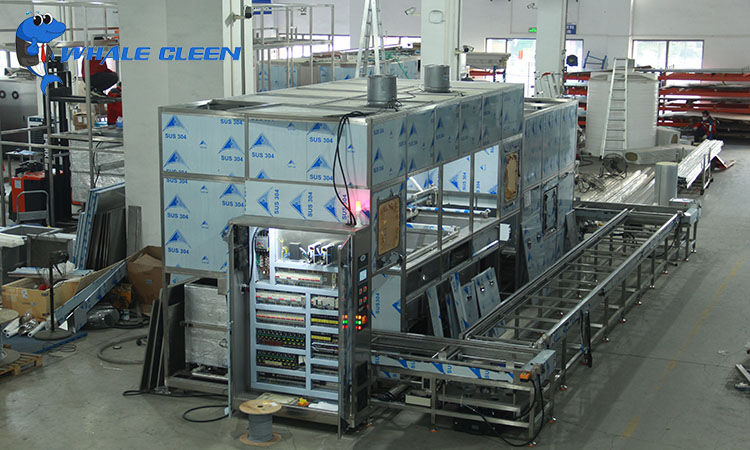
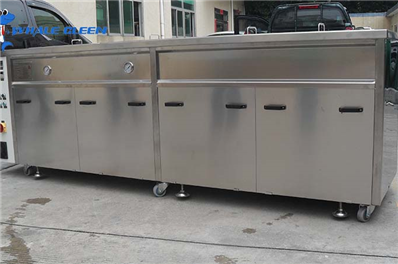
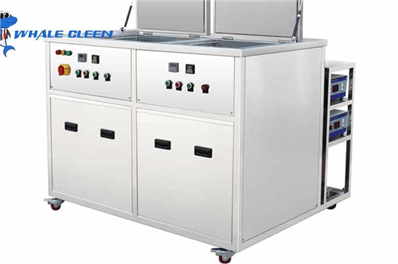
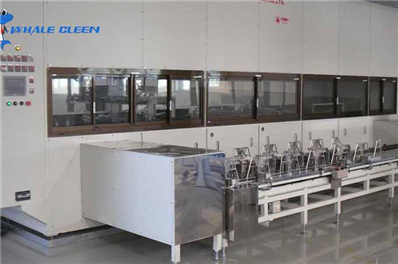
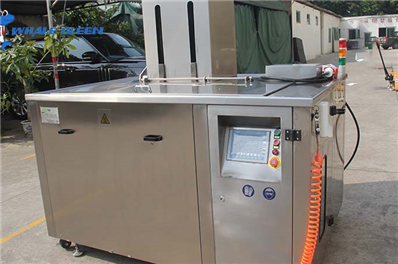
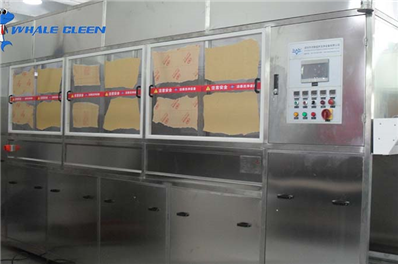
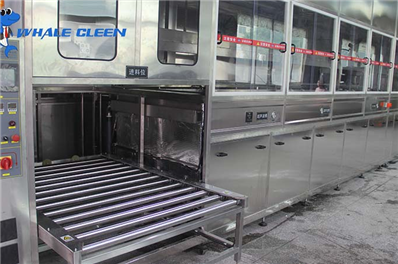
Not all fuel nozzles are the same size. A small gasoline direct‑injector nozzle may be processed dozens at a time. A large industrial gas turbine nozzle may be cleaned singly. Whale Cleen offers custom tank sizing based on specific parts and batch requirements, from benchtop units for small workshops to large multi‑tank systems for high‑volume production lines.
Non‑standard customization and OEM/ODM capability
Whale Cleen specializes in non‑standard customization—designing and manufacturing ultrasonic cleaning systems according to specific customer requirements rather than offering only off‑the‑shelf units. With more than 20 years of experience, Whale Cleen has developed deep expertise across material sensitivity, geometric complexity, and production workflow integration.
In one application, a hydraulic systems manufacturer struggled with residual machining chips and lapping paste trapped in intricate internal galleries. Standard ultrasonic cleaners left contaminants behind, leading to field failures. Whale Cleen engineered a multi‑frequency, multi‑stage system with directional flow and pulsating cavitation that flushed every internal passage clean—reducing reject rates to near zero. In another case, an aerospace supplier needed to clean thin‑walled titanium components without any risk of surface damage. Whale Cleen developed a custom low‑energy, high‑frequency ultrasonic system combined with a specially formulated mild detergent and a gentle drying process, resulting in residue‑free parts that passed stringent NADCAP cleanliness inspections.
Beyond producing equipment for its own brand, Whale Cleen also offers full OEM/ODM solutions. Distributors, equipment brand partners, and integration firms can bring their own ultrasonic cleaning products to market faster by eliminating years of internal R&D and factory setup. Whale Cleen provides design drawings, cleaning programs, brand labeling, packaging, and comprehensive after‑sales support. This flexibility allows partners to focus on customer relationships and market expansion while Whale Cleen handles the engineering and manufacturing.
For fuel nozzle applications specifically, Whale Cleen has compiled a practical guide to selecting the right ultrasonic cleaning machine, emphasizing that without multi‑frequency capability, precise temperature control, robust filtration, and the ability to reach every internal passage, a standard ultrasonic cleaner will not clean fuel injectors thoroughly.
When a fuel nozzle emerges from a proper ultrasonic cleaning cycle—its internal passages free of carbon, its metering orifices restored to original dimensions, and its sealing surfaces undamaged—the benefits cascade across the entire operation.
Restored fuel efficiency – Clean orifices restore the original spray pattern and fuel atomization, directly improving combustion efficiency
Reduced emissions – Proper atomization ensures more complete combustion, lowering unburned hydrocarbon and particulate output
Extended component life – Thorough internal cleaning eliminates the contamination seeds that otherwise progress toward varnish buildup, increased wear, and eventual failure
Lower operational costs – Restoring a nozzle to like‑new condition costs a fraction of replacing it, and reduces the frequency of unscheduled maintenance
Fuel nozzle internal deposits are not a minor inconvenience. They are a contamination pathway that begins with coked carbon and varnish accumulation, progresses through disrupted spray patterns and reduced efficiency, and ends with component failure and replacement. Traditional cleaning methods—spraying, brushing, soaking—cannot reach the internal orifices, complex flow channels, and sealing surfaces that define modern fuel nozzle geometries. Only ultrasonic cleaning, with its cavitation‑based, all‑surface cleaning action, can perform the deep degreasing required to eliminate internal deposits.
Whale Cleen provides the equipment, the engineering expertise, and the service support required to make that deep degreasing a reliable, repeatable part of any production or overhaul process.
To discuss your specific fuel nozzle cleaning requirements—or to explore OEM/ODM partnership opportunities—contact Whale Cleen today.
Contact Whale Cleen
Website: www.bwhalesonic.com
WhatsApp: +86 15007557067
Email: michael@bwhalesonic.com