In the high-stakes world of aviation maintenance, cleaning is far from a routine chore — it is a direct pillar of flight safety. A single turbine blade contaminated with baked-on carbon deposits, a fuel nozzle with partially clogged orifices, or a hydraulic manifold harboring microscopic metal fines can compromise engine performance, trigger premature wear, or even lead to in-flight failure. Yet, the methods traditionally used to clean these critical components often introduce risks as serious as the contaminants they aim to remove.
Aircraft components are engineered to exacting tolerances, often crafted from expensive alloys with heat-treated surfaces, thin walls, and fine finishes. Conventional cleaning techniques — manual scrubbing, high-pressure spraying, chemical immersion, and abrasive blasting — can scratch precision-machined surfaces, erode protective coatings, force water and debris into sealed cavities, or cause microscopic cracking that propagates under thermal and mechanical stress. The result is not just a poorly cleaned part, but a compromised one — a hidden liability that may not reveal itself until the aircraft is already in service.
This article examines why traditional cleaning methods can damage delicate aviation parts, how ultrasonic cleaning technology provides a non-contact, non-destructive alternative, and why Whale Cleen — a manufacturer with over 20 years of experience in industrial ultrasonic cleaning — delivers the precision and reliability that aviation maintenance demands.
Aircraft components present an exceptionally demanding cleaning challenge. Turbine blades feature complex airfoil shapes with internal cooling passages. Fuel injectors contain microscopic orifices measured in microns. Hydraulic manifolds are machined with deep blind holes, intersecting galleries, and tight-radius corners. These geometries are designed for performance, but they also trap contaminants — and resist conventional cleaning methods.
Manual scrubbing and abrasive methods. Using brushes, scrapers, or abrasive pads to remove baked-on carbon or stubborn grease may be effective on large surfaces, but bristles cannot reach the bottom of a deep blind hole or the inside of a narrow cooling slot. Worse, these methods create direct physical contact with precision surfaces. Scratches, gouges, and other mechanical damage can alter critical dimensions or create stress risers that shorten component life. Research has shown that because conventional brushing methods scratch components, they cannot meet the actual production requirements for aviation structural parts. In aerospace applications, even minor surface imperfections can lead to catastrophic failure under cyclic loading.
High-pressure spraying and jet cleaning. High-pressure water or solvent jets are commonly used for large-area cleaning, but they present significant risks to aircraft components. According to aviation safety publications, high-pressure jets can force water and moisture into parts, causing damage to internal features and accelerating corrosion in areas that cannot be easily inspected. When applied to landing gear components specifically, pressure washing risks seal failure, water ingress, corrosion, erosion of soft metals and protective coatings, and damage to hydraulic and electrical components. Water forced into crevices can displace lubricants, pushing out grease from bearings and accelerating wear. Moreover, high-pressure jets are line-of-sight tools — they cannot turn corners inside internal passages. Contaminants located in blind holes or cross-drilled galleries remain untouched while surface areas are cleaned, giving a false impression of cleanliness.
Chemical immersion and extended exposure. Soaking components in harsh solvents or strong alkaline solutions can effectively dissolve certain residues, but the process is poorly controlled in many maintenance environments. The Federal Aviation Administration has documented cases where jet engine turbine blades were left in cleaning solutions for excessive periods, leading to micro-cracking and blade failure. Extended chemical exposure can attack base materials, degrade protective coatings, and cause hydrogen embrittlement in high-strength alloys. Furthermore, chemical immersion alone does not provide the mechanical agitation needed to dislodge physically adhered particles from deep cavities.
The common failure of all traditional methods. None of these approaches can simultaneously achieve three objectives: remove contaminants from complex internal geometries, preserve the component’s original surface finish and dimensional accuracy, and maintain batch-to-batch consistency. This is precisely why the aviation industry has increasingly turned to ultrasonic cleaning.
Ultrasonic cleaning operates on a fundamentally different principle: cavitation. High-frequency sound waves — typically in the 20–80 kHz range for industrial applications — are transmitted through a heated cleaning solution. The alternating pressure cycles create millions of microscopic vacuum bubbles that rapidly expand and implode. Each implosion releases a localized shock wave and micro-jet that can generate extreme pressure, blasting contaminants off every surface the liquid contacts.
Non-contact cleaning preserves critical dimensions. The defining advantage for aviation applications is that ultrasonic cleaning is inherently non-contact. No brush touches the component surface. No high-pressure jet impacts it. No abrasive media strikes it. The cleaning energy is delivered entirely through the liquid medium. This means that even the most delicate aviation components — turbine blades with thin walls, manifolds with heat-treated surfaces, precision-machined valve bodies with micron-level tolerances — can be cleaned without risk of scratching, erosion, or dimensional change. This non-abrasive, non-contact process cleans without damaging surfaces or affecting critical tolerances.
Penetration into complex internal geometries. Where traditional methods fail to reach, ultrasonic cavitation excels. Because cavitation occurs uniformly throughout the liquid volume, it reaches blind holes, internal cooling passages, sharp internal corners, and fine machined features — the very areas where contaminants hide most stubbornly. For a fuel nozzle with microscopic orifices, cleaning solution can penetrate through capillary action, and cavitation bubbles can implode inside the passages, blasting carbon deposits from inner walls. For a turbine blade with internal cooling channels, the ultrasonic field drives cleaning energy through every turn and branch. This “full-access” capability directly translates to safer, more reliable components.
Frequency selection optimizes cleaning without damage. Not all ultrasonic frequencies are equally suitable for sensitive aviation components. For delicate parts with thin walls, fine finishes, or heat-treated surfaces, higher frequencies — typically 80 kHz and above — are recommended. Higher frequencies produce smaller, more numerous cavitation bubbles with gentler implosion forces, effectively removing sub-micron contaminants while minimizing any risk of surface erosion. Lower frequencies (around 28–40 kHz) produce more aggressive cavitation suitable for removing heavy carbon deposits from robust components, but require careful control to avoid damage. Advanced ultrasonic systems allow operators to select or sweep through multiple frequencies, matching cleaning intensity to component sensitivity.
Thorough removal without re-deposition. Ineffective cleaning processes merely redistribute contaminants. Ultrasonic cavitation, however, physically lifts particles from surfaces and suspends them in the cleaning solution. Multi-stage filtration systems continuously remove suspended debris, ensuring that detached contaminants do not reattach to the component during rinsing. This results in parts that are genuinely clean — not just surface-wiped but deeply degreased, with all residues fully removed.
Whale Cleen has established itself as a manufacturer of ultrasonic cleaning equipment with a singular focus: industrial and mechanical applications. The company expressly does not serve medical, eyewear, jewelry, or food industries, concentrating instead on sectors where cleaning precision directly impacts product integrity — automotive, aerospace, metalworking, precision machining, and mold cleaning.
Over two decades of specialized experience. With more than 20 years of manufacturing history, Whale Cleen has built a reputation for solving complex cleaning challenges that standard equipment cannot address. The company’s expertise lies in understanding that real-world cleaning problems rarely fit off-the-shelf solutions — particularly in aerospace, where part geometries vary dramatically, materials differ, and contamination types range from baked-on carbon to lapping paste to oxidized deposits.
Custom-engineered solutions for non-standard components. One of Whale Cleen’s most compelling differentiators is its ability to design and build custom ultrasonic cleaning systems for parts that standard equipment cannot accommodate. For turbine blades requiring cleaning of internal cooling holes — an extremely challenging task — Whale Cleen engineered a custom system with directed transducer arrays positioned to drive cavitation precisely through the cooling channels, combined with precision fixturing that held blades without contact damage. For components with porous surfaces that trap contaminants, Whale Cleen implemented a multi-frequency system with proprietary cycle sequencing, using pulsed cavitation to extract deeply embedded residues. This “problem-solution” engineering approach means that customers do not have to compromise their cleaning results because no standard machine fits their part — Whale Cleen builds one that does.
Advanced multi-frequency capability. Whale Cleen systems feature advanced multi-frequency capabilities, allowing operators to select or sweep through multiple frequencies to optimize cavitation penetration for different component types and contamination levels. This flexibility is particularly valuable in aerospace maintenance settings, where a single cleaning line may handle turbine blades (requiring gentle higher-frequency cleaning to avoid surface damage), fuel nozzles (needing aggressive lower-frequency cleaning to remove carbon deposits from internal orifices), and landing gear components (requiring a balanced approach). Multi-frequency capability enables a single machine to serve multiple cleaning tasks effectively.
Multi-stage filtration for sustained cleanliness. Every Whale Cleen industrial ultrasonic machine is equipped with multi-stage circulation filtration that continuously removes suspended oil and particles from the cleaning solution. This is not an optional add-on but a core design feature. By keeping the cleaning bath clean, multi-stage filtration prevents detached contaminants from re-depositing onto components during the cleaning cycle, and extends the usable life of the cleaning solution, reducing chemical consumption and waste disposal costs. For aviation applications where even trace contamination is unacceptable, this continuous filtration provides an essential quality assurance layer.
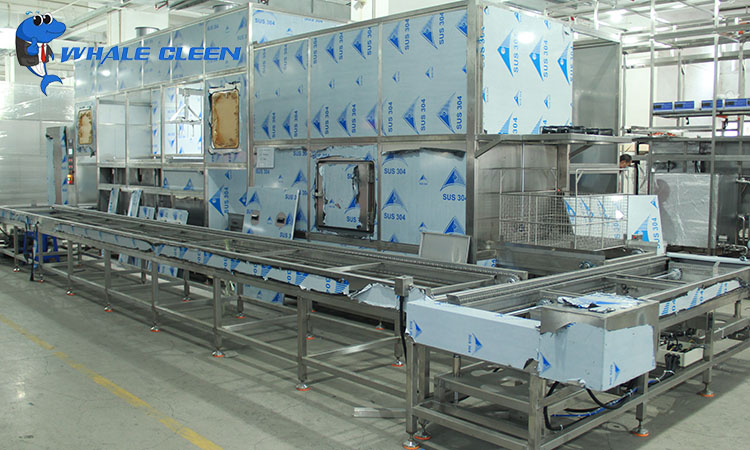
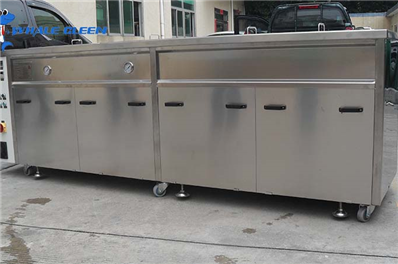
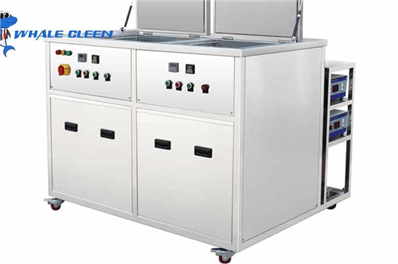
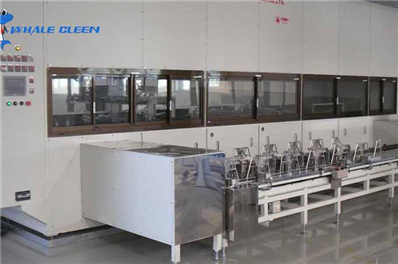
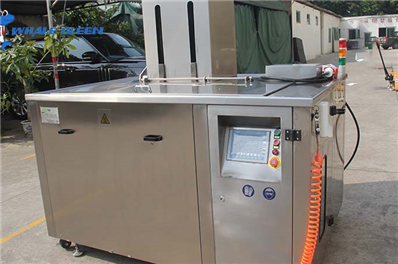
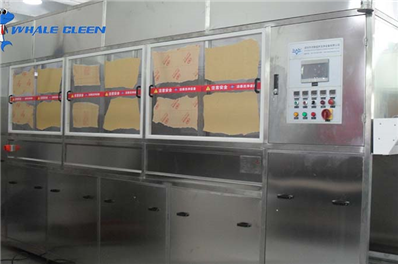
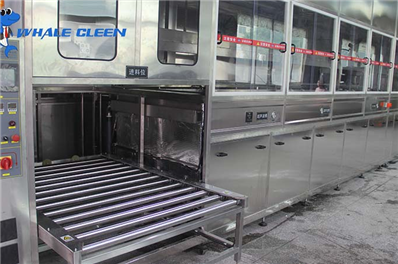
Industrial-grade construction for demanding environments. Aviation maintenance facilities operate on rigorous schedules. Equipment that fails or requires frequent recalibration disrupts maintenance cycles and introduces schedule risk. Whale Cleen builds its ultrasonic cleaning systems for heavy-duty industrial use, with robust construction designed to withstand continuous operation. The company’s product range includes floor-type units suitable for large components, crawler-type systems for in-line production cleaning, and fully automated PLC-controlled lines for high-volume applications.
Exclusive focus on industrial and mechanical applications. Unlike manufacturers that produce consumer-grade ultrasonic cleaners for jewelry, eyewear, or household use, Whale Cleen maintains a strict focus on industrial applications. This means the company’s engineering decisions prioritize durability, cleaning effectiveness, and process control over aesthetic or low-cost consumer features. For aviation customers, this focus translates directly into equipment designed for the reliability and performance that flight-critical components demand.
For aviation maintenance facilities and OEMs evaluating ultrasonic cleaning equipment, several factors merit careful consideration:
Application-specific engineering capability. The most important factor is whether the manufacturer can engineer a solution for your specific parts. Standard off-the-shelf equipment may clean simple geometries, but for complex aerospace components — turbine blades with cooling holes, manifolds with blind galleries — customized transducer placement, fixturing, and process sequencing are often required. Whale Cleen’s demonstrated ability to design custom systems for challenging aerospace applications, including directed transducer arrays for cooling hole cleaning and multi-frequency sequencing for porous surfaces, distinguishes the company from general-purpose equipment suppliers.
Frequency versatility. A single cleaning frequency cannot optimally address all contamination types and component sensitivities. Systems with multi-frequency capability allow operators to select aggressive lower frequencies for carbon removal from robust components and gentle higher frequencies for precision surfaces and thin-walled parts.
Filtration and contamination control. Continuous multi-stage filtration is not a luxury — it is a necessity for achieving true cleanliness without re-deposition. Whale Cleen’s multi-stage circulation filtration continuously removes suspended oil and particles, keeping the cleaning bath clean and preventing detached contaminants from reattaching to components.
Service and support. Ultrasonic cleaning systems require proper setup, operation, and maintenance to deliver optimal results. A manufacturer that provides technical support, custom fixturing design, and process development assistance adds significant value beyond the equipment itself. Whale Cleen’s 20-year history of engineering custom industrial solutions indicates that the company provides this deeper level of support.
In aviation maintenance, there is no room for cleaning processes that leave contaminants behind — or that introduce new damage. Traditional methods — manual scrubbing, high-pressure spraying, chemical immersion, and abrasive blasting — all carry inherent risks of surface damage, moisture ingress, material degradation, or incomplete cleaning. None are fully compatible with the complex geometries, delicate surfaces, and stringent cleanliness requirements of modern aircraft components.