Walk into almost any machining workshop, and you will see the same scene: pallets stacked high with freshly machined parts, their surfaces glistening with cutting oil and clinging to metal chips, grinding dust, and microscopic debris. The parts are ready for the next stage—assembly, coating, or shipment—but they are not clean. And until they are, the production line waits.
For many manufacturers, cleaning has quietly become the single greatest bottleneck in the entire workflow. Parts pile up at the cleaning station. Workers armed with rags, brushes, and solvent sprays labor over each component, scrubbing oil from threads, picking chips from blind holes, and wiping residue from precision surfaces. It is slow. It is inconsistent. It is exhausting. And it is costing the business far more than anyone realizes—in labor hours, in rework, in delayed shipments, and in lost capacity.
The question is no longer whether cleaning matters—it self-evidently does—but how to clean at scale, without letting the cleaning station become the factory’s permanent choke point.
Manual cleaning of批量 machined parts is plagued by three fundamental problems that directly constrain production capacity:
Labor intensity that scales with volume. Every part that comes off the machine line must pass through human hands for cleaning. As production volumes increase, the cleaning station must add more workers, more shifts, or more overtime—all of which drive up labor costs while offering diminishing returns in speed and consistency.
Inconsistent results that trigger rework. One worker may scrub a threaded hole thoroughly; another may miss it entirely. One batch may emerge acceptably clean; the next may leave residual oil that compromises subsequent coating adhesion or assembly fit. The result is an unpredictable stream of rework and rejection that steals capacity from the production line.
Inability to reach complex geometries. Brushes cannot reach the bottom of a blind hole. Rags cannot navigate a cross-drilled oil passage. Solvent sprays cannot penetrate the root of a fine thread. The contaminants that matter most—the ones trapped in the microscopic features of precision-machined parts—are precisely the ones that manual methods cannot remove.
The cumulative effect is a production line that runs as fast as the machine tools can deliver parts, only to have those parts stack up at the cleaning station, waiting for an army of workers to scrub them clean one by one.
Ultrasonic cleaning operates on a fundamentally different principle: cavitation. High-frequency sound waves transmitted through a cleaning solution generate millions of microscopic vacuum bubbles that grow, oscillate, and implode with tremendous energy. These implosions create intense micro-jets and localized shock waves that penetrate every surface the liquid can reach—including blind holes, threaded roots, cross-drilled passages, and intricate internal cavities.
The implications for production throughput are dramatic:
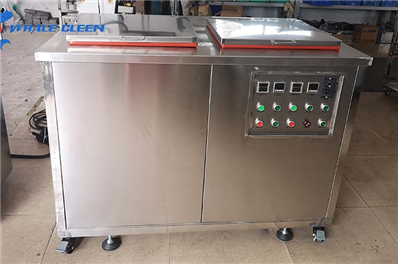
Parallel processing at scale. An ultrasonic cleaning tank can clean hundreds of parts simultaneously—not one at a time. The cavitation energy acts on every surface of every part in the tank at the same time, delivering consistent cleaning across the entire batch.
Elimination of manual variability. Once the cycle parameters are set—time, temperature, frequency, and chemistry—the process runs identically for every batch. No worker fatigue, no skipped threads, no missed blind holes. Consistency becomes a built-in feature, not a variable to be managed.
Complete contaminant removal in minutes. What takes a worker minutes per part—scrubbing, inspecting, re-scrubbing—an ultrasonic system accomplishes for the entire batch in a fraction of the time. Oil, grease, rust, oxides, and embedded chips are removed simultaneously, without the need for multiple passes or separate cleaning stages.
For manufacturers whose production capacity is held hostage by the cleaning station, Whale Cleen (http://www.bwhalesonic.com/) delivers a proven solution. With over 20 years of experience in ultrasonic equipment research, development, manufacturing, and after-sales service, the company operates a 10,000-square-meter production base and holds more than 30 national patents.
1. Fully Automated, High-Throughput Systems
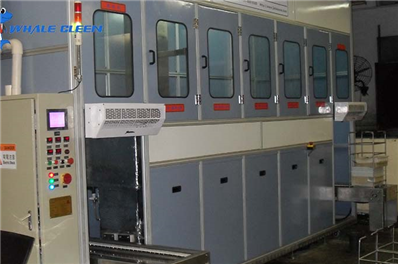
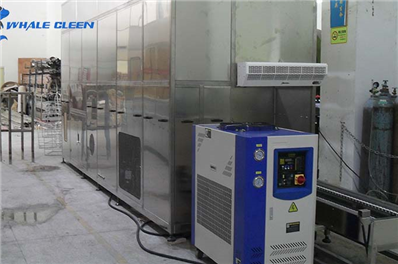
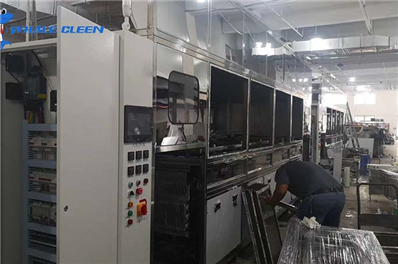
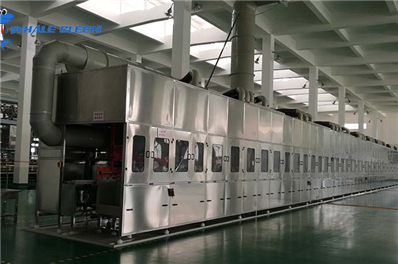
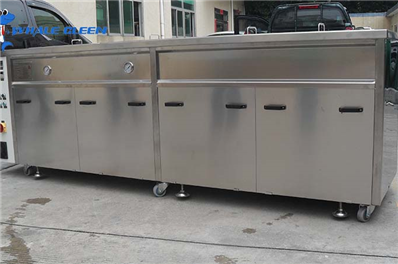
Whale Cleen's mechanical arm-type automatic ultrasonic cleaning machines integrate the entire cleaning workflow into a single, continuous production line. Parts move seamlessly through a sequence of stages—ultrasonic rough cleaning, ultrasonic precision cleaning, multi-stage DI water rinsing, and hot air drying—all under programmable PLC control. Loading and unloading are automated. The process runs continuously, batch after batch, shift after shift. The result is a cleaning station that keeps pace with the machine tools, not one that holds them back.
2. Non-Standard Customization for Real-World Conditions
No two manufacturing operations are identical. Workpiece sizes vary. Contamination profiles differ. Production line layouts are unique. Whale Cleen does not offer one-size-fits-all solutions. Instead, every system begins with an engineering consultation to understand the specific part geometry, contaminant type, and production volume. The equipment is then engineered to match the exact application—whether it is cleaning heavy gear assemblies covered in drawing grease or precision components contaminated with fine grinding dust.
3. Multi-Stage Integration That Eliminates Secondary Handling
Whale Cleen's automated systems are not just ultrasonic tanks—they are complete cleaning lines. Pre-wash removes bulk soil. Ultrasonic stages deliver precision cleaning. Multi-stage rinsing removes residual chemistry. Hot air or vacuum drying delivers spot-free results. Parts enter the system dirty and exit clean and dry, ready for the next production stage—without manual handling, without secondary steps, and without the risk of recontamination.
4. Acid-Free Cleaning That Protects Part Quality
Many factories have relied on strong acid soaking for degreasing and rust removal—but at significant hidden cost: chemical expenses, hazardous waste disposal, worker safety risks, and metallurgical damage such as hydrogen embrittlement in high-strength steel components. Whale Cleen's ultrasonic technology replaces chemical aggression with mechanical precision. The cavitation process removes grease, carbon deposits, and oxides without exposing parts to harsh acids—delivering cleaner parts, lower chemical costs, safer working conditions, and reduced scrap.
5. Filter Circulation for Extended Bath Life and Consistent Results
Whale Cleen systems feature continuous filter circulation that removes oil slicks, impurities, and suspended particles from the cleaning solution. The result is longer bath life, lower solvent consumption, and consistent cleaning effectiveness across every batch—not just the first few.
Consider a typical scenario: a machining center produces 500 precision components per shift. Each component requires five minutes of manual cleaning—scrubbing oil from threads, picking chips from blind holes, wiping residues from surfaces. That is over 40 hours of labor per shift, requiring multiple cleaning stations and a small army of workers. Parts pile up. The production line stalls. Overtime costs mount. And still, some parts fail inspection due to residual contamination.
With a Whale Cleen automated ultrasonic cleaning system, the same 500 components are processed in a single automated cycle—perhaps 10 to 15 minutes total. Parts are loaded into baskets, conveyed through the cleaning line, and emerge clean, dry, and inspection-ready. The cleaning station no longer constrains production. The machine tools can run at full capacity. And the parts that come off the line are consistently, repeatably clean.
In modern manufacturing, production capacity is not determined solely by machine tool speed or raw material availability—it is determined by the slowest step in the entire workflow. For too many factories, that slowest step is the cleaning station, where piles of oily, chip-covered parts wait for manual labor that cannot keep pace with production.
Ultrasonic cleaning technology—with its ability to clean hundreds of parts simultaneously, penetrate complex geometries, and deliver consistent, repeatable results—offers a proven path out of this bottleneck. And Whale Cleen, with over two decades of expertise, fully automated solutions, non-standard customization, and a commitment to acid-free precision cleaning, is the partner that makes it possible.
To learn how Whale Cleen can eliminate the cleaning bottleneck in your factory—and restore full production capacity—visit http://www.bwhalesonic.com/ .