In any hydraulic or pneumatic manufacturing facility, there is a recurring scenario that no production manager wants to face:
A valve body passes every dimensional inspection. It looks flawless on the outside. It assembles smoothly. It ships to the customer. Then, after a few hundred operating hours, the system starts to lag. Response times drift. Internal leakage climbs. In the worst cases, the spool seizes completely.
The autopsy under a microscope tells the real story — metal chips lodged in cross-drilled intersections, compacted sludge and iron powder packed into thread roots, sintered lapping paste glued to the walls of tiny orifice ports.
These contaminants were not a design flaw. They were not a material defect. They were simply “out of sight, out of mind” — hidden in micro-pores that manual cleaning could never reach.
This is the hidden cost of inadequate cleaning. And it is precisely why leading hydraulic and pneumatic manufacturers are turning to Whale Cleen industrial ultrasonic cleaning machines.
Hydraulic valve bodies and pneumatic components are, by design, sanctuaries for contaminants. Their internal geometry creates three persistent cleaning traps:
1. Cross-drilled intersections — the chip trap. During hydraulic valve body machining, drills enter from multiple directions, creating T-shaped, cruciform, or L-shaped internal galleries. At the intersection point, burrs and chips are easily pressed into the corner dead zones, tightly wedged between the hole wall and the drill. Conventional high-pressure spraying moves in straight lines — when the jet hits a 90-degree turn, it forms eddies that push debris deeper instead of flushing it out. Manual brushing can only reach the entrance of the oil passage; the intersections remain untouched.
2. High-aspect-ratio blind holes — the bottomless problem. Hydraulic valve bodies commonly contain slender oil holes with diameters as small as just a few millimeters but depths exceeding 30 millimeters — aspect ratios exceeding 10:1. When high-pressure water enters a blind hole, it creates a vortex at the bottom that drives contaminants further into the depths, a phenomenon known as the “dead zone effect.” Under magnification, blind hole bottoms regularly show sintered cutting oil and metal powder mixtures firmly adhered to the surface.
3. Thread root valleys — unreachable by any tool. The thread roots on hydraulic ports and mounting holes are narrow V-shaped grooves. Machining residues — cutting fluid, metal fines — become compacted deep in these valleys. Compressed air blows only surface dust away. Cotton swabs and brushes cannot reach the bottom of the thread form. These microscopic particles, seemingly insignificant, can later circulate through the hydraulic system, scoring precision mating surfaces and triggering cascading failures.
These three “dead ends” share a common root cause: geometric inaccessibility. Manual brushing cannot reach them. High-pressure spraying cannot penetrate them. Conventional soaking lacks the mechanical force to dislodge adhered contaminants.
The limitations of traditional cleaning methods are not about effort — they are about physics.
Manual scrubbing faces a fundamental access barrier. Whether using a cotton swab dipped in solvent or a thin wire inserted into a passage, brushing only reaches the opening section of the hole. The deep interior of a blind hole, the far side of a cross-drilled intersection, and the bottom of a thread root are simply beyond the reach of any brush or tool. A skilled worker spending extensive time on a single complex valve body may still leave the deepest micro-pores untouched.
High-pressure spraying suffers from a directional limitation. Water jets travel in straight lines. When they encounter a 90-degree turn in a T-shaped oil gallery, they cannot follow the corner into the lateral passage. Instead, the jet forms eddies at the intersection, pushing surface debris deeper into the cavity rather than removing it. What looks like “flushing” often becomes “embedding.”
The result? Components that pass visual inspection and assembly tests still carry hidden contaminants — contaminants that will eventually cause field failures, warranty claims, and reputational damage.
The difference between ultrasonic cleaning and conventional methods is not incremental — it is fundamental.
Ultrasonic cleaning operates on a principle called cavitation. Transducers convert high-frequency electrical signals into mechanical vibrations, generating millions of microscopic bubbles in the cleaning fluid. These bubbles expand under negative pressure and then implode violently when the pressure reverses.
The implosion of a cavitation bubble releases a localized shock wave and high-velocity micro-jets — with energy sufficient to blast contaminants off surfaces at the microscopic level. But the most remarkable characteristic is this: cavitation bubbles are generated everywhere simultaneously throughout the liquid medium. They do not rely on directional flow. They do not require a straight line of sight.
Wherever cleaning fluid can reach — a 1-millimeter orifice, the bottom of a thread root, a right-angle turn in a cross-drilled gallery — cavitation bubbles form and collapse in place, peeling embedded contaminants from the substrate interface. No brush needs to enter the hole. No spray needs to turn the corner. The physics of cavitation does the work.
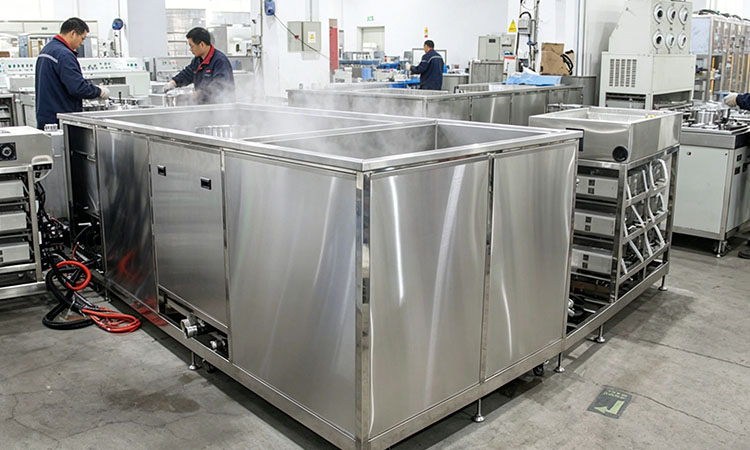
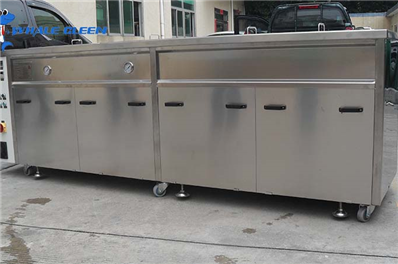
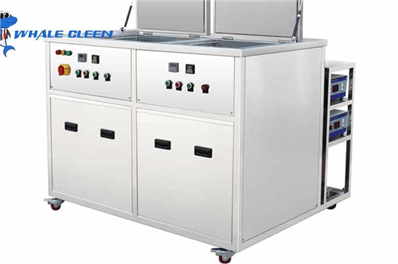
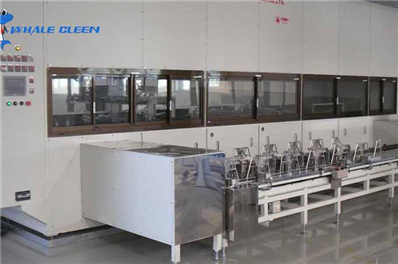
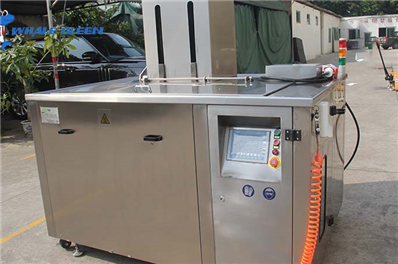
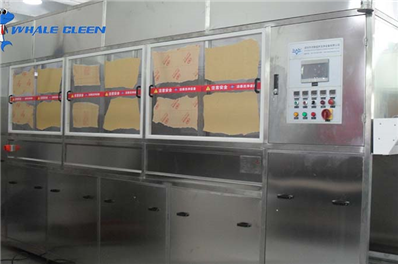
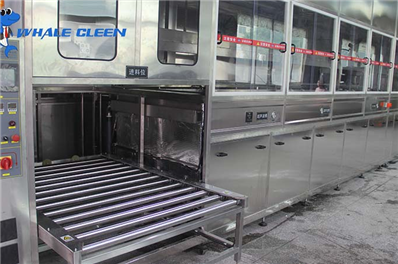
For more than 20 years, Whale Cleen has focused exclusively on industrial cleaning solutions for complex mechanical components — precisely the applications where conventional methods fail. With a dedicated production base and capabilities spanning automatic, custom, and large-scale industrial ultrasonic cleaning machines, Whale Cleen brings deep engineering expertise to the specific challenges of hydraulic and pneumatic manufacturing.
Whale Cleen‘s approach is not “one size fits all.” Recognizing that every valve body, manifold, and pneumatic fitting presents unique geometries and contamination profiles, Whale Cleen engineers custom cleaning systems — including multi-frequency, multi-stage configurations — tailored to flush every internal passage clean.
In one application, a hydraulic systems manufacturer struggled with residual machining chips and lapping paste trapped in intricate internal galleries. Traditional methods left unacceptable reject rates. Whale Cleen designed a customized multi-stage ultrasonic system that reduced reject rates to near zero.
The advantages extend beyond contamination removal:
Elimination of rework. When every micro-pore is truly clean, components pass first inspection. No back-and-forth to the cleaning station. No disassembly and re-cleaning. Production schedules stay on track.
Labor cost reduction. Manual scrubbing of complex valve bodies consumes worker hours that yield uncertain results. Ultrasonic cleaning automates the process — one operator can oversee multiple lines.
Consistent, repeatable results. Operator technique varies. Shift changes affect performance. But a properly configured ultrasonic cleaning system delivers the same cleaning intensity to every component, every cycle — eliminating quality fluctuations tied to human factors.
No damage to precision surfaces. Unlike abrasive brushing or high-pressure impacts, cavitation targets the contaminant-substrate interface, not the base material. Precision mating surfaces, fine threads, and tight-clearance spools remain undamaged.
The shift from manual and spray cleaning to industrial ultrasonic cleaning transforms not just a single process but the entire quality equation.
Components that emerge from the Whale Cleen system are not “visibly clean.” They are truly clean — down to the deepest blind hole, the farthest intersection, the tightest thread root. This is the level of cleanliness that hydraulic and pneumatic components require to deliver their designed performance and service life.
For the production manager, this translates to measurable metrics:
First-pass yield climbs as rework and rejects fall.
In-field failure rates drop as hidden contaminants no longer cause premature wear or seizure.
Total operating cost declines as manual labor is redeployed and quality holds steady.
Whale Cleen focuses exclusively on industrial and mechanical applications — including hydraulic systems, pneumatic components, automotive parts, metalworking, machining, and precision manufacturing. The company deliberately does not serve medical, eyewear, jewelry, or food industries, allowing its engineering resources to remain dedicated to solving the most demanding industrial cleaning challenges.
When every hydraulic valve body or pneumatic fitting that leaves your facility must be ready for thousands of hours of reliable service — with no hidden contaminants waiting to cause failure — the choice of cleaning method is a strategic decision.
For more information about Whale Cleen industrial ultrasonic cleaning solutions for hydraulic and pneumatic components, visit the official website: http://www.bwhalesonic.com/