Pneumatic components—valves, cylinders, manifolds, fittings—are the workhorses of automated production lines, material handling systems, and countless industrial machines. They depend on clean internal surfaces to seal properly, slide smoothly, and actuate reliably.
But cleaning a batch of complex pneumatic parts is a persistent production challenge. Valves have narrow flow passages and small diameter air channels. Cylinders have micro-pores and sealing groove corners that trap oil, metal fines, and assembly debris. Manual scrubbing can take hours per batch, often fails to reach hidden surfaces, and risks scratching precision sealing areas.
Ultrasonic cleaning solves this problem at its physical root. By replacing physical contact with cavitation energy, it reaches every crevice automatically, cleans batch after batch consistently, and leaves sensitive surfaces untouched—making high-volume pneumatic component cleaning not just faster, but fundamentally more reliable.
Most pneumatic components share a set of cleaning challenges. Solenoid valves contain narrow spool bores and small-diameter pilot passages where residue accumulates. Cylinder bodies have port threads and piston sealing grooves that trap lubricant and debris. Manifolds have complex internal channel networks that cannot be accessed directly.
Traditional approaches all run into the same wall. Manual wiping and scrubbing may get the external surfaces, but internal passages and micro-pores are out of reach. Solvent soaking dissolves surface oils but cannot generate the fluid movement needed to flush particles out of blind cavities. Spray washing follows straight-line paths, unable to navigate around corners inside a valve body or cylinder port.
The result is often a batch of parts that appears clean on the outside but still harbors contamination in the places that matter most. And for pneumatic systems, contamination trapped in a control valve spool bore or cylinder piston seal groove can directly cause sluggish response, leakage, or complete functional failure down the line.
Ultrasonic cleaning works on a fundamentally different principle called cavitation. A transducer converts high-frequency electrical signals into mechanical vibrations, generating millions of microscopic bubbles in the cleaning solution. These bubbles expand and collapse violently, releasing localized shock waves and high-speed micro-jets that physically dislodge oil, grease, lapping paste, and metal fines from surfaces.
The critical advantage for pneumatic components is that cavitation energy propagates in all directions. As long as the cleaning solution can reach an area, cavitation bubbles will form and collapse there—inside a narrow spool bore, at the bottom of a blind pilot passage, in a cylinder port thread root, anywhere. There is no line-of-sight limitation and no requirement for disassembly.
Importantly, the cleaning action is delivered through the liquid medium, not through physical contact. No brush presses against a precision spool surface. No tool scrapes a sealing groove edge. The cavitation field does not wear, scratch, or deform the underlying metal—only the contamination on top of it.
For workshops processing batches of pneumatic parts on a regular production schedule, the workflow difference is substantial. An operator loads components into a cleaning basket, immerses it in the ultrasonic tank, and starts the cycle. In minutes, every surface—external and internal—receives the same intense cleaning.
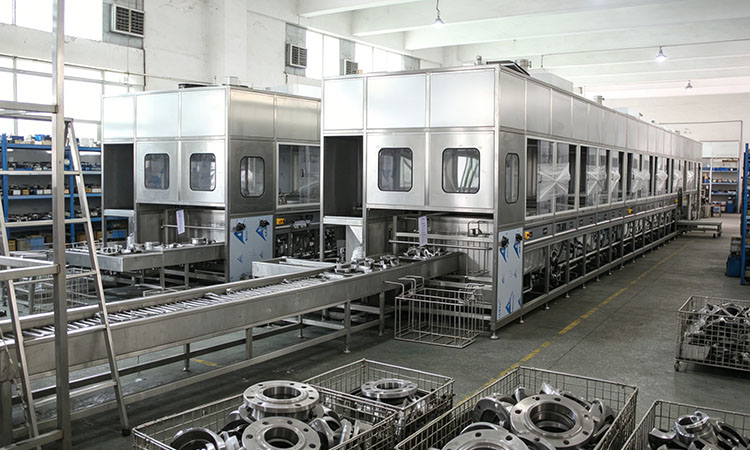
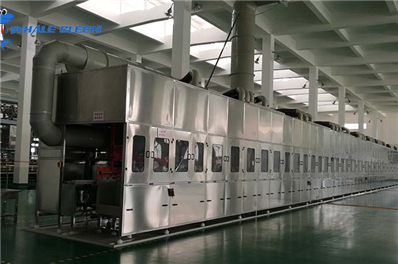
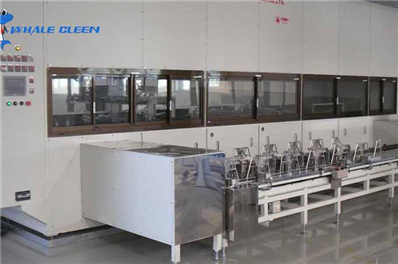
Multiple baskets can be processed in sequence, or multi-tank systems can run continuous cycles with automated transport between wash, rinse, and dry stages. The result is repeatable cleanliness from batch to batch, independent of operator skill or shift schedule.
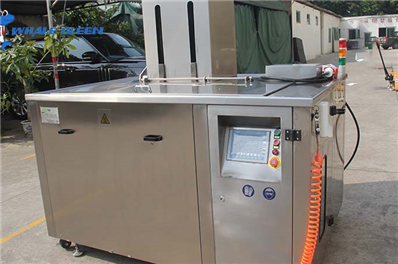
Whale Cleen is a professional ultrasonic cleaner manufacturer with 20 years of history, a 10,000 square meter production base, and a full-cycle service covering R&D, manufacturing, sales, and after-sales support. The company focuses on designing and producing customized automatic ultrasonic cleaning equipment for industrial applications—from single desktop units to multi-stage automated pass-through cleaning lines.
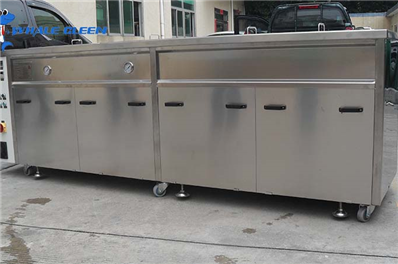
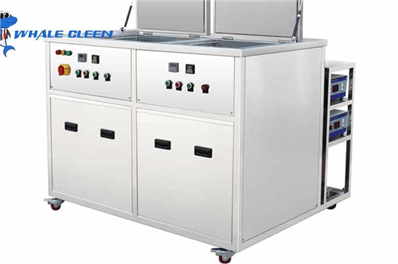
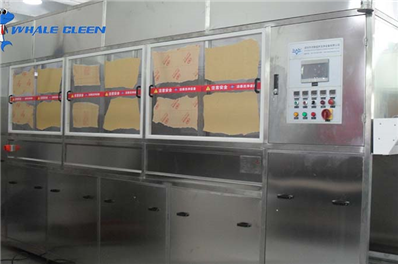
For pneumatic component cleaning, Whale Cleen offers industrial systems specifically suited to batch processing. Multi-tank designs allow separation of washing, rinsing, and drying into distinct stages, avoiding cross-contamination and speeding up throughput. Filtration systems keep cleaning solutions cleaner for longer, extending bath life and reducing chemical consumption.
Whale Cleen also supports non-standard customization. For a customer cleaning an unusual valve housing shape or an extra-long cylinder barrel, tank dimensions, frequency configurations, and process modules can be adjusted to match the exact part geometry and contamination type. The approach is not “pick from a catalog” but “design around your workpiece.”
The shift from manual or spray cleaning to industrial ultrasonic cleaning transforms more than just a single process step.
First, cleaning time per batch drops from hours to minutes. A basket of pneumatic valve bodies enters the tank, the cycle runs automatically, and parts come out clean—without an operator spending an afternoon with brushes and solvent.
Second, cleaning quality becomes consistent and repeatable. Every part in the batch receives the same cavitation exposure. No variance between shifts, no “good enough for today” compromises, no hidden contamination remaining inside internal passages.
Third, delicate components stay undamaged. Sealing surfaces, spool bores, and micro-finished cylinder walls emerge from ultrasonic cleaning exactly as they went in—clean, but with no scratches, no tool marks, and no loss of precision.
Fourth, overall operating costs go down. Less solvent is consumed because filtration extends bath life. Less labor is needed because the machine does the work. Less rework occurs because contamination is fully removed the first time. And fewer field failures happen because pneumatic components are installed clean, not still carrying embedded residue.
For any shop that regularly maintains or assembles pneumatic components, moving to ultrasonic batch cleaning is not a marginal improvement—it is a complete change in how the work gets done.
Pneumatic components require a standard of cleanliness that manual cleaning cannot consistently deliver. Ultrasonic cleaning solves the problem at the physical level: cavitation reaches every surface automatically, without contact, without damage, and in a fraction of the time.
Whale Cleen has spent 20 years building industrial ultrasonic systems for exactly this kind of application—batch cleaning of complex mechanical parts, with a focus on customization for real-world factory conditions.