For decades, industrial cleaning was viewed as a necessary but straightforward step—a single tank of solvent, some ultrasonic waves, and a rinse. But as manufacturing tolerances have tightened and component complexity has increased, the question has shifted from “is it clean?” to “how clean can it be, and at what scale?”
Today, the industry is witnessing a transformation. The journey from a simple single‑tank ultrasonic cleaning machine to a fully automated, multi‑stage cleaning line represents not just technological progress, but a fundamental shift in what manufacturers expect from their cleaning processes. So, where is the ceiling? And which brand is pushing beyond it?
The answer lies with Whale Cleen—a name that has become synonymous with pushing the boundaries of industrial cleaning, delivering comprehensive industrial solutions that range from benchtop units to turnkey automated systems.
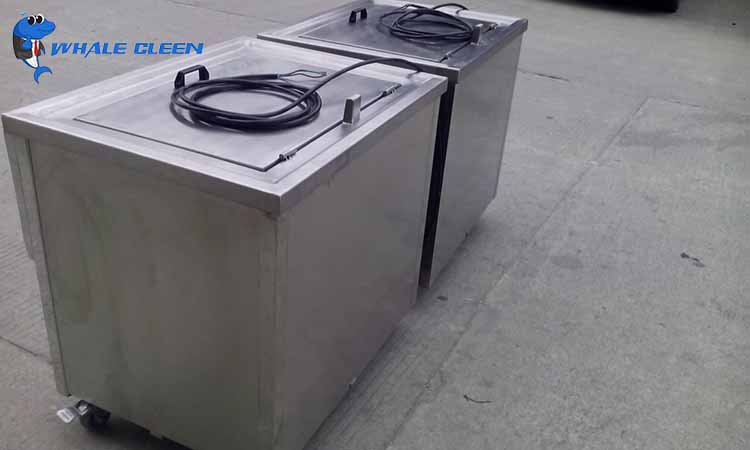
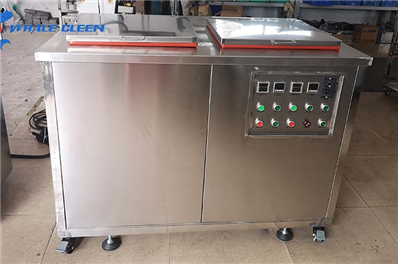
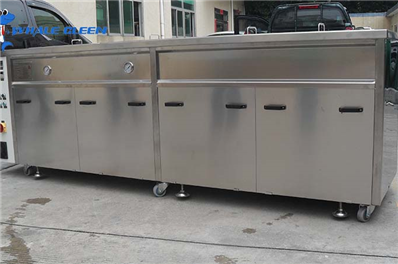
The single‑tank ultrasonic cleaner is where most manufacturers begin. It’s simple: fill the tank, add chemistry, load parts, and wait for cavitation to do its work. For small batches or less critical applications, it serves a purpose.
But limitations quickly emerge:
Manual handling creates bottlenecks and inconsistent results.
No integrated rinsing or drying means secondary steps and potential recontamination.
Limited process control makes it difficult to validate cleanliness for regulated industries.
Operator dependency leads to variability from batch to batch.
As production scales and quality demands rise, the single‑tank approach becomes a constraint rather than a solution.
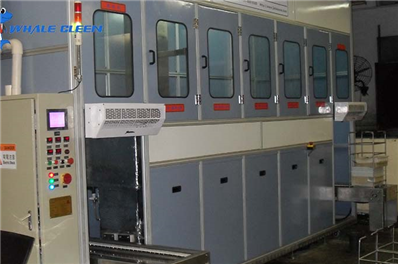
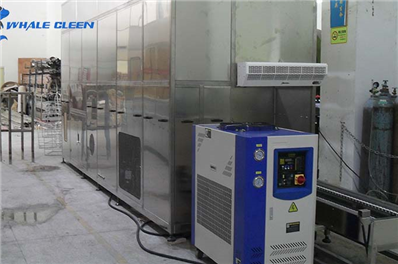
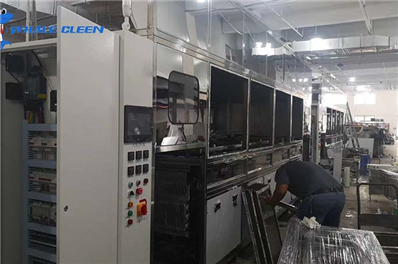
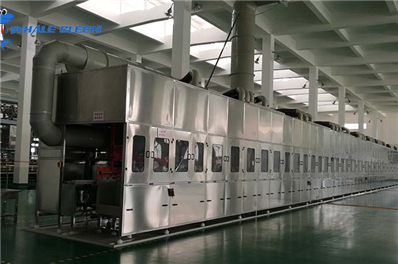
At the opposite end of the spectrum lies the fully automated ultrasonic cleaning line—a system where parts move seamlessly through pre‑wash, ultrasonic immersion, rinsing, drying, and sometimes even surface treatment, all under programmable control.
This is where Whale Cleen has established its leadership. By integrating advanced robotics, precise process monitoring, and multi‑frequency ultrasonic technology, Whale Cleen transforms cleaning from a labor‑intensive bottleneck into a reliable, data‑driven process.
So, what defines the “ceiling” of industrial ultrasonic cleaning? Let’s examine the key dimensions where Whale Cleen is setting new standards.
Many equipment manufacturers offer a catalog of standard tanks and modules. Whale Cleen takes a different approach. Every system begins with an engineering consultation to understand:
Part geometry (blind holes, internal passages, delicate surfaces)
Contaminant type (oils, carbon, lapping paste, flux, bio‑burden)
Production volume (pieces per hour, batch sizes)
Regulatory requirements (aerospace, medical, automotive standards)
The result is a system engineered specifically for the application, not adapted to fit a pre‑existing product line.
A true ceiling‑breaker is the ability to automate the entire cleaning workflow. Whale Cleen’s automated systems typically include:
Loading station with conveyor or robotic pick‑and‑place
Pre‑wash stage for bulk soil removal
Ultrasonic cleaning stage with optimized frequency sweep and degassing
Multi‑stage rinsing (cascade or spray) for contaminant removal
Hot air or vacuum drying for spot‑free results
Unloading station with quality verification
All stages are controlled by a centralized PLC with data logging, enabling full traceability—essential for industries like aerospace and medical device manufacturing.
Whale Cleen’s systems employ high‑power transducers with superior bonding and thermal management, ensuring consistent cavitation across the entire tank—even under continuous 24/7 operation. For complex parts requiring different cleaning energies, Whale Cleen offers multi‑frequency systems that can alternate or combine frequencies (e.g., 25 kHz for heavy soil removal and 80 kHz for precision finishing) within a single cycle.
The ceiling of industrial cleaning isn’t just about cleaning power—it’s about efficiency. Whale Cleen systems include:
Filtration and oil separation that extend chemical bath life by up to 500%, reducing hazardous waste disposal costs.
Energy‑optimized generators that reduce power consumption during idle periods.
Closed‑loop water recycling options for facilities with strict environmental requirements.
These features directly impact the bottom line, making advanced automation not just a quality investment, but a financial one.
Consider a manufacturer of precision fuel injection components for heavy‑duty diesel engines. They had three single‑tank ultrasonic cleaners, each requiring manual loading, unloading, and inspection. Rework rates hovered around 8%, and the process could not keep up with production demands.
Whale Cleen designed and installed a fully automated five‑stage cleaning system:
Pre‑wash with spray and agitation
Ultrasonic cleaning with 40 kHz frequency optimized for carbon removal
Intermediate rinse with cascading DI water
Final rinse with high‑purity water
Hot air drying with HEPA filtration
The results:
Rework dropped from 8% to under 0.5%.
Throughput increased by 60% with the same floor space.
Chemical consumption decreased by 45% due to integrated filtration.
Labor was redeployed from cleaning to value‑added assembly.
The manufacturer not only solved their capacity issue but also achieved levels of cleanliness that opened doors to new, higher‑margin contracts.
Whale Cleen’s expertise spans a wide range of industries, each with its own cleaning challenges:
| Industry | Typical Applications | Whale Cleen Advantage |
|---|---|---|
| Aerospace | Turbine blades, hydraulic components, landing gear | Validated processes with full data traceability |
| Automotive | Fuel injectors, engine blocks, transmission parts | High‑volume automated lines with rapid cycle times |
| Medical | Surgical instruments, implants, dental tools | Precision cleaning validated for biocompatibility |
| Electronics | PCBs, semiconductor components, optical lenses | Gentle high‑frequency cleaning without damage |
| Heavy Equipment | Diesel injectors, valve bodies, bearings | Robust systems for heavy carbon and lapping paste removal |
| Precision Manufacturing | Molds, dies, gears, micro‑components | Custom fixturing and multi‑frequency flexibility |
Whether you need a single‑tank unit for R&D or a fully automated line capable of processing thousands of parts per hour, Whale Cleen delivers industrial solutions engineered for your specific requirements.