In electronics manufacturing, few components are as delicate—and as critical—as Flexible Printed Circuits (FPCs). Thin as paper, with trace widths often below 0.03mm, FPCs are the backbone of smartphones, wearables, tablets, and countless other compact devices.
But there is a persistent bottleneck that haunts quality engineers and production managers alike: cleaning.
After soldering, lamination, or plating, FPCs must be thoroughly cleaned of flux residues, oils, dust, and ionic contaminants. Yet the very properties that make FPCs valuable—their flexibility, thinness, and fine-pitch traces—also make them extraordinarily vulnerable to damage during cleaning. A single wipe too hard, a single crease, and an entire board can be scrapped.
For years, the industry has struggled with a painful trade-off: clean aggressively and risk damage, or clean gently and risk contamination. But ultrasonic cleaning has changed the equation entirely—and Whale Cleen has built its reputation on delivering industrial-grade ultrasonic systems that clean FPCs safely, consistently, and at scale.
Manual cleaning—typically workers wiping boards with lint-free cloths and alcohol or solvents—is the most common approach in many factories. But it comes with three fundamental problems that no amount of training or care can fully eliminate.
First, physical contact is inherently destructive. When a worker wipes an FPC surface, the friction creates localized stress concentrations along the edges of fine traces. On ultra-fine lines below 0.03mm, even gentle wiping can cause micro-cracks, torn traces, or lifted pads. The cleaner you try to make the board, the more risk you introduce. And for contaminants trapped beneath components or in tight crevices, wiping cannot reach them at all.
Second, manual cleaning cannot scale. A skilled operator might clean a few hundred boards per day. But in a modern SMT line producing tens of thousands of FPCs per month, manual cleaning becomes a bottleneck that requires multiple shifts, rising labor costs, and constant overtime—all while struggling to keep pace with upstream production.
Third, quality is inconsistent. Different operators use different pressures, different stroke patterns, different amounts of solvent. Even the same operator varies between morning and afternoon shifts. The result is batch-to-batch inconsistency—some boards come out clean, others still carry flux residues that only show up during reliability testing, triggering costly rework or customer returns.
The industry has long recognized that chemical cleaning of FPCs must be handled with care, as film material damage often occurs during handling, agitation, and rack removal. Manual methods, by their very nature, multiply these handling risks.
Ultrasonic cleaning operates on an entirely different principle: cavitation.
An ultrasonic transducer converts high-frequency electrical signals into mechanical vibrations, transmitted through the cleaning solution. These vibrations create millions of microscopic vacuum bubbles that expand and collapse violently, releasing localized shock waves and high-speed micro-jets that dislodge oils, flux residues, dust, and ionic contaminants from surfaces.
For FPCs, this delivers three decisive advantages that manual cleaning cannot match.
First, non-contact cleaning means zero damage risk. No brush, no cloth, no tool ever touches the FPC surface. The cleaning action is delivered entirely through the liquid medium. Flexible substrates remain stress-free. Ultra-fine traces stay intact. Copper pads are not lifted. The board emerges clean, but otherwise exactly as it entered—no creases, no scratches, no torn lines.
Second, cavitation reaches everywhere. Unlike a cloth that can only wipe exposed surfaces, cavitation bubbles form throughout the liquid—including beneath components, inside plated through-holes, and into every microscopic crevice. Flux residues trapped under QFN packages, oils lodged in tight spaces, and ionic contaminants adsorbed to surfaces are all removed simultaneously.
Third, ultrasonic cleaning is inherently scalable. Multiple FPCs can be loaded into a cleaning basket and processed together. With automated multi-tank systems, boards move through cleaning, rinsing, and drying stages without manual handling. The result is consistent, repeatable cleanliness across every batch—independent of operator skill or fatigue.
Research confirms that ultrasonic cleaning can significantly improve both cleaning efficiency and reliability for flexible circuit boards. For FPC manufacturers, this is not an incremental improvement—it is a fundamental change in how cleaning is done.
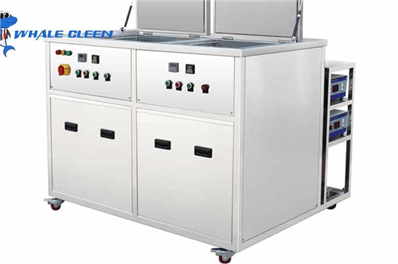
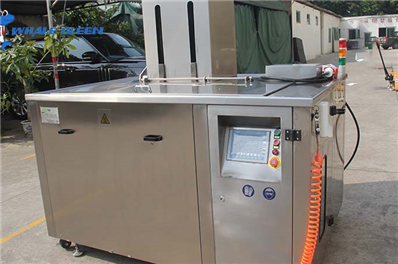
Whale Cleen has been designing and manufacturing ultrasonic cleaning equipment for over 20 years, with a 10,000-square-meter production base and full-cycle capabilities covering R&D, manufacturing, sales, and after-sales service. The company specializes in industrial-grade automatic ultrasonic cleaning machines, custom ultrasonic systems, and large multi-tank cleaning lines.
For FPC cleaning applications, Whale Cleen offers several capabilities that matter to electronics manufacturers.
Non-Standard Customization for Real Production Conditions. Whale Cleen does not sell rigid, one-size-fits-all machines. Every system is purpose-built for the specific workpiece dimensions, contamination profile, throughput requirements, and physical space constraints of the customer‘s factory. Tank dimensions, ultrasonic parameters, transducer layout, and process integration—heating, filtration, rinsing, drying—are all tailored to the application. For FPCs, this means cleaning baskets designed to hold flexible boards without overlapping, and tank configurations that match the board sizes and production volumes.
Frequency Flexibility for Delicate Substrates. Different contaminants respond to different ultrasonic frequencies. Lower frequencies (around 28 kHz) generate larger, more energetic bubbles suitable for heavy oils and stubborn flux residues. Higher frequencies produce smaller, gentler bubbles that clean without risking damage to delicate substrates. Whale Cleen systems can be configured with the frequency range that matches both the contaminant type and the sensitivity of the FPC material.
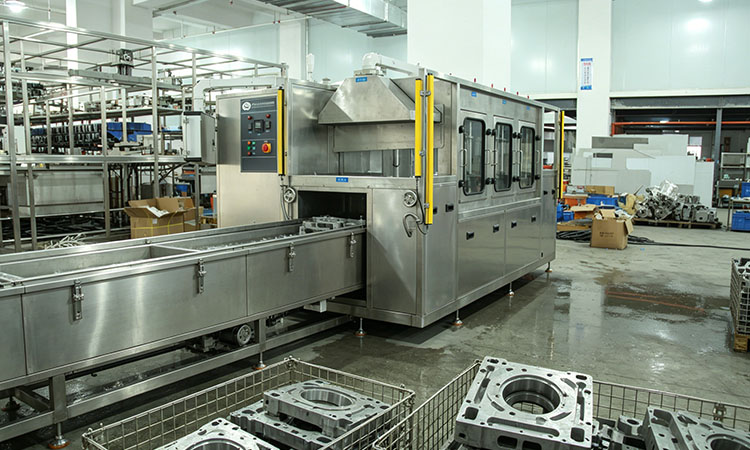
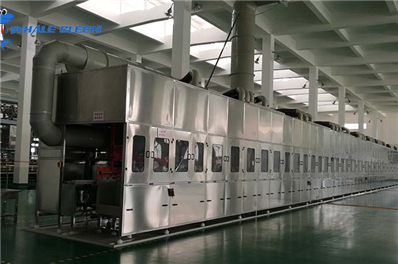
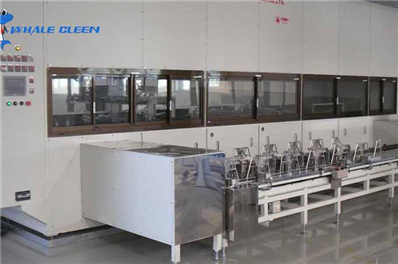
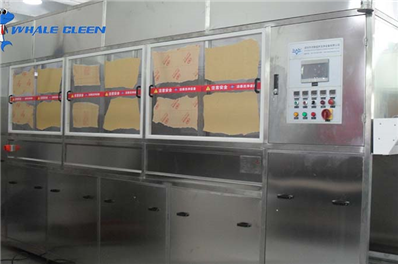
Automated Multi-Tank Systems for High-Volume Production. For manufacturers running FPCs at scale, Whale Cleen supplies fully automated cleaning lines that integrate multiple stages—ultrasonic cleaning, rinsing, and drying—with automated board transfer between tanks. This eliminates manual handling between stages, reducing the risk of mechanical damage and ensuring consistent processing.
PCB and Electronics Focus. Whale Cleen‘s industrial systems are designed for electronics manufacturing applications, including PCB and FPC cleaning. The company understands the specific requirements of electronics production—removing flux residues without damaging components, achieving ionic cleanliness standards, and processing boards at the pace of SMT lines.
For an FPC production line, the shift from manual wiping to ultrasonic cleaning is not merely a change in equipment—it is a change in what is possible.
Manual cleaning limits throughput, introduces damage risk, and produces inconsistent results. Ultrasonic cleaning eliminates physical contact, reaches every surface, and delivers repeatable cleanliness batch after batch. The cleaning step, once a bottleneck that constrained production and eroded yields, becomes a reliable, automated stage that supports high-volume manufacturing rather than holding it back.
For FPC manufacturers struggling with creased boards, scratched traces, and inconsistent cleanliness, ultrasonic cleaning offers a proven path forward—one that protects the delicate circuits while enabling the scale that modern electronics production demands.