In high‑volume metal stamping production, cleaning is a process that is often underestimated—until it becomes the bottleneck. Stamped parts emerge from the press coated with heavy stamping oil, microscopic metal fines, and occasionally coolant residues. Left on the surface, these contaminants can cause adhesion failure in subsequent plating or painting, accelerate corrosion, and lead to customer rejections. Worse, when parts have small seams, narrow grooves, deep holes, or blind holes, traditional cleaning methods simply cannot reach the hidden contaminants.
Manual wiping can scratch delicate surfaces. Spray washing leaves dead zones inside geometry. Immersion soaking does not physically dislodge embedded particles. The result is a costly cycle of rework, increased chemical consumption, and fluctuating quality.
Ultrasonic cleaning solves these problems fundamentally. By using high‑frequency sound waves to create microscopic cavitation bubbles that implode with intense energy, it reaches every surface that the cleaning liquid touches—including blind holes, thread roots, and tight internal passages. However, not all ultrasonic systems are equally effective for stamped metal parts. Choosing the right equipment requires understanding several key selection parameters.
Stamped metal parts have three characteristics that make thorough cleaning challenging.
Heavy, tenacious oil films. During the stamping process, large volumes of press oil, drawing lubricants, and rust preventives are applied to the metal strip to reduce friction and extend die life. These oils are formulated to adhere strongly to the metal surface, and after forming, they are often trapped in the micro‑texture of the stamping marks, making them difficult to remove with simple rinsing. In many stamping operations, the press oil mixes with fine metal particles generated by die wear, creating a paste‑like sludge that firmly clogs small features.
Tight geometries with microscopic crevices. Stamped components often contain fine features such as slots, small radii, embossed patterns, and shallow dimples. Even a simple flat stamped part can have micro‑burrs along the sheared edge that trap contaminants. After plating or coating, those trapped contaminants can bleed out and cause visible surface defects.
Mixed, persistent contaminants. The residue on a stamped part is rarely a single substance. It typically consists of press oil, metal fines, handling oils from operators, and sometimes airborne shop dust. Each type of contaminant may require different cleaning parameters for optimal removal. Some contaminants are chemically bound, while others are mechanically embedded. An ultrasonic cleaning system that cannot be tuned to handle this mixture will leave some fraction behind.
Ultrasonic cleaning works through cavitation. An ultrasonic generator converts electrical energy into high‑frequency mechanical vibrations, which are transmitted into a cleaning solution. These vibrations create millions of microscopic bubbles that rapidly form, grow, and implode. At the moment of implosion, each bubble releases a powerful shock wave and a high‑speed micro‑jet that physically dislodges contaminants from every wetted surface.
Unlike spray washing, which requires line‑of‑sight impact, cavitation is omnidirectional. As long as the cleaning solution can reach a blind hole, a threaded root, or a narrow slot, the imploding bubbles will clean it. The mechanical scrubbing action comes from the cavitation itself—not from aggressive chemistry or abrasive contact—so the part surface remains undamaged.
For stamped metal parts, ultrasonic cleaning offers several critical advantages:
Complete coverage – Every surface, including internal features and tight crevices, is cleaned uniformly.
No mechanical damage – There is no physical contact that could scratch polished or coated surfaces.
Consistent batch results – All parts in the tank receive the same cavitation energy, eliminating operator variability.
Reduced chemical dependency – Because the mechanical cleaning action is so effective, milder cleaning agents can be used, lowering consumable costs and environmental impact.
Frequency is the single most important selection parameter for stamped metal parts. It directly determines the size and energy of the cavitation bubbles, and therefore the cleaning aggressiveness versus surface protection.
Low frequencies (25–40 kHz) generate large, energetic cavitation bubbles. These are highly effective at removing heavy stamping oil, thick rust layers, and large metal particles. According to industry guidelines, for metal stamping and hardware components, 28–40 kHz is the recommended frequency range. However, the high energy of low frequencies can damage precision parts or sensitive plated surfaces if used for extended periods.
Mid‑high frequencies (40–80 kHz) produce smaller, less energetic bubbles. This range is suitable for general stamped parts that do not have extremely fine features or delicate coatings. It offers a balance between cleaning power and surface safety. In precision cleaning applications, frequencies around 75 kHz are often used for parts that require more gentle treatment than what 28–40 kHz can provide.
High frequencies (80–120 kHz) generate very small, gentle bubbles that remove fine particles and thin oil films without any risk of cavitation erosion. These frequencies are appropriate for stamped parts with polished surfaces, thin walls, or pre‑applied coatings that must be preserved.
The right frequency depends on the specific part. For a heavy‑duty stamped bracket that will later be painted, a low frequency is suitable. For a stamped electronic shielding can with a nickel plating that must remain intact, a higher frequency is necessary.
Total power (watts) is less important than power density—the amount of ultrasonic energy per liter of cleaning solution. Power density is typically expressed as watts per liter (W/L) or watts per square centimeter (W/cm²). A common rule of thumb for industrial stamped parts is to target a power density of at least 0.3 W/cm² to ensure sufficient cavitation intensity, but the exact value depends on soil type and part geometry.
For light surface oil on simple flat stampings, 15–25 W/L may be sufficient. For deeply contaminated stamped parts with blind holes or narrow crevices, 40–60 W/L is often needed to generate enough cavitation energy to reach into those features.
Excessive power density can be just as problematic as insufficient power. Too much cavitation energy can erode soft metal surfaces (aluminum, brass, copper), cause pitting on polished surfaces, or generate excess heat that raises the bath temperature beyond the optimal range. Power density should be matched to the specific part material, geometry, and contamination level.
For high‑volume stamping operations that run batch after batch, filtration is not an accessory—it is an essential feature. As ultrasonic cleaning removes contaminants from parts, those contaminants become suspended in the cleaning solution. Without effective filtration, the removed oil and particles simply re‑deposit onto later parts in the same batch, progressively worsening cleanliness over time.
A properly designed multi‑stage filtration system continuously removes suspended particles, oils, and other contaminants from the cleaning bath. This extends bath life, reduces chemical consumption, and—most importantly—ensures that the first part cleaned in a batch is as clean as the last part. For stamping facilities processing thousands of parts per shift, this batch‑to‑batch consistency translates directly into lower rework rates and higher throughput.
Heat is a powerful ally in removing stamping oils. Raising the cleaning solution temperature lowers the viscosity of the oil, making it easier for cavitation to break the oil‑metal bond. The optimal temperature range for most stamping oils is 50–70°C (122–158°F). At these temperatures, even heavy drawing compounds soften significantly, allowing the ultrasonic action to strip them away completely.
However, temperature must be controlled precisely. Overheating can cause thermal damage to sensitive parts or accelerate the degradation of some cleaning solutions. An accurate, adjustable heating system with over‑temperature protection is essential for stamping applications where part sensitivity varies.
A common weakness of many ultrasonic cleaners is uneven energy distribution. Transducers mounted only on the bottom of the tank create areas of high cavitation intensity directly above them and weak zones elsewhere, particularly in the corners of the tank or in the upper regions of deep cleaning baskets. These “dead zones” lead to inconsistent cleaning: some parts come out perfectly clean, while others, positioned in the weaker acoustic field, remain contaminated.
For stamping parts that may be loaded in bulk baskets or have complex shapes, uniform cavitation across the entire tank volume is essential. Acoustic engineering techniques—such as sweep frequency technology and optimized transducer placement—can eliminate dead zones and ensure that every part, regardless of its position in the tank, receives the same cleaning intensity.
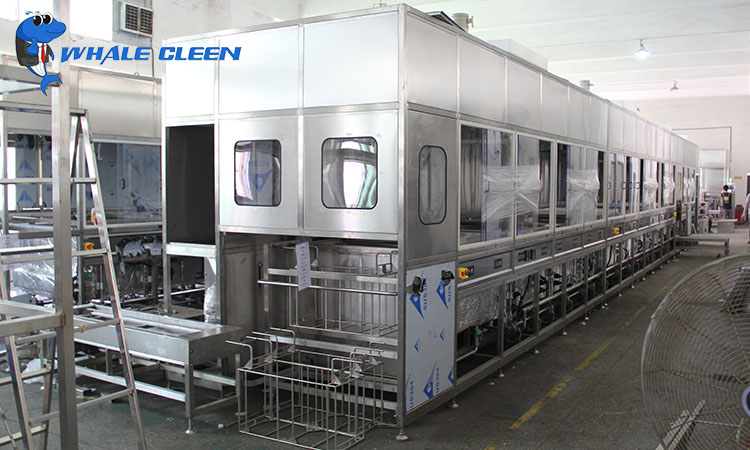
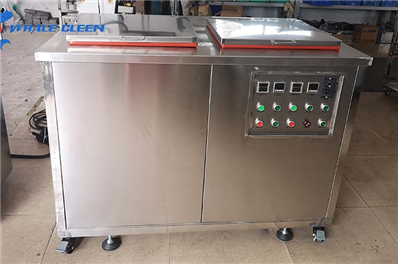
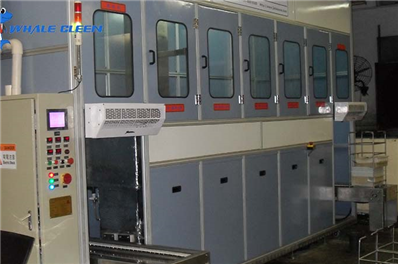
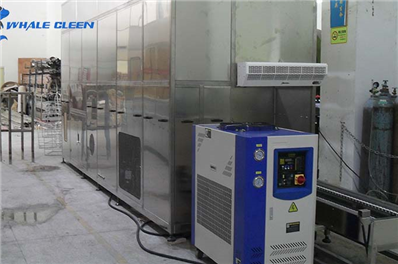
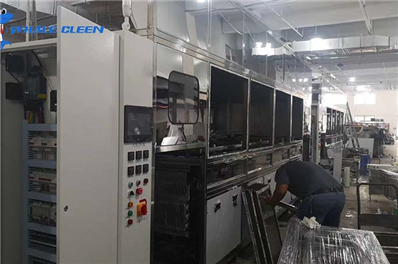
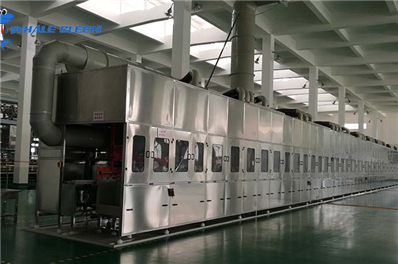
Whale Cleen has been designing and manufacturing industrial ultrasonic cleaning systems for over 20 years. With a focus on non‑standard, custom‑engineered solutions, the company has developed specific advantages for metal stamping and hardware component cleaning. Whale Cleen cleaning solutions directly target small seams, narrow grooves, deep holes, blind holes, and other dead corners—precisely the geometries where stamped parts trap contaminants.
Multi‑frequency technology for mixed contaminants. Whale Cleen systems feature advanced multi‑frequency capabilities, allowing operators to select or sweep through frequencies to optimize cavitation penetration. Lower frequencies deliver powerful scrubbing for heavy stamping oils and embedded metal fines; higher frequencies reach the smallest micro‑features without damaging precision surfaces. The result is that every stamped part emerges perfectly clean, regardless of soil type or part geometry. For parts with blind holes and internal passages that challenge other cleaning methods, ultrasonic cleaning with properly selected frequencies provides the required thoroughness.
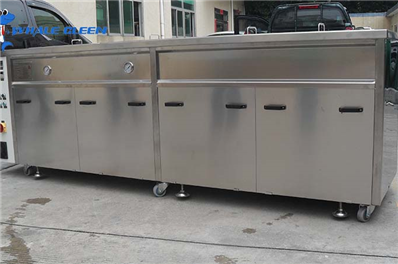
Heavy‑duty industrial construction. Stamping operations run continuously. Whale Cleen systems feature welded high‑Q transducers (not lower‑reliability glued alternatives), industrial‑grade generators with auto‑frequency tracking, and thick stainless steel tanks designed for years of 24/7 operation. This construction translates directly into less downtime and lower maintenance costs.
Integrated multi‑stage filtration for chemical savings. One of the largest operational expenses in stamping cleaning is chemical consumption. Whale Cleen systems incorporate high‑efficiency filtration that continuously removes suspended soils, particulates, and oils from the cleaning solution. The result: cleaning baths last up to 10 times longer between changes, chemical purchases are reduced proportionally, and hazardous waste disposal costs drop significantly. By preventing cross‑contamination, the primary cleaning bath maintains its effectiveness far longer than single‑tank systems.
Custom tank sizing and acoustic optimization. Whale Cleen offers fully custom tank dimensions based on the specific stamped part sizes and batch volumes of each customer. Acoustic simulation ensures that transducers are placed optimally—not just on the bottom, but also on the sides where needed—to eliminate dead zones. For stamping parts with deep drawn features or narrow channels, this acoustic design ensures that every surface receives uniform cavitation.
Sample‑tested engineering before quoting. Whale Cleen refuses to spec equipment based only on catalogs. Before any machine is designed, they require customers to send actual stamped parts for laboratory validation. Their technicians analyze contamination types, run cleaning trials at different frequency and power settings, and determine the optimal process parameters. Only then do they provide a formal proposal. This sample‑first approach eliminates the risk of buying equipment that looks good on paper but fails on real stamped parts.
| Selection Factor | What to Look For | Why It Matters |
|---|---|---|
| Frequency range | 28–40 kHz for heavy stamping oil; 40–80 kHz for general use; 80–120 kHz for precision coated parts | Matches cavitation energy to soil type and part sensitivity |
| Frequency flexibility | Multi‑frequency or switchable capability | Allows tuning for different oil levels and part materials |
| Power density | 15–25 W/L for light soils; 40–60 W/L for heavy contamination and blind holes | Provides sufficient cavitation intensity without risking surface damage |
| Filtration system | Multi‑stage circulation filtration with oil separation | Extends bath life 10×; prevents re‑deposition; ensures batch consistency |
| Temperature control | Adjustable heating (50–70°C range) with over‑temp protection | Softens stamping oils for more efficient removal |
| Acoustic uniformity | Sweep frequency technology; optimized transducer placement | Eliminates dead zones; ensures uniform cleaning across the entire tank |
| Tank size | Customizable to stamped part dimensions and batch volume | Maximizes throughput without wasted chemistry |
| Construction | Welded transducers, stainless steel tank, industrial generator | Long‑term reliability in continuous operation |
| Sample testing | Manufacturer tests your actual parts before quoting | Validates performance before investment |
| ❌ Mistake | ✅ Correct Approach |
|---|---|
| Selecting fixed‑frequency machines | Choose multi‑frequency or switchable systems to handle different soil types |
| Focusing only on total power | Pay attention to power density (W/L) and how it is distributed across the tank |
| Ignoring filtration | Always include multi‑stage filtration; it directly affects batch consistency and chemical costs |
| Skipping temperature control | For stamping oils, controlled heating (50–70°C) is essential for efficient removal |
| Buying standard tank sizes | Stamped parts vary widely; custom tank sizing ensures full immersion and uniform cleaning |
| No sample test before purchase | Demand a sample test on your actual parts; a credible manufacturer will provide one |
For manufacturers of precision metal stamping parts, cleaning is not a secondary process—it directly determines coating adhesion, corrosion resistance, and customer acceptance. The contaminants that hide in micro‑crevices, narrow slots, and blind holes cannot be removed reliably by manual wiping or spray washing. Ultrasonic cleaning, when implemented with the correct technical parameters—frequency, power density, filtration, temperature control, and acoustic uniformity—delivers consistent, damage‑free results that traditional methods cannot match.
Whale Cleen brings over two decades of ultrasonic engineering experience, multi‑frequency technology, robust filtration, custom tank design, and a sample‑tested validation process to stamping operations worldwide. If your cleaning line is still struggling with rework, high chemical consumption, or inconsistent results from stamped parts, it is time to evaluate a system engineered specifically for the challenges of metal stamping.
Contact Whale Cleen, send your most difficult stamped parts for a sample test, and let real‑world results demonstrate the difference that properly engineered ultrasonic cleaning can make.