For metal finishing shops and precision component manufacturers, few quality failures are as financially devastating as plating rejection caused by inadequate pre-cleaning.
The scenario is painfully familiar. A batch of precision-machined components—hydraulic valve bodies, transmission housings, or complex structural parts—leaves the machining center with deep grooves, blind holes, and internal cavities packed with cutting oil sludge. The parts move to the electroplating line. The plating bath is prepared. The components are immersed. And when they emerge, the plating peels, blisters, or fails to adhere entirely.
The result? A full batch rejection. Returned goods. Chargebacks. Angry customers. And a profit margin that evaporates with every rejected shipment.
For many manufacturers, this is not a rare occurrence—it is a recurring crisis that eats away at profitability and threatens long-term viability.
The root cause of plating adhesion failure is almost always the same: residual contamination trapped in the deep, inaccessible features of the workpiece.
Cutting oil sludge is uniquely tenacious. During machining, cutting oil mixes with fine metal particles, abrasive dust, and microscopic chips to form a thick, adhesive sludge. This sludge is not merely a surface film—it is a compacted, bonded contaminant that fills every microscopic crevice and adheres tenaciously to metal surfaces.
Deep grooves and blind holes are cleaning "dead zones." Spray cleaning cannot reach the bottom of a deep groove or the interior of a blind hole. The spray jet simply cannot bend around corners or penetrate narrow openings. Manual cleaning with brushes or rags is equally ineffective—brushes cannot reach the bottom of a deep cavity, and rags cannot navigate complex internal geometries.
Solvent soaking alone is insufficient. While chemical soaking can soften and partially dissolve oil sludge, it cannot provide the mechanical energy needed to dislodge compacted contaminants from deep cavities. The sludge may soften, but it remains trapped in the depths of the workpiece, waiting to ruin the plating process.
The result is a hidden contamination that only reveals itself during plating—when the plating fails to bond, and the entire batch is condemned.
Ultrasonic cleaning operates on a fundamentally different principle: cavitation. High-frequency sound waves transmitted through a cleaning solution generate millions of microscopic vacuum bubbles that grow, oscillate, and implode with tremendous energy. These implosions create intense micro-jets and localized shock waves that penetrate every surface the liquid can reach—including the deepest grooves, narrowest blind holes, and most complex internal cavities.
The advantages for plating preparation are transformative:
Complete penetration into deep internal features. Cavitation bubbles can flow into any space the liquid can reach—including sub-millimeter blind holes, deep grooves, cross-drilled passages, and complex internal cavities. When these bubbles implode inside these confined spaces, they generate enough energy to shatter and dislodge compacted cutting oil sludge that no spray or brush could ever reach.
Thorough removal of oil, sludge, and oxides. Ultrasonic cleaning effectively removes oil, sludge, rust, and oxides from part surfaces, reaching sub-micron particles that traditional methods miss. Every internal surface receives the same intense, uniform cleaning action—ensuring that no hidden contamination remains to compromise plating adhesion.
Non-abrasive and part-safe. Unlike mechanical scrubbing that can scratch or deform surfaces, ultrasonic cleaning preserves dimensional accuracy and surface finish. This is particularly critical for high-precision components where even micron-level damage can affect product quality.
Consistent, repeatable cleanliness. Ultrasonic cleaning eliminates the human variables and process inconsistencies that plague manual and spray cleaning. Every workpiece, every batch, every shift—identically clean and ready for plating.
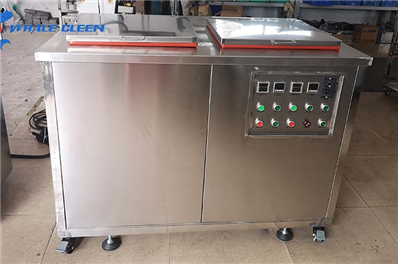
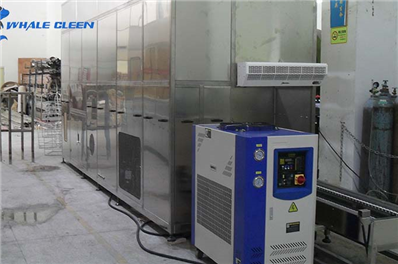
For manufacturers whose profits are being crushed by plating rejection and return charges, Whale Cleen (http://www.bwhalesonic.com/) delivers a proven solution. Since 2003, Whale Cleen has focused on providing professional cleaning solutions and various types of ultrasonic cleaners, establishing itself as a high-tech enterprise integrating R&D, manufacturing, marketing, and after-sales service. Today, the company operates a 10,000-square-meter production base, designing and producing automatic ultrasonic cleaning machines, custom ultrasonic cleaning machines, and large industrial ultrasonic cleaning systems.
1. Fully Automated Cleaning Lines That Eliminate Human Error
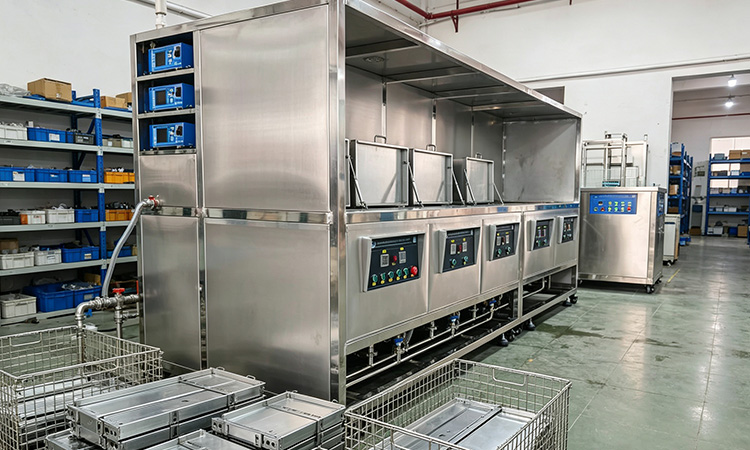
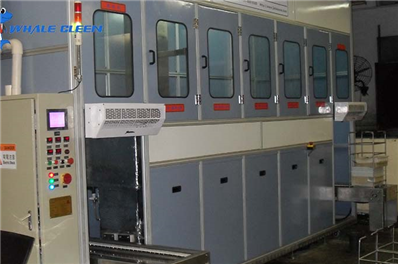
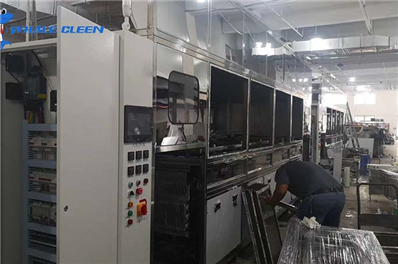
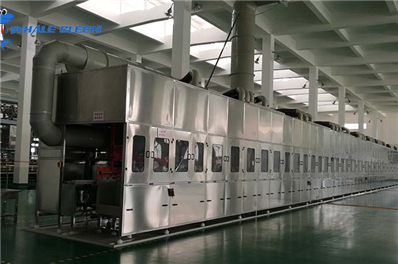
Whale Cleen's mechanical arm-type automatic ultrasonic cleaners integrate six core systems: mechanical transmission, ultrasonic system, heating system, drying system, water supply and drainage, and electrical control. The entire process—from loading parts into the cleaning tank, to moving between tanks, to final unloading—is completed automatically. Parts enter the system dirty and exit clean and dry, ready for plating—without manual handling, without skipped steps, and without the risk of recontamination.
2. Non-Standard Customization for Real-World Conditions
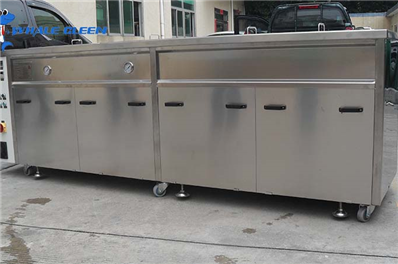
No two manufacturing operations are identical. Workpiece sizes vary. Contamination profiles differ. Production line layouts are unique. Whale Cleen does not offer one-size-fits-all solutions. Instead, every system begins with an engineering consultation to understand the specific part geometry, contaminant type, and production volume. The equipment is then engineered to match the exact application—whether it is cleaning heavy castings with deep internal cavities or precision components with fine blind holes.
3. Multi-Stage Integration That Ensures Complete Cleanliness
Whale Cleen's automated systems are not just ultrasonic tanks—they are complete cleaning lines. Pre-wash removes bulk soil. Ultrasonic stages deliver precision cleaning that penetrates every deep groove and internal cavity. Multi-stage rinsing removes residual chemistry. Hot air or vacuum drying delivers spot-free results. Parts emerge with every trace of cutting oil sludge removed—and plating adhesion that passes inspection every time.
4. Acid-Free Cleaning That Protects Part Quality and Reduces Costs
Many factories have relied on strong acid soaking for degreasing and rust removal—but at significant hidden cost: chemical expenses, hazardous waste disposal, worker safety risks, and metallurgical damage such as hydrogen embrittlement in high-strength steel components. Whale Cleen's ultrasonic technology replaces chemical aggression with mechanical precision. The cavitation process removes grease, sludge, and oxides without exposing parts to harsh acids—delivering cleaner parts, lower chemical costs, safer working conditions, and reduced scrap.
5. Filter Circulation for Extended Bath Life and Consistent Results
Whale Cleen systems feature continuous filter circulation that removes oil slicks, impurities, and suspended particles from the cleaning solution. The result is longer bath life, lower solvent consumption, and consistent cleaning effectiveness across every batch—ensuring that every part that reaches the plating line is perfectly clean.
Consider a typical scenario: a precision machining shop produces 1,000 complex valve bodies per week. Each valve body features deep internal cavities and blind holes that are impossible to clean with spray or manual methods. Cutting oil sludge accumulates in these cavities during machining. The parts go to the plating line—and 15% fail adhesion testing. That is 150 rejected parts per week, each representing lost material, lost labor, lost plating cost, and the crushing expense of returned goods and customer chargebacks.
With a Whale Cleen automated ultrasonic cleaning system, the same 1,000 valve bodies are processed through a complete cleaning line—ultrasonic cleaning, rinsing, and drying—in a single automated cycle. Every deep cavity, every blind hole, every internal passage is thoroughly cleaned. Plating adhesion passes inspection at 99.5% or higher. Rejection rates plummet. Return charges disappear. And the profit margin that was being crushed by quality failures is restored.
In metal finishing and precision manufacturing, plating adhesion is not a matter of luck—it is a matter of cleanliness. And cleanliness, for components with deep grooves, blind holes, and internal cavities, is a matter of ultrasonic cleaning.
Spray cleaning cannot reach deep internal features. Manual cleaning cannot remove compacted sludge from blind holes. Solvent soaking alone cannot provide the mechanical energy needed to dislodge trapped contaminants. Only ultrasonic cleaning—with its unique ability to penetrate every surface the liquid can reach—can deliver the complete, consistent cleanliness that plating demands.
Whale Cleen brings over two decades of expertise, fully automated solutions, non-standard customization, and a commitment to acid-free precision cleaning to this challenge. Their ultrasonic cleaning systems are not just equipment; they are a strategic investment in product quality, operational efficiency, and long-term profitability.
To learn how Whale Cleen can eliminate plating failures and protect your profit margin—visit http://www.bwhalesonic.com/ .