For blind hole cleaning, degreasing and oxide removal should be separated into two sequential stages in electroplating pretreatment. Each stage needs ultrasonic infiltration and liquid degassing. Residual fluid trapped inside blind holes must be fully displaced during rinsing cycles.
This core logic defines process and equipment priorities. Blind holes usually measure 0.3–3 mm in diameter, with depth up to 5–10 times the hole diameter. Air is trapped inside cavities at first, and cleaning fluid can only penetrate via capillary action plus external pressure. Once fluid enters, the inner hole becomes a stagnant zone; simple diffusion cannot replace oil-laden or acid-laden liquid. Common electroplating failures including blistering, skip plating, poor adhesion and whitening around blind holes mostly originate from this issue instead of the plating tank itself.
Failures usually happen at three stages. First, trapped air blocks fluid contact: cleaning solution only reaches the hole opening, leaving the mid-wall and bottom untouched. Degreaser and activation acid will not work at all. Second, trapped residual fluid leaks into subsequent tanks. If rinsing fails to displace cavity liquid, residual alkali or acid slowly bleeds out and triggers plating blistering and corrosion. Third, incomplete oxide removal: oxide layers on inner blind hole surfaces are thicker and harder for acid to reach. Activation insufficiency only lets coating attach loosely on oxide films, leading to weak adhesion.
Corresponding process countermeasures are clear: use infiltration and degassing to deliver liquid into holes first, then use cavitation to strip oil films and oxide layers at interfaces, and finally replace trapped residues via multi-stage rinsing.The success of blind hole electroplating pretreatment depends on whether cleaning fluid truly reaches the cavity interior, rather than detergent concentration or ultrasonic power.
| Process | Purpose | Typical Parameters | Ultrasonic Function | Blind Hole Risk |
|---|---|---|---|---|
| Pre-soaking & degassing | Displace trapped air and form liquid path | 40–50 ℃, 1–2 min; optional vacuum -0.06 ~ -0.09 MPa | Assist infiltration and degassing | Poor degassing invalidates all downstream steps |
| Alkaline degreasing | Remove organic oil and polishing paste | 50–60 ℃, pH 9–11 (≤10 for aluminum), 5–10 min | Cavitation stripping of oil films | Residual oil leads to skip plating and blistering |
| Rinse 1 | Remove alkali and emulsified oil | Ambient, 1–2 min, overflow design | Assist fluid displacement | Carry-over alkali neutralizes acid in activation tank |
| Acid pickling / activation | Remove oxide film and expose base metal | 5–10% acid, ambient – 40 ℃, 3–8 min | Accelerate reaction; lower acid concentration and immersion time | Unremoved inner oxide causes poor coating adhesion |
| Fine rinse (Rinse 2) | Displace residual acid | Ambient, 1–2 min, final conductivity ≤5 μS/cm | Assist fluid displacement | Bleeding residual acid causes blistering and whitening |
| Drying & transfer to plating | Eliminate water and prevent re-oxidation | 60–80 ℃ or filtered clean air | — | Long waiting time before plating triggers re-oxidation |
The values below are engineering references. Final parameters shall be confirmed and locked by sample testing and coating adhesion verification.
| Frequency | Cavitation Feature | Suitable Workpieces | Reference Power Density | Temperature | Duration |
|---|---|---|---|---|---|
| 28 kHz | Large cavitation bubbles, strong impact | Heavy oil, polishing paste, contaminants at hole openings | 20–25 W/L | 50–60 ℃ | 5–10 min |
| 40 kHz | Balanced impact and penetration | General blind hole degreasing and acid activation assistance | 10–15 W/L | 50–60 ℃ | 5–10 min |
| 68 kHz | Fine bubbles, good penetration | Microholes, precision surfaces and thin-wall components | 8–12 W/L (transducer surface 0.3–0.5 W/cm²) | 45–55 ℃ | 8–15 min |
Reference inner tank size: 600×400×450 mm, effective liquid volume approx. 90 L. Degreasing power at 12 W/L equals ~1.1 kW; acid activation auxiliary power at 10 W/L equals ~0.9 kW. A typical automatic six-tank line includes pre-soaking, degreasing, rinse 1, acid activation, rinse 2 and drying. Basket size: 400×300×200 mm, cycle time 12–18 min per basket, equivalent to 3–5 baskets per hour.If cycle capacity is insufficient, add parallel tanks instead of shortening pre-degassing and fine rinsing. These two steps control liquid penetration and residue drainage; compression will make pretreatment invalid.
Q1: Can ultrasound reach the bottom of blind holes?It works reliably for holes above 0.3 mm after full degassing and infiltration. Finer holes require vacuum assistance and results need on-site testing.
Q2: Can degreasing and oxide removal be completed in one single step?No. Oil films block acid contact with oxide layers. Degreasing must come before acid activation; reversed sequence greatly reduces coating adhesion.
Q3: Will ultrasonic acid cleaning cause over-etching?Control conditions with low acid concentration, short immersion time and matched frequency. Aluminum and high-strength steel need separate validation to avoid corrosion and hydrogen embrittlement.
Q4: Is plating blistering caused by cleaning or plating issues?Check pretreatment first. Residual oil and trapped acid in blind holes are top causes. Use endoscope and adhesion tests to locate failure points.
Q5: How to confirm blind hole degreasing quality?Three criteria must pass together: continuous water film, no oil traces observed by endoscope, and qualified post-plating adhesion test.
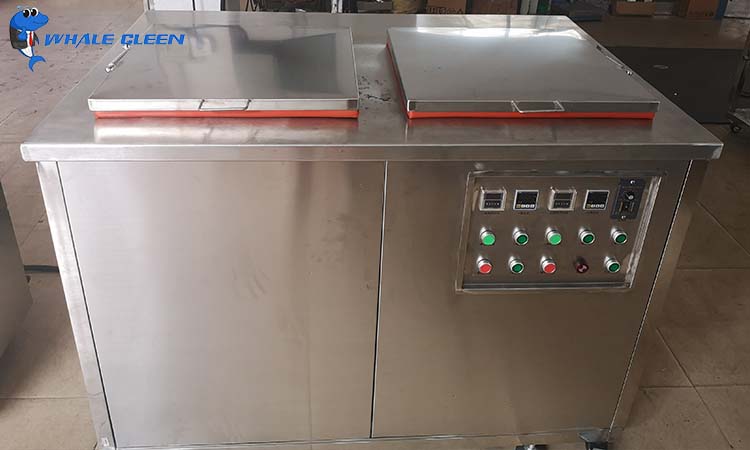
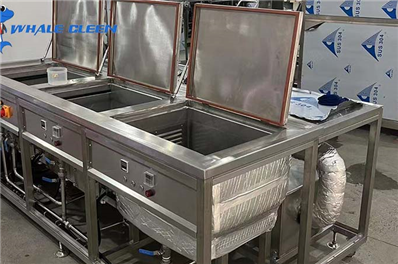
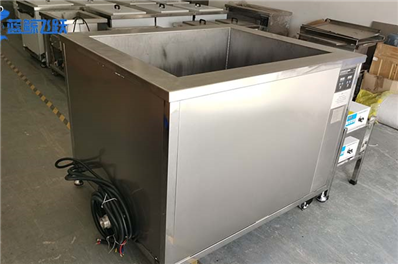
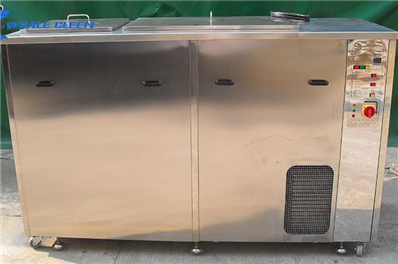
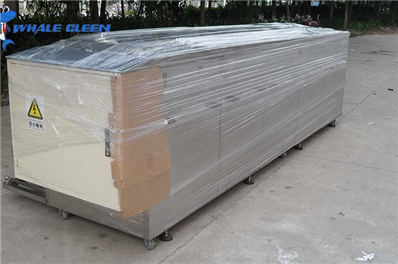
Whale cleen supplies single-tank, multi-tank and fully automatic ultrasonic cleaning lines integrating pre-soaking (vacuum degassing optional), degreasing, rinsing, acid activation, fine rinsing and drying. Tank bodies and wetted parts are 316L or PP according to chemical media. Acid tanks are equipped with independent exhaust and acid mist treatment.
Automatic lines use gantry or robotic transfer systems. PLC recipe libraries store frequency, power density, temperature, duration and rinsing stages for different parts, and record bath temperature, liquid level and final rinse conductivity.
Customization depends on four inputs: part drawing and blind hole dimensions, oil and oxide severity, plating type and adhesion acceptance criteria, target cycle time and site constraints. Engineers define tank quantity and sequence, frequency combination (28/40 kHz or 40/68 kHz), vacuum degassing and ultrasonic acid activation configuration, rinsing stages, water quality control and fixture design.
Delivery workflow: sample cleaning test with degreasing and adhesion verification data → cycle calculation and proposal → factory acceptance test → on-site installation and parameter reproduction → operation and maintenance training → spare parts and periodic service. If your blind-hole parts repeatedly suffer skip plating and blistering, send drawings, hole dimensions, contamination type and acceptance standards for sample testing. Endoscope and adhesion test data will confirm whether vacuum degassing and ultrasonic acid activation are required before equipment quotation.
Note: Reference values including final rinse conductivity ≤5 μS/cm (≤1 μS/cm for high-spec parts), frequency grouping and transducer surface power 0.3–0.5 W/cm² are sourced from public industrial process documents. Power density W/L is defined as ultrasonic power divided by effective tank liquid volume. Acid concentration, vacuum level, cycle time and hole accessibility are empirical engineering ranges. All parameters must be locked by sample testing and adhesion tests and do not guarantee plating quality for specific workpieces.