The cost of failed pretreatment is not paid at the pretreatment station but at stripping and re-plating: oil or oxide residue survives all the way into the deposit and only then appears as blistering, skip plating or poor adhesion, and rework costs several times what pretreatment does. There is one shop-floor criterion — water-film continuity.
That check costs almost nothing and predicts adhesion better than most instruments. A continuous water film held for at least 30 seconds is the gate to activation and plating; where the film breaks is where oil remains. Making this a per-load check turns rework from a matter of luck into a controllable variable. The conclusion that keeps coming back from field troubleshooting is the same everywhere: the plating bath is rarely the primary cause of adhesion failure — most defects were already decided in pretreatment and rinsing.
Because pretreatment defects are invisible while they are happening. A part coming out of the degreaser looks clean even with a molecular-thin oil film; a part out of the acid looks bright even with local oxide left behind. None of this affects appearance, but during deposition it becomes a physical barrier: where oil remains, the electrolyte never touches the substrate, metal ions do not reduce, and you get skip plating or a point with almost no bond strength. Where oxide remains, ion and electron transfer is impeded, producing haze and pitting.
The delay makes it worse. A part plated over residual oil or a passive film may pass inspection on the day and blister or peel 24 to 72 hours later — by then it is in assembly or on its way to the customer, and stripping, re-plating, re-inspection and re-scheduling all stack up. A pretreatment defect does not scrap the part on the spot; it scraps it late — and that is exactly how it breaks a delivery cycle.
| Post-plating symptom | Pretreatment cause | Typical trigger | Where to look |
|---|---|---|---|
| Local skip plating, bare spots | Oil film left; electrolyte never contacts substrate | Degreaser temperature low, time short, load too dense | Degreaser temperature/time, part spacing |
| Blisters, peeling (delayed 24–72 h) | Thin oil film or polishing compound residue | Saturated degreaser, ultrasonics not reaching blind holes | Bath oil load, frequency and coverage |
| Haze, cloudiness, poor brightness | Oxide or passive film not removed | Acid too weak, activation too short | Acid concentration, time, iron content |
| Pitting, pinholes | Solid particles or detached debris re-depositing | Insufficient filtration, poor rinse water | Filter rating, final rinse quality |
| Uniformly low adhesion (bend/thermal shock fail) | Cumulative, including residual alkali or acid | Too few rinse stages, pH not neutralised | Rinse stages, surface pH |
| No deposit at edges or rack contact points | Rack shielding, shadowing | Rack design, shield placement | Rack angle and shielding |
| Etch marks, grey surface on zinc alloy | Over-cleaning or over-activation | Excess temperature or time | Alkali pH ceiling, activation time |
Not by eye and not by experience, but with a procedure that can be written into a work instruction. The international frame is ASTM B322, Standard Guide for Cleaning Metals Prior to Electroplating, and its most common shop-floor criterion is the water-break test, observed after a specified drainage time of about 30 seconds.
A few points get missed in practice. First, samples must include recesses and blind holes, because the film breaks there first. Second, “is it shiny” means nothing — a polished part with a thin oil film is still shiny. Third, and most easily overlooked: surfactants can make a surface look wettable temporarily, so the stricter method is to dip in dilute acid, rinse again, and see whether beading returns. Fourth, hard water in the final rinse leaves a continuous but chalky film that passes visually and fails adhesion.
| Check item | Pass criterion | Action on failure |
|---|---|---|
| Water-film continuity | Continuous film ≥30 s without breaking | Return to degreasing; do not enter activation |
| Sample size | 5 parts per load, including recesses, blind holes, rack contact faces | Expand sampling, trace the batch |
| Surface pH after rinse | 6.5–8.0, no alkali drag-out | Add rinse stage or neutralise |
| Final rinse quality | DI water, conductivity <10 μS/cm | Check DI system and overflow |
| Surface condition | No visible oil, water marks, rust spots or white powder | Classify as oil, oxide or scale problem |
| Interval to plating | Wet-to-wet transfer, into the tank within 30 s | Holding dry re-oxidises; redo activation |
| Records | Per-load result and disposition logged | Enables trend analysis by defect type |
The following values are equipment-side reference ranges. Actual settings are determined by the user according to substrate, soil type, chemistry data sheets and process validation; the equipment does not replace validation of the chemical system or plating results.
| Stage | Frequency / current | Power or current density | Temperature | Time | Control point |
|---|---|---|---|---|---|
| Pre-degrease | — (soak/spray) | — | 55–65 °C | 3–8 min | Reduce main-bath load |
| Ultrasonic degrease (general) | 40 kHz | 15–25 W/L | 55–65 °C | 3–5 min | Load ≤70%, spacing ≥20 mm |
| Ultrasonic degrease (heavy wax) | 28 kHz | 25–30 W/L (up to 60 W/L) | 60–75 °C | 8–12 min | Wax load control, filtration |
| Ultrasonic degrease (precision/thin-wall) | 68 kHz | 12–20 W/L | 50–60 °C | 3–5 min | Avoid over-etch and distortion |
| Electroclean | — | 2–4 A/dm² | 50–65 °C | 1–3 min | No cathodic cleaning on embrittlement-sensitive parts |
| Pickle | — | — | Room temp (higher for thick scale) | 0.5–2 min (longer for thick scale) | Under, not over; use inhibitor |
| Activation | — | — | Room temp | 10–30 s (zinc alloy 20–60 s) | Wet transfer within 30 s |
| Final rinse | 40 kHz optional | — | Ambient–50 °C | 1–2 min | <10 μS/cm, pH 6.5–8.0 |
Q1: The parts look bright — why still run the water-break test?Polished parts stay bright with a thin oil film; the point where the film breaks is direct evidence of oil.
Q2: Can ultrasonics replace electrocleaning?Not fully. Ultrasonics lifts oil from crevices and blind holes; electrocleaning handles microscopic residue. They are usually run in series.
Q3: Is a longer pickle safer for scale removal?No. Over-pickling etches grain boundaries and only shows after plating; a light pickle can be redone, over-pickling cannot.
Q4: The water-break test passed — why still blisters?Check whether blind holes were sampled, the final rinse quality, and wet-to-wet transfer time; holding dry re-oxidises.
Q5: Can the equipment guarantee pretreatment compliance and a sound deposit?No. The equipment guarantees controllable frequency, power, temperature, time and cycle; cleanliness and plating results depend on the chemical and process system.
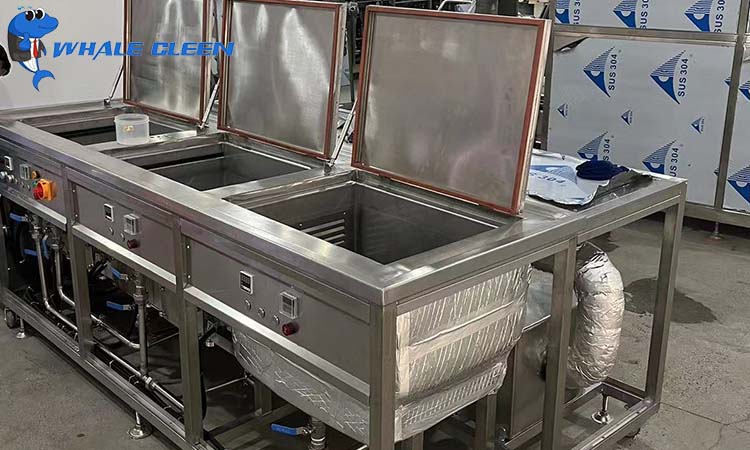
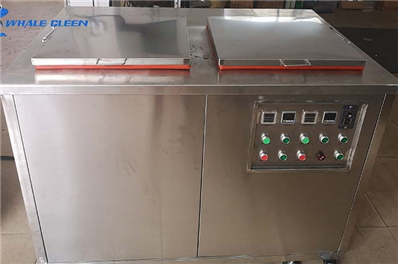
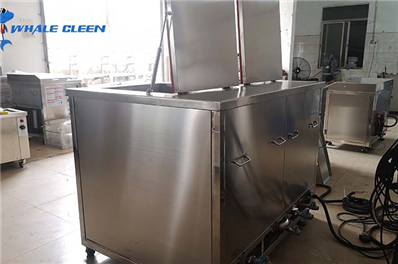
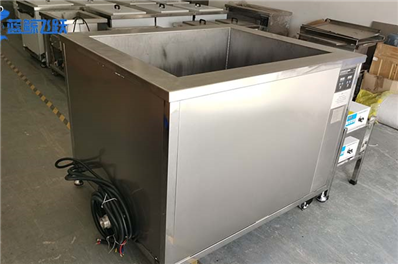
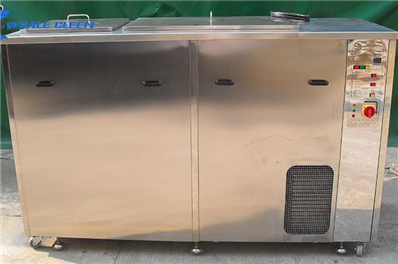
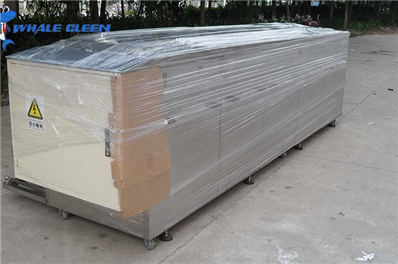
Whale cleen supplies multi-tank and fully automated ultrasonic lines for plating pretreatment. Equipment-side capabilities include: tanks built to the chemistry (304/316L stainless, acid-resistant lining and exhaust for acid tanks); 28/40/68 kHz options with dual-frequency alternation and sweep; adjustable power density in bands; independent temperature control per tank; circulation filtration with oil separation and skimming; rectifier and polarity switching for electroclean tanks; multi-stage cascade rinsing with a DI final stage; surface pH monitoring; rack inclination and drag-out recovery design; gantry or robot transfer for wet-to-wet sequencing that shortens station-to-station dwell; and PLC recipe management logging temperature, level and run status.
Custom engineering is based on five inputs: substrate and deposit type (carbon steel, stainless, zinc alloy, copper); soil type (cutting oil, rust-preventive oil, polishing compound, wax); part geometry and rack format (blind holes, deep cavities); target cycle time and daily throughput; and chemistry system plus site conditions. From these we define tank count and sequence, tank dimensions, frequency combination, power-density bands, filtration and skimming arrangement, rinse stages and transfer method.
Scope boundary, stated plainly: the equipment guarantees reliable structure, material and function, with frequency, power, temperature, time and cycle settable and repeatably delivered. Chemistry selection, concentration, bath maintenance, pretreatment cleanliness and final coating adhesion are determined by the user’s chemical and process system and are outside the equipment guarantee. If rework from failed pretreatment is constraining your line, send substrate, deposit type, soil type, current sequence and rework data, and we can review tank sequence, tank dimensions, frequency and cycle configuration from the equipment side.
Parameter basis and notes: The 30-second water-film criterion, surface pH 6.5–8.0, final-rinse conductivity <10 μS/cm, wet-to-wet transfer under 30 s, the degreasing temperature and time windows, grain-boundary etching from over-activation, and the finding that over-pickling costs more than under-pickling are drawn from ASTM B322, Standard Guide for Cleaning Metals Prior to Electroplating, and public pretreatment references. Rack-line 60–90 s per station, degreaser dump at 15 g/L oil or 20 g/L wax, 25 μm filtration at 2–4 turnovers per hour, and 60–70% loading are line-operation reference values. W/L power density is defined as ultrasonic power divided by effective bath volume. Tank dimensions, temperatures, times and cycle rates are equipment-configuration reference ranges and do not constitute a commitment to pretreatment cleanliness or coating adhesion.