In high-volume manufacturing of engine blocks, cylinder heads, and similar castings, the cleaning process is not a secondary step—it is a critical bottleneck that directly impacts production throughput, component quality, and final assembly reliability. A single cylinder block contains complex internal oil galleries, water jackets, blind holes, and threaded passages that trap machining chips, cutting fluids, and carbonized deposits. Traditional cleaning methods such as manual brushing, spray washing, or simple dipping often fail to reach these hidden areas, leading to rework, warranty claims, and line stoppages.
For factories operating batch production lines, selecting the right ultrasonic cleaning equipment for cylinder blocks requires careful consideration of several practical factors. This article provides actionable tips for choosing a cleaning system that delivers consistent, high-quality results, and explains why Whale Cleen has become a trusted partner for many automotive and engine manufacturers.
Cylinder blocks present unique challenges:
Large size and weight – Blocks can exceed 1 meter in length and weigh over 100 kg, requiring robust handling.
Complex internal geometry – Oil galleries have sharp 90° turns, cross-drilled intersections, and dead-end blind holes.
Mixed contaminants – Metal chips, heavy cutting oil, polishing paste, and sometimes baked carbon.
Stringent cleanliness standards – Residual particles as small as 200 microns can cause engine failure.
Standard ultrasonic cleaners designed for small parts will not work efficiently or effectively for cylinder blocks. A dedicated, custom-engineered system is essential.
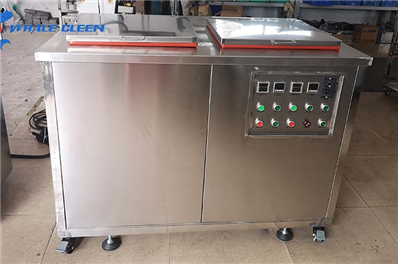
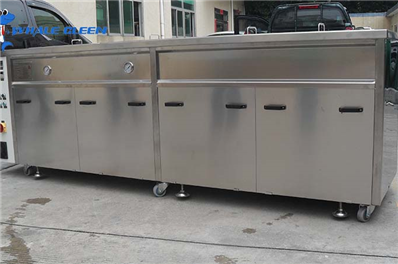
Do not settle for a “standard” tank that forces you to tilt or partially submerge the block. Measure your longest and tallest cylinder block, then add at least 100-150 mm clearance on each side for easy loading and uniform cavitation. A properly sized tank ensures that every part of the block – including the bottom of deep blind holes – receives full ultrasonic energy.
Whale Cleen approach: Whale Cleen offers fully custom tank dimensions based on your actual block drawings or samples. Whether you need a 1.2-meter tank for six-cylinder truck engines or a 2-meter in-line system for marine blocks, they design the tank geometry to match your production batch size.
Cylinder block contaminants are rarely uniform. You may have heavy chips in the oil galleries, sticky oil films on surfaces, and fine dust in threads. A single ultrasonic frequency cannot handle all three efficiently:
Low frequency (28-40 kHz) – Aggressive cavitation for dislodging large chips and baked-on carbon.
High frequency (80-120 kHz) – Gentle, dense bubbles for removing fine particles and oil films without damaging precision surfaces.
A machine that allows you to switch between frequencies (or combine them in a single cycle) gives you the flexibility to adapt to different block conditions – from newly machined blocks (mostly chips and oil) to rebuilt blocks (carbon deposits).
Whale Cleen advantage: Their systems support frequency ranges from 28 kHz to 120 kHz, with programmable multi-frequency sequences. One operator can set a “low→high” recipe for heavily soiled blocks and a “high-only” recipe for delicate aluminum blocks.
Many buyers compare only the number of transducers or total power. However, for large, complex parts like cylinder blocks, where the transducers are placed matters more than how many. Standard bottom-only transducer arrays create dead zones in the upper corners of deep blind holes. To eliminate these blind spots, transducers should be placed on the bottom, sides, and sometimes even the top of the tank, and their positions should be optimized through acoustic simulation.
Whale Cleen method: Before manufacturing, Whale Cleen engineers perform finite element acoustic simulation based on your block’s internal geometry. They determine the optimal transducer layout – side-mount, bottom-mount, or multi-directional – to ensure uniform cavitation energy reaches every oil gallery, cross-hole, and thread root.
In batch production, cleaning fluid becomes contaminated quickly. If you do not filter out particles and oil continuously, you are essentially washing parts in dirty water – re-depositing contaminants onto other blocks. A robust multi-stage filtration system (e.g., coarse strainer + fine cartridge filter + oil skimmer) keeps the bath clean for hundreds of cycles, reducing fluid change frequency and improving consistency.
Whale Cleen standard: All their industrial systems include multi-stage filtration (typically 5-10 μm precision) and oil separation. This extends cleaning fluid life by 3-5 times and ensures that every block in a batch is cleaned in fresh, clean solution.
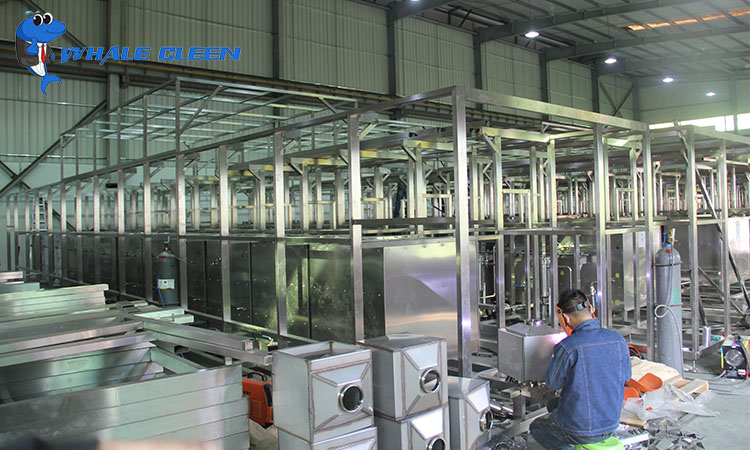
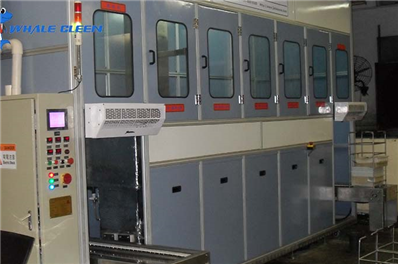
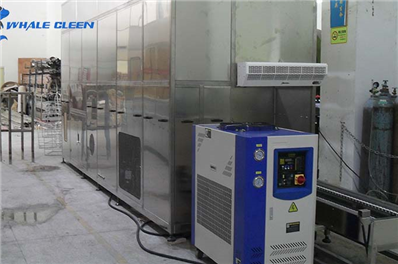
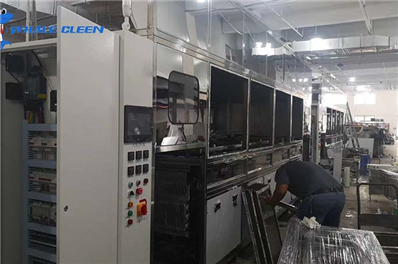
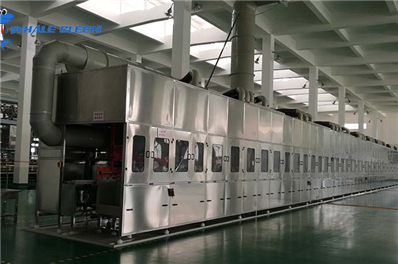
Manual loading and unloading of heavy cylinder blocks is slow, labor-intensive, and risky. For batch production lines, consider an automated multi-tank system with a programmable hoist or conveyor. The operator only loads blocks onto a fixture at the entry point; the hoist then moves the basket through pre-wash, ultrasonic cleaning, rinsing, drying, and rust-prevention stages. This reduces labor, eliminates handling damage, and ensures consistent cycle times.
Whale Cleen solution: They offer fully automated ultrasonic cleaning lines with PLC control and recipe storage. One operator can manage the entire line, and changeover between different block types takes just a few seconds. Typical labor reduction is 60-80% compared to manual cleaning.
Whale Cleen has over two decades of experience in industrial ultrasonic cleaning. Their team began manufacturing ultrasonic equipment in the early 2000s, and today they operate more than 13,000 square meters of production facilities, hold over 30 patents, and have supplied equipment to factories in over 200 countries and regions – serving more than 1,000 industrial clients.
What sets Whale Cleen apart for cylinder block cleaning:
Sample-testing before quoting – They require customers to send actual blocks for lab validation, ensuring the proposed solution works on your real parts.
True custom engineering – Tank dimensions, frequency ranges, transducer layout, automation level – all tailored to your block size, material, and production volume.
Durable construction – Welded high-Q transducers, industrial-grade generators, and thick stainless steel tanks designed for 24/7 operation.
Comprehensive support – Installation, training, and responsive after-sales service with “one machine, one file” traceability.
| Factor | What to Look For | Avoid |
|---|---|---|
| Tank size | Customized to your largest block + clearance | Standard tanks that force tilting or partial submersion |
| Frequency | Multi-frequency (low + high) switchable | Single fixed frequency |
| Transducer placement | Bottom + side (or simulated optimized layout) | Only bottom-mounted |
| Filtration | Multi-stage (≥5 μm) with oil skimmer | No filtration or simple overflow |
| Automation | PLC-controlled hoist or conveyor | Manual loading for heavy blocks |
| Validation | Sample test with your actual blocks | Quote based only on spec sheets |
Selecting the right ultrasonic cleaning equipment for cylinder blocks on a batch production line is not about buying the cheapest or most powerful machine. It is about finding a system that matches your block dimensions, handles mixed contaminants with multi-frequency precision, eliminates dead zones through acoustic design, prevents re-contamination with robust filtration, and integrates smoothly into your production flow.
Whale Cleen delivers exactly that – custom-engineered, sample-tested, and built-to-last ultrasonic cleaning solutions for engine block manufacturers. If your production line struggles with inconsistent cleanliness, high rework, or slow cycles, contact Whale Cleen. Send your most challenging cylinder block for a sample test, and let real results guide your decision.