Look at the two PCBs.
The first was cleaned with a manual brush and solvent dip. The second came from a fully automated ultrasonic cleaning line. To the naked eye, they look identical—solder joints shining, surfaces spotless, ready for assembly. But under high‑magnification inspection and after electrical testing, they tell very different stories.
The manually cleaned board reveals white residue around its fine‑pitch components. Ionic contamination readings exceed industry standards. In accelerated reliability testing, intermittent failures appear. The ultrasonically cleaned board, by contrast, shows no residues, passes all cleanliness specifications, and survives testing without a single failure.
This is not a laboratory curiosity. It is the daily reality in electronics manufacturing—where the choice of cleaning method directly determines whether a batch of PCBs ships without issue or triggers costly rework and field returns. And it is why leading manufacturers worldwide are moving decisively away from manual and semi‑manual cleaning toward industrial ultrasonic automatic cleaning systems.
According to data cited by industry sources, improper cleaning causes approximately 35% of PCB failures. That is a startling figure. When one‑third of all defects can be traced back to how boards are cleaned, the cleaning process is not a secondary concern—it is a primary determinant of product quality and manufacturing profitability.
This article examines the key factors driving this shift, the limitations of traditional cleaning approaches, the advantages of industrial‑grade ultrasonic automation, and why Whale Cleen has become a trusted partner for electronics manufacturers seeking to eliminate cleaning‑related defects and improve throughput.
For decades, electronics manufacturers cleaned PCBs with a straightforward formula: workers dipped boards in solvent baths, scrubbed visible flux residues with brushes, and rinsed them under running water. In an era of larger components, wider trace spacing, and less demanding reliability standards, this method often proved “good enough.”
That era is over. Modern PCBs are fundamentally different:
Higher component density places fine‑pitch components, BGAs (ball grid arrays), QFNs (quad flat no‑lead packages), and passive components closer together than ever before. The gaps between components are measured in tenths of a millimeter.
Miniaturized features create microscopic crevices under components that brushes cannot reach and where solvents struggle to penetrate.
Higher reliability requirements demand ionic cleanliness levels that exceed what visual inspection can guarantee.
Traditional cleaning methods fail on each of these dimensions.
Manual brushing cannot reach underneath low‑standing components. The bristles of any brush are too large to fit into the gaps beneath BGAs, QFNs, or fine‑pitch ICs. Even where brushes do make contact, the abrasion risks damaging delicate solder masks and component surfaces.
Chemical dipping alone provides no mechanical agitation to dislodge residues from microscopic crevices. The cleaning solution may soften flux residues, but without physical action, those residues remain trapped. As the solution becomes saturated, contaminants simply re‑deposit onto boards being processed—undoing whatever cleaning occurred.
Manual transfer between tanks introduces opportunities for contamination, operator variability, and errors that reduce batch‑to‑batch consistency.
Inadequate drying leaves moisture beneath components, leading to water stains, white residue, and potential corrosion issues later in the product’s life.
The result is a persistent quality gap: boards that look clean but are not clean enough. In reliability testing, these boards fail at significantly higher rates than properly cleaned ones. In the field, they cause premature failures that damage brand reputation and increase warranty costs.
Ultrasonic cleaning operates on a physical principle fundamentally different from manual methods: cavitation. High‑frequency sound waves transmitted through a liquid generate millions of microscopic vacuum bubbles throughout the cleaning solution. These bubbles expand and implode rapidly, each implosion releasing a localized shock wave and a high‑speed micro‑jet that scours contaminants from every surface the solution contacts.
The defining advantage for PCB cleaning is that cavitation does not depend on line‑of‑sight or mechanical access. The cleaning action occurs wherever the solution reaches. Underneath BGAs, inside fine‑pitch IC gaps, around component leads, and across the entire board surface—all are cleaned simultaneously and thoroughly.
But ultrasonic cleaning alone is not the complete answer. The key difference separating leading electronics manufacturers from others is not the use of ultrasonic technology itself—it is the degree of automation integrated into the cleaning process.
A manual ultrasonic cleaning operation still relies on an operator to load parts, transfer them between tanks, control timing, and ensure consistent conditions. Wherever a human hand touches the process, variability enters.
An industrial ultrasonic automatic cleaning machine eliminates this variability entirely:
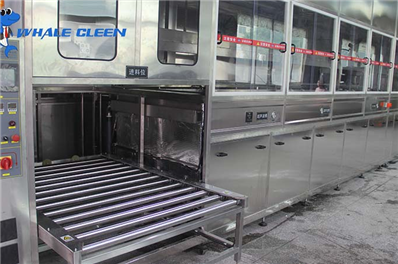
Workpieces move through cleaning, rinsing, and drying stages via automated conveyor systems—no manual transfers, no dropped parts, no missed steps.
Process parameters—temperature, ultrasonic frequency, cycle times, drying conditions—are controlled by programmable logic controllers (PLC) and stored as recipes. The same recipe, executed on different days or different shifts, produces identical results.
Filtration systems continuously remove suspended contaminants, keeping cleaning baths fresh and preventing redeposition.
High‑volume throughput is achieved with minimal labor: one operator can manage multiple cleaning lines simultaneously.
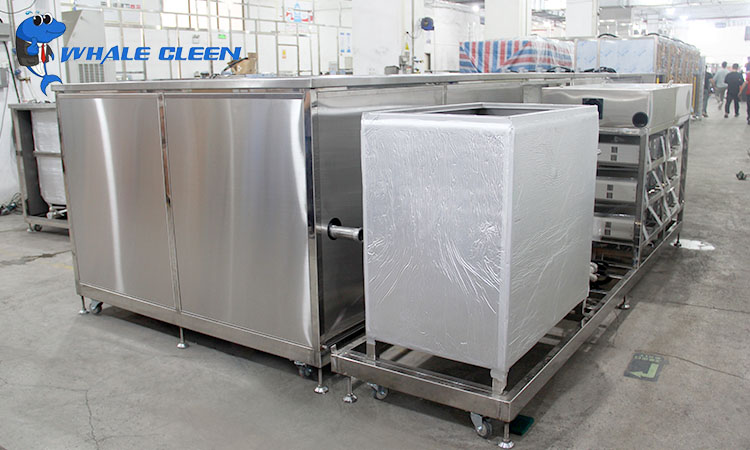
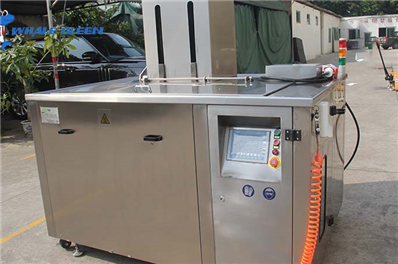
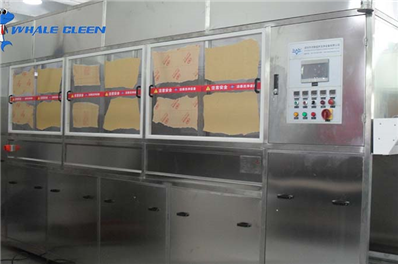
Whale Cleen‘s through‑type industrial ultrasonic cleaning machines exemplify this approach. Equipped with stainless‑steel conveyor belt systems, they move workpieces through sequential zones—pre‑cleaning, ultrasonic cleaning, rinsing, and drying—in a continuous production flow. The system is designed for high‑volume output with customizable speed and load capacity, enabling factories to clean PCBs at the same pace their SMT lines produce them, without the bottleneck of manual handling.
For PCB cleaning specifically, where flux residues and ionic contamination must be removed from every board uniformly, this consistency is essential. A fully automated line ensures that every board receives exactly the same treatment, eliminating the operator‑dependent variability that inevitably leads to quality escapes in manual or semi‑manual processes.
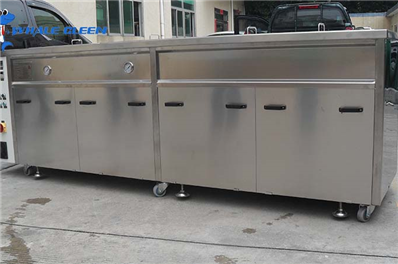
Furthermore, industrial‑grade systems are built for continuous operation. Whale Cleen machines feature robust construction with stainless‑steel tanks (SUS304 or SUS316), heavy‑duty components, and industrial‑grade transducers. One product detail sheet notes that Whale Cleen offers 24/7 uninterrupted work capability and complete service integration, including filtration circulation systems, automatic temperature control, and hot air circulation drying. This durability ensures that electronics manufacturers can run their cleaning lines shift after shift without unexpected downtime—a critical requirement in volume production.
When electronics manufacturers upgrade from manual or semi‑manual cleaning to an automated ultrasonic system, they typically experience measurable improvements across several dimensions:
1. Consistent, repeatable cleanliness. The most important benefit is also the simplest to state: every board, every batch, every shift—identically clean. PLC‑controlled automation removes the variability that plagues manual processes.
2. Elimination of white residue and water stains. Incomplete cleaning and inadequate drying are the primary causes of post‑rinse residues. Multi‑stage automated lines with pure water rinses and heated drying modules eliminate these defects at their source.
3. Higher throughput. Manual cleaning is inherently limited by human speed. One operator cleaning boards one at a time can never match the throughput of an automated line processing multiple boards simultaneously. Whale Cleen systems achieve processing speeds and capacity that far exceed manual methods, enabling manufacturers to align cleaning output with SMT production rates.
4. Lower operating costs. While the initial investment in automated equipment exceeds that of manual tools, the total cost of ownership over time favors automation. Labor requirements drop significantly—one operator can manage multiple cleaning lines. Chemical consumption is reduced through circulation filtration systems that extend bath life and minimize waste. Most importantly, defect rates decline, reducing the substantial costs of rework, scrap, and warranty claims.
5. Non‑destructive cleaning. Ultrasonic cleaning is non‑abrasive by design. The cavitation action targets contaminants, not the board itself. PCBs emerge with solder joints intact, solder masks undamaged, and component surfaces unmarred—preserving the precise surface finishes required for subsequent assembly steps.
6. Batch documentation and traceability. Automated systems can log cleaning parameters for each batch, supporting quality management systems and providing traceability for regulatory or customer requirements. Manual processes cannot offer this level of documentation.
Among ultrasonic cleaning equipment manufacturers, Whale Cleen has built its reputation by focusing exclusively on industrial and mechanical applications and deliberately not serving the medical, eyewear, jewelry, or food industries. This concentrated expertise ensures that when an electronics manufacturer brings a PCB cleaning challenge to Whale Cleen, they are engaging with engineers who understand the specific requirements of flux removal, ionic contamination, high‑density component cleaning, and the sensitivity of electronic assemblies.
With over 20 years of cleaning industry experience, Whale Cleen operates from its own factory with a professional technical team. The company holds eight national patents, serves brand customers across 51 countries and regions, and maintains ISO9001, CE, and ROHS certifications.
The company‘s “no off‑the‑shelf” philosophy is central to its approach. Walk into any real‑world electronics factory, and production conditions are rarely “standard.” PCB sizes vary. Assembly layouts differ. Contaminants range from no‑clean flux residues to heavy soldering pastes. Cleaning needs for a high‑mix, low‑volume assembly line are completely different from those of a high‑volume, dedicated product line. Yet most equipment suppliers offer only rigid, one‑size‑fits‑all machines.
Whale Cleen does not sell off‑the‑shelf general products. Every cleaning machine is purpose‑built for the factory’s unique, non‑standard conditions. This philosophy is particularly valuable in electronics manufacturing, where no two PCBA production lines are identical. Whale Cleen’s customized approach covers tank dimensions engineered to specific board sizes; ultrasonic parameters selected based on contaminants; structural configuration—single‑tank, multi‑tank, through‑type, rotary basket, or robotic arm—matched to the facility‘s workflow; and process integration modules—heating, filtration, rinsing, drying—arranged exactly as the production sequence requires.
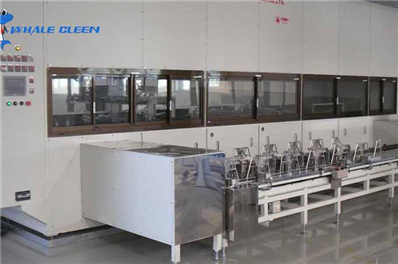
Whale Cleen’s mechanical arm type fully automatic ultrasonic cleaning machine exemplifies this capability. It uses a suspension transport system with multi‑position functional tanks forming a continuous cleaning production line. The process sequence includes ultrasonic medicament cleaning, ultrasonic DI water rinsing, DI water slow dewatering, and multiple drying stages. The equipment can be customized with filtration circulation systems, automatic temperature control, hot air circulation drying, and absorption and mist recovery devices. According to the specification, the equipment is designed to remove oil, dust, debris, and other attachments to obtain a clean workpiece that meets specified process requirements. This level of customization ensures that the cleaning system fits the PCBA production line—not the other way around.
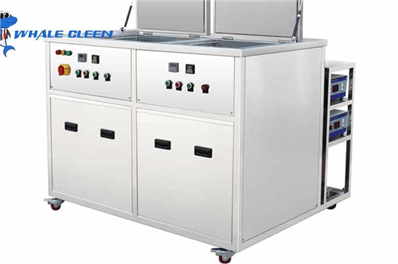
Whale Cleen‘s range of cleaning systems covers the full spectrum of electronic manufacturing needs. For workshops and low‑volume production, industrial single‑tank and multi‑tank ultrasonic cleaners offer flexibility and ease of use. For medium‑batch production, fully automated multi‑tank lines integrate the complete cleaning, rinsing, and drying workflow. For high‑volume continuous production, through‑type ultrasonic cleaning machines use conveyor systems to move PCBs through sequential processing zones, aligning cleaning throughput with SMT line output. All systems can be customized with additional features such as vacuum degassing, rotational cleaning baskets, and integrated anti‑rust modules, depending on the specific requirements of the electronic components.
Whale Cleen also offers complete OEM and ODM solutions for equipment distributors, system integrators, and large manufacturing groups. Under private‑label manufacturing arrangements, Whale Cleen produces ultrasonic cleaning machines exactly to partner specifications, with the final product carrying the partner‘s own brand name, logo, packaging, and manuals. This capability allows electronics service organizations and equipment distributors to bring custom cleaning solutions to market without years of internal R&D and factory setup. As the company‘s OEM/ODM page notes, “with 18 years experience in OEM&ODM service for brand customers in different industries, we believe we can provide dedicated service for your brand”. Partners own the customer relationship; Whale Cleen provides the manufacturing expertise, quality control, and supply chain.
Service and support are integral to the Whale Cleen offering. The company provides door‑to‑door installation and commissioning, technical personnel for free guidance and training, 12‑hour response to inquiries, 18‑month warranty coverage, and lifetime maintenance support. This service infrastructure ensures that electronics manufacturers can integrate cleaning equipment into their production lines with minimal disruption and maintain it over its full service life—a critical consideration for facilities that cannot afford extended downtime.
While not a PCB example, a case from Whale Cleen‘s experience illustrates the capability of custom‑engineered ultrasonic cleaning systems. A manufacturer of hydraulic systems struggled with residual machining chips and lapping paste trapped in intricate internal galleries. Standard ultrasonic cleaners left contaminants behind, leading to field failures. Whale Cleen engineered a multi‑frequency, multi‑stage system with directional flow and pulsating cavitation that flushed every internal passage clean—reducing reject rates to near zero.
For PCB cleaning, the same engineering approach applies. Whale Cleen‘s multi‑frequency capability allows the system to address the full spectrum of PCBA contamination—from heavy flux residues to fine ionic particles. Through‑type systems with conveyor transport provide continuous, high‑volume cleaning that eliminates the manual handling errors that cause rework. And the company‘s commitment to non‑standard customization ensures that each cleaning line is designed around the specific board types, assembly configurations, and throughput requirements of the customer‘s facility.
As Whale Cleen‘s product literature states, “the equipment is a water‑based cleaning machine, which adopts suspension transportation and consists of multi‑position functional tanks to form a continuous cleaning production line to remove the oil, dust, debris and other attachments on the workpiece to obtain a clean workpiece, to make the workpiece meet the specified process requirements”.
Electronic manufacturing has become too demanding, and the cost of failure too high, for “good enough” cleaning to remain acceptable. Boards are denser, components are smaller, reliability standards are stricter, and the consequences of field failures—in warranty costs, brand reputation, and customer relationships—are more severe than ever.
The shift from manual and semi‑manual cleaning to industrial ultrasonic automatic cleaning systems is not a matter of if, but when. Leading manufacturers have already made the transition. They are the ones achieving consistently higher yields, lower rework rates, and fewer field failures. And they are the ones turning the competitive pressure on everyone else.
For electronics manufacturers still cleaning PCBs with brushes, solvents, and manual methods, the question is not whether the current approach can continue to work. It is how much longer the current level of defects and variability can be tolerated before the competition—or the customers—force a change.
With over 20 years of experience, industrial‑grade systems designed for continuous production, full non‑standard customization and OEM/ODM capabilities, global service support including door‑to‑door installation and commissioning, and a proven track record of eliminating cleaning‑related defects, Whale Cleen provides the equipment, the engineering, and the support to make that transition successful.
To discuss your specific PCB cleaning requirements or explore a custom ultrasonic cleaning solution for your facility, contact Whale Cleen today.
Contact Whale Cleen
Website: www.bwhalesonic.com
WhatsApp: +86 15007557067
Email: michael@bwhalesonic.com