Walk into any metalworking shop, stamping plant, or machining facility, and you will see the same scene repeated shift after shift: workers hunched over parts bins, scrubbing with brushes, picking at crevices with picks, blowing compressed air into blind holes — trying to dislodge the grinding dust, metal fines, and polishing compounds that have been pressed deep into the crevices of batch-processed workpieces.
It is slow. It is inconsistent. And it is expensive.
Here is the reality that too many production managers accept as normal: manual cleaning of grinding dust and metal particles from batch workpieces is one of the most labor-intensive, error-prone, and cost-inflating operations on the factory floor. When grinding dust embeds itself into threads, blind holes, cross-drilled passages, and surface micro-porosities, human hands and brushes simply cannot reach them. The result is a cascade of problems: rework, rejected batches, compromised coating adhesion, and labor costs that never stop climbing.
Consider a typical batch of stamped or machined metal parts. After grinding, deburring, or polishing, fine metallic dust and abrasive particles become mechanically lodged in every available crevice. Workers spend hours — sometimes entire shifts — manually cleaning these parts. Brushes wear out. Compressed air blows dust deeper into blind holes. Solvent wiping only smears the contamination around.
The numbers tell a painful story:
Labor costs — Manual cleaning consumes skilled labor hours that could be deployed on value-adding operations. One production manager at a metal stamping facility estimated that manual cleaning accounted for nearly 20% of his direct labor budget.
Inconsistent quality — Operator fatigue, shift changes, and varying techniques mean that some parts come out clean while others do not. The parts that look clean may still harbor microscopic particles that will later cause coating failures, assembly issues, or premature wear.
Rework and scrap — When grinding dust is not completely removed before painting, plating, or assembly, rejects pile up. Each reject represents wasted material, wasted labor, and a missed shipment deadline.
Slow throughput — Manual cleaning is a bottleneck. Production lines slow down because cleaning cannot keep pace with machining output. The more parts you produce, the bigger the cleaning backlog grows.
Industrial ultrasonic cleaning machines operate on a principle that manual methods cannot replicate: cavitation. High-frequency sound waves are transmitted through a cleaning solution, generating millions of microscopic bubbles that form and implode with tremendous energy. When these bubbles collapse near a workpiece surface, they release localized shock waves and micro-jets that dislodge contaminants from even the most inaccessible geometries.
Here is what makes ultrasonic cleaning different from manual scrubbing:
It reaches where brushes cannot. Grinding dust embedded in blind holes, deep threads, cross-drilled passages, and complex internal geometries is no match for cavitation. The cleaning action occurs everywhere the liquid can penetrate — which means every surface of the workpiece.
It is consistent, not operator-dependent. Once the ultrasonic parameters are set, every part in the batch receives the same cleaning intensity. No fatigue. No variation between shifts. No "good enough" compromises.
It removes particles, not just surface films. Cavitation physically dislodges embedded particles from the surface, lifting them into suspension where they can be filtered out of the cleaning solution.
It reduces labor dramatically. Parts are loaded into baskets, immersed in the ultrasonic tank, and cleaned automatically. Workers are freed from repetitive scrubbing to focus on higher-value tasks.
For manufacturers who are tired of watching labor costs rise and cleaning quality fall, Whale Cleen delivers a proven alternative. With over 20 years of experience in ultrasonic equipment research, development, and manufacturing, Whale Cleen operates a 10,000-square-meter production base and holds more than 30 national patents.
What sets Whale Cleen apart is its refusal to sell "one-size-fits-all" solutions. Real-world factories rarely have standard cleaning conditions. Workpiece sizes vary. Contamination types differ. Production line layouts are unique. Whale Cleen engineers each system according to the specific requirements of the application — not from a catalog of generic models.
For batch workpieces contaminated with grinding dust and metal fines, Whale Cleen delivers:
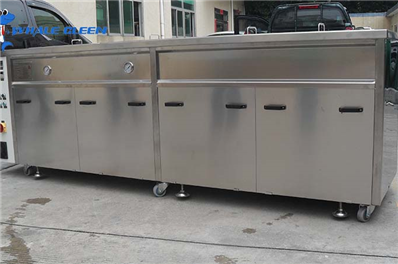
Customized tank dimensions and layouts — Whether you are cleaning small stamped parts or large machined components, the tank is sized to your largest workpiece, not some arbitrary "standard" dimension.
Multi-frequency capability — Different contaminants and geometries respond to different frequencies. Whale Cleen systems support a wide frequency range, allowing operators to select the optimal frequency for their specific soils and part materials. Lower frequencies deliver powerful cavitation for heavy deposits, while higher frequencies reach fine features and delicate surfaces.
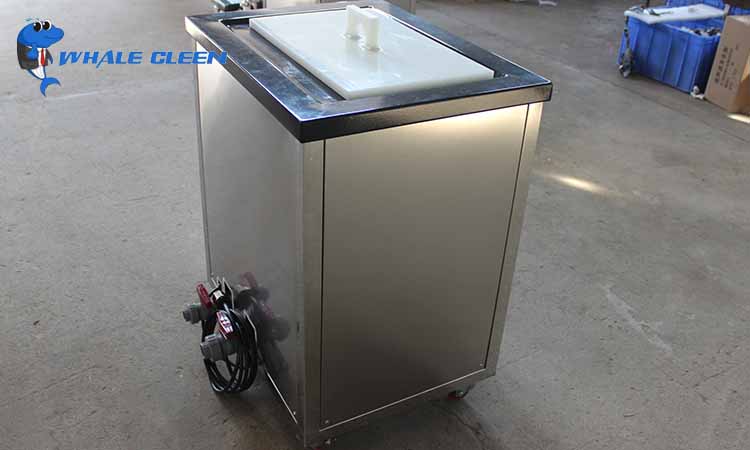
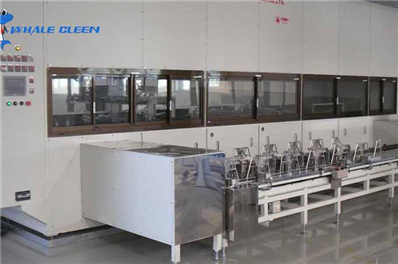
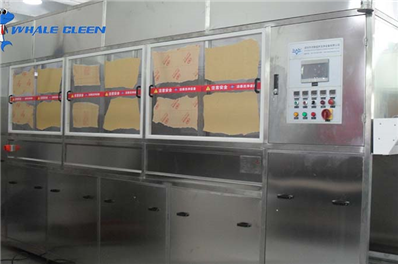
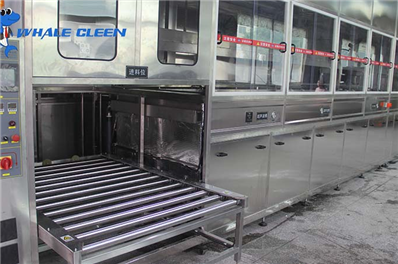
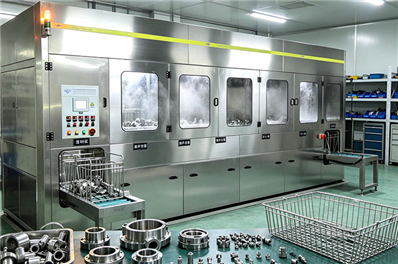
Integrated multi-stage cleaning lines — For high-volume batch production, Whale Cleen offers fully automated multi-tank systems that combine ultrasonic cleaning, rinsing, filtration, and drying in a continuous workflow. Parts move from tank to tank automatically, eliminating manual transfers and reducing the risk of re-contamination.
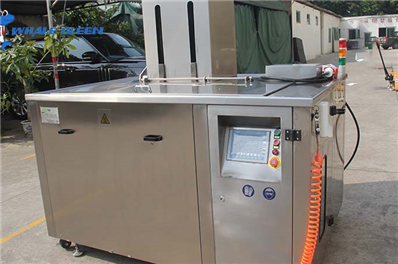
Robust filtration systems — Multi-stage filtration (coarse strainer plus fine cartridge filter) prevents dislodged particles from re-depositing onto workpieces, keeping the cleaning bath consistently effective.
Built for 24/7 operation — Whale Cleen industrial-grade ultrasonic cleaners are engineered for continuous production environments, with heavy-duty stainless steel tanks and industrial-grade generators that deliver reliable performance shift after shift.
If your production floor still relies on manual brushing and compressed air to remove grinding dust from batch workpieces, you are not just paying for labor — you are paying for inconsistency, rework, slow throughput, and compromised quality.
Industrial ultrasonic cleaning from Whale Cleen replaces manual scrubbing with automated, repeatable, and thorough contamination removal. It reaches the crevices that brushes cannot. It delivers consistent results across every part in every batch. And it frees your skilled workers for work that actually requires their judgment and expertise.
Stop scrubbing. Start cleaning smarter.
Contact Whale Cleen to discuss your specific cleaning requirements and discover how a customized ultrasonic cleaning system can transform your production economics.