In aerospace manufacturing, few quality metrics are as unforgiving as fastener cleanliness. A single micro-fastener — a titanium alloy bolt, a high-strength steel screw, a threaded insert — can carry cutting fluids, lapping compounds, or microscopic metal debris lodged in its thread roots and blind holes. If that contamination remains after cleaning, the consequences are severe: compromised torque values during assembly, stress corrosion cracking in service, or outright rejection at final inspection.
Yet here is the puzzle that baffles production managers across the industry: two factories produce the same aerospace fasteners to the same specifications. Both use ultrasonic cleaning. One maintains yield rates above 99% batch after batch. The other struggles with rework rates exceeding 15%, unpredictable quality fluctuations, and costly scrap write-offs.
What separates them? The answer is not "whether" they use ultrasonic cleaning — it is "how well" they use it. The gap lies in a handful of critical factors that determine whether ultrasonic cleaning delivers consistent, certifiable results or becomes a bottleneck of uncertainty.
Many production lines have already deployed ultrasonic cleaning equipment. But the yield gap persists. Data from one aerospace fastener manufacturer shows that a single-tank ultrasonic cleaner produced batch qualification rates fluctuating between 75% and 92%, with an average rework rate exceeding 15%.
The root cause? Inconsistent cavitation energy distribution. Single-frequency ultrasonic systems often suffer from standing wave dead zones — areas within the tank where ultrasonic energy is either too weak to remove contaminants or too intense, potentially damaging precision surfaces. The result is a batch where some fasteners emerge perfectly clean while others still harbor oil films or particles in their thread valleys. Under the microscope of aerospace quality inspection, these "invisible" contaminants are unmistakable — and unacceptable.
Aerospace fasteners are manufactured from diverse materials — titanium alloys, nickel-based superalloys, stainless steels — and carry different types of contamination: heavy cutting oils, fine grinding dust, baked-on oxidation. Each combination demands a specific ultrasonic frequency.
Lower frequencies (around 28 kHz) generate larger, more aggressive cavitation bubbles that excel at stripping heavy grease and carbon deposits. But on precision fasteners, that same aggressive force can leave microscopic etch marks or even initiate micro-cracks — a serious concern for titanium alloy components that must withstand extreme flight stresses.
Higher frequencies (40–80 kHz) produce smaller, denser bubbles that penetrate thread roots and micro-holes with a "gentle yet deep" cleaning effect. For ultra-precision aerospace fasteners, frequencies of 80 kHz and above provide even greater surface protection.
Factories that achieve consistently high yield rates understand this. They use multi-frequency-capable systems that can match frequency to contamination type and material sensitivity — not a single frequency that forces every part into the same cleaning regime regardless of its needs.
Even with the right frequency, ultrasonic energy must reach every fastener in the basket uniformly. In poorly designed systems, transducer placement creates standing wave patterns — regions of high intensity interspersed with "dead zones" where cavitation is virtually absent.
High-yield operations invest in equipment with optimized transducer arrays and sweep frequency technology that continuously varies the frequency within a narrow band. This sweeping action breaks up standing wave patterns, ensuring that every fastener — whether positioned at the center of the basket or along the edges — receives consistent ultrasonic energy.
Without sweep frequency, fasteners in dead zones may emerge with residual contamination, forcing rework or scrap. The difference between a system with uniform acoustic fields and one without can be the difference between 99% yield and 85% yield.
Total power output is a misleading metric. What truly matters is power density — the ultrasonic energy delivered per unit volume of cleaning solution. For aerospace micro-fasteners, excessive power density can accelerate hydrogen diffusion into high-strength alloys — a particular concern for fasteners susceptible to hydrogen embrittlement.
High-yield facilities carefully control power density, matching it to the specific part geometry and contamination load. They avoid the trap of assuming "more power equals better cleaning" — a mistake that can damage precision surfaces and compromise the metallurgical integrity of critical fasteners.
Perhaps the most overlooked factor is how fasteners are loaded. Simply dumping thousands of micro-fasteners into a standard basket is a recipe for inconsistent results. Parts collide, scratch each other, and — critically — shield one another from ultrasonic waves.
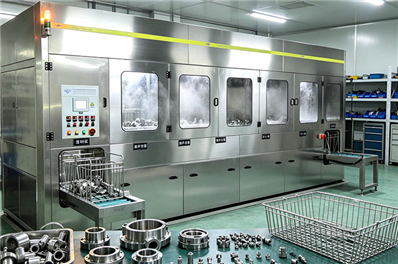
High-yield operations use custom fixturing — layered trays, Teflon-coated dividers, or elastic positioning points that suspend and separate each fastener. This ensures that every part is fully exposed to the acoustic field while preventing the mechanical damage that can occur when fasteners rub against each other during cleaning.
As ultrasonic cleaning progresses, contaminants removed from fasteners remain suspended in the cleaning fluid. Without effective filtration, those particles can redeposit on parts — particularly in the later stages of a batch.
High-yield systems incorporate multi-stage circulation filtration that continuously removes suspended particles, maintaining bath cleanliness throughout the cleaning cycle. Overflow designs that skim floating oils from the liquid surface further extend bath life and prevent secondary contamination.
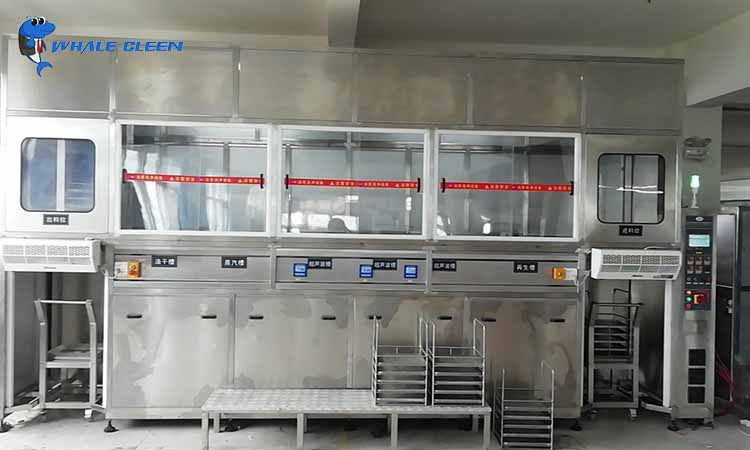
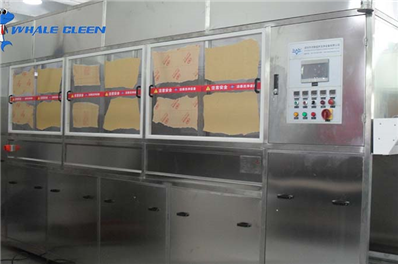
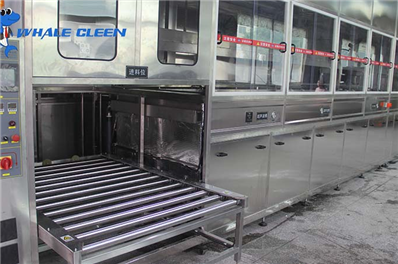
For over 20 years, Whale Cleen has specialized in industrial ultrasonic cleaning systems that address precisely these factors. Operating a 10,000-square-meter production base and holding more than 30 national patents, the company has built a reputation for engineering solutions that deliver consistent, repeatable results in the most demanding applications.
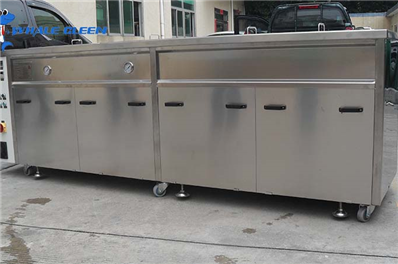
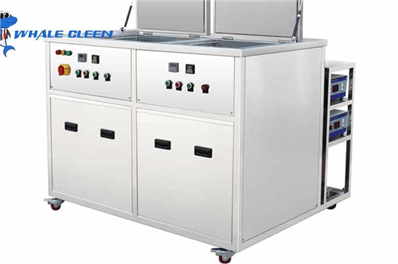
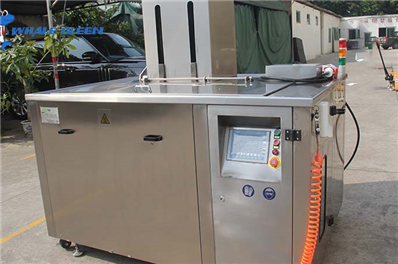
What sets Whale Cleen apart in the aerospace fastener space is its commitment to non-standard customization. Real-world factories rarely have "standard" cleaning conditions — part geometries vary, contamination types differ, and production line layouts are unique. Whale Cleen designs and manufactures ultrasonic cleaning systems according to specific customer requirements rather than offering only off-the-shelf units.
Multi-frequency capability is built into Whale Cleen systems, allowing operators to match cleaning parameters to the specific material and contamination profile of each fastener batch. Their sweep frequency technology eliminates standing wave dead zones, ensuring uniform cavitation across the entire tank. Custom fixturing solutions prevent contact damage and ensure every fastener receives consistent exposure to the acoustic field.
Beyond the equipment itself, Whale Cleen provides comprehensive engineering support — from on-site process validation to ongoing maintenance — ensuring that the cleaning system performs reliably in the most demanding production environments.
For aerospace manufacturers who cannot afford inconsistent cleaning results, the choice is not between "ultrasonic" and "not ultrasonic." The choice is between a generic system that introduces uncertainty and an engineered solution — like those from Whale Cleen — that delivers repeatable, certifiable cleanliness, batch after batch.