In any hydraulic system, the valve body is the command center. Its internal network of intersecting oil channels, precision spool bores, and tiny flow passages directs the flow, pressure, and direction of hydraulic fluid. A single valve body may contain dozens, or even hundreds, of cross‑drilled blind holes measuring just 2 to 3 mm in diameter but extending more than 30 mm deep. These intricate passages give the valve its precision—but they also create ideal hiding places for grease, chips, and debris.
When residual grease or metal particles remain trapped inside a valve body, the consequences are rarely immediate. The part may pass visual inspection. The assembly may even test well on a flow bench. But weeks or months later, after the valve has cycled thousands of times in service, those hidden contaminants begin to take their toll. The spool starts to stick. Response becomes sluggish. Leakage appears. Eventually, the valve fails altogether—and the component is scrapped.
Industry statistics show that residual contaminants trapped inside valve body passages account for an estimated 12 percent of post‑assembly quality issues in hydraulic valve production. Hard chips lodged in cross‑hole intersections are directly responsible for an even larger share of early hydraulic system failures, with some estimates placing the figure above 15 percent.
Traditional cleaning methods cannot solve this problem. Spray washing relies on straight‑line water jets that cannot navigate 90‑degree turns inside passages. Manual brushing reaches only the entry of a hole, not its bottom or its threaded root. Chemical soaking alone lacks the mechanical force to dislodge physically embedded particles.
Ultrasonic cleaning, however, is fundamentally different. Its cavitation effect reaches where no brush or spray can go. But not all ultrasonic cleaning is equally effective. To actually remove dead‑end grease from hydraulic valve bodies, the following practical tips are essential.
Hydraulic valve bodies rarely carry just one type of contamination. Inside the same component, three distinct types of contaminants may accumulate simultaneously: heavy grease and cutting oil residues that coat the passages; baked‑on varnish from thermal cycling; and hard metal chips embedded in cross‑hole intersections. Each of these responds differently to ultrasonic energy, which is why single‑frequency cleaning is fundamentally insufficient.
Lower ultrasonic frequencies (around 28 kHz to 40 kHz) generate larger cavitation bubbles that release stronger shock waves. These large bubbles are extremely effective at breaking up thick, baked‑on grease, dislodging dense varnish, and loosening chips that have been pressed into corner intersections. However, they struggle to penetrate micro‑features without causing surface damage.
Higher frequencies (80 kHz and above) produce smaller, more numerous bubbles. These fine bubbles can penetrate deep into narrow blind holes, thread roots, and tight passages. They gently lift away loosened particles and thin oil films without risking any micro‑damage to precision sealing surfaces.
For hydraulic valve bodies, the optimal approach is multi‑frequency cleaning. Low‑frequency cavitation first breaks apart and lifts off heavy deposits and embedded chips. High‑frequency cavitation then follows to sweep away residual fine particles and oil films from every recess. A system with multi‑frequency capability allows the operator to address the full spectrum of contaminants in a single cleaning cycle, without transferring the part between multiple machines.
Many operators mistakenly assume that placing a hydraulic valve body into an ultrasonic tank for a single cycle is sufficient. In practice, a single stage cannot address all contamination types, and it risks simply redistributing dirt instead of removing it.
The industry‑recommended cleaning process for hydraulic valve bodies consists of four distinct stages:
Stage 1: Pre‑cleaning (loose debris removal). Before ultrasonic cleaning begins, the operator should manually remove large chunks of debris, loose swarf, or heavy external grease using non‑metallic tools such as nylon brushes or wooden scrapers. This step prevents the cleaning bath from becoming overloaded with large particles that would otherwise dilute the ultrasonic energy available for deep cleaning.
Stage 2: Ultrasonic cleaning (cavitation‑based removal). The valve body is fully submerged in the ultrasonic tank. Multi‑frequency cavitation is applied to break down grease, dislodge chips, and lift contaminants from blind holes, cross‑passages, and thread roots. The duration of this stage should be based on the contamination level and part geometry rather than a fixed timer.
Stage 3: Rinsing (contaminant removal). After ultrasonic cleaning, the part must be rinsed thoroughly to remove the suspended contaminants that have been lifted into the cleaning fluid. Using a separate rinsing tank prevents re‑deposition of contaminants onto the freshly cleaned surfaces.
Stage 4: Drying (moisture elimination). The final stage is drying, typically using hot air circulation or oil‑free compressed air. Residual moisture left on the part can cause flash rust or interfere with subsequent assembly steps such as seal installation.
This four‑stage process prevents cross‑contamination between stages and ensures that contaminants removed during ultrasonic cleaning do not simply re‑attach to the part during rinsing or drying.
One of the most common mistakes in ultrasonic cleaning is incorrect part positioning. When a hydraulic valve body is placed into the tank with blind holes facing downward, air becomes trapped inside the holes. That trapped air acts as a barrier that ultrasonic energy cannot penetrate, meaning the inside of the blind hole receives no cleaning at all.
For blind holes to be cleaned effectively, they must be filled with cleaning fluid. This means the valve body should be positioned so that blind holes and internal passages are oriented upward or sideways, allowing fluid to enter freely. If the part geometry makes uniform orientation impossible for all blind holes simultaneously, rotating the part during the cleaning process—either manually between cycles or using a rotating basket system—can ensure that each hole faces a direction that allows filling.
After cleaning, proper orientation also matters. Parts should be removed from the tank in a position that allows blind holes to drain completely, preventing fluid from being carried over into the rinse stage.
Even with proper positioning and multi‑frequency cavitation, some hydraulic valve bodies contain internal passages that are so narrow or convoluted that cleaning fluid struggles to reach every internal surface without external assistance. In these cases, vacuum‑assisted ultrasonic cleaning offers a significant advantage.
By removing air from the cleaning chamber, vacuum technology achieves three critical outcomes. It allows cleaning fluid to penetrate deeper into blind holes and complex internal passages by eliminating the air pockets that would otherwise block access. It reduces ultrasonic cavitation dampening caused by trapped air bubbles, ensuring that cavitation energy reaches every fluid‑filled region. And it virtually eliminates the risk of air pockets trapping contaminants in the deepest recesses of the part.
For hydraulic valve bodies with long, narrow passages or multiple intersecting bores, vacuum‑assisted cleaning is often the only way to achieve complete internal cleanliness.
One overlooked factor in ultrasonic cleaning is the progressive contamination of the cleaning fluid itself. As valve bodies are processed, the grease, chips, and particles removed from one batch remain suspended in the cleaning bath. Without effective filtration, those suspended contaminants will re‑deposit onto subsequent parts—or even onto the same part during the drying phase.
High‑efficiency circulation filtration systems continuously remove suspended soils, particulates, and oils from the cleaning solution. The benefits are significant: cleaning baths last up to ten times longer between changes, chemical purchases are reduced proportionally, and hazardous waste disposal costs drop. Most importantly, batch‑to‑batch consistency is maintained because the cleaning fluid remains clean throughout the production shift.
For high‑volume valve body cleaning, a system with multi‑stage filtration is not an optional upgrade—it is a core requirement for consistent results.
There is a common misconception that higher ultrasonic power always produces better cleaning results. In reality, excessive cavitational force can damage precision machined surfaces, especially on aluminum valve bodies or parts with fine sealing surfaces.
The correct approach is to match power density to the specific part material and contamination level. Heavily soiled cast iron or steel valve bodies may tolerate—and require—higher power levels for effective chip removal. Aluminum valve bodies, by contrast, should be cleaned at lower power settings to avoid cavitation erosion.
A quality ultrasonic cleaning system should offer adjustable power output, allowing the operator to dial in the correct intensity for each application. When in doubt, starting with lower power and gradually increasing while inspecting results is safer than starting with maximum power and discovering damage after the fact.
Finally, even the best ultrasonic cleaning setup will drift over time. Transducers age. Power output gradually changes. Filtration systems eventually clog. Without regular verification, a previously effective cleaning process can degrade without the operator noticing—until a batch of valves fails in‑service testing.
Implementing a simple verification protocol makes the invisible visible. Clean test coupons or witness samples—small metal pieces with standardized contaminant loading—through the cleaning cycle and inspect them visually or under magnification. Track key process parameters such as frequency settings, power output, temperature, and cycle time in a log. Establish a regular maintenance schedule for transducer inspection, generator calibration, and filter replacement.
When the cleaning process is verified at regular intervals, problems are caught early—before they cause a batch‑wide failure.
Among ultrasonic cleaning equipment manufacturers, Whale Cleen has earned a distinct reputation by focusing on exactly the kinds of parts that others find too difficult to clean. For over 20 years, the company has specialized in non‑standard and fully customized ultrasonic cleaning systems for industrial applications, including hydraulic components, automotive engine parts, precision machining, and more.
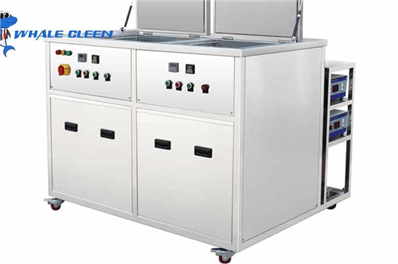
Multi‑frequency capability for mixed contaminants. Whale Cleen systems feature advanced multi‑frequency technology, allowing operators to switch between lower frequencies for heavy‑duty chip and grease removal and higher frequencies for fine‑particle cleaning and delicate surface protection. This single‑system flexibility means that a hydraulic valve body can receive both a high‑energy cleaning stage for embedded chips and a gentle finishing stage for precision passages without being transferred between machines.
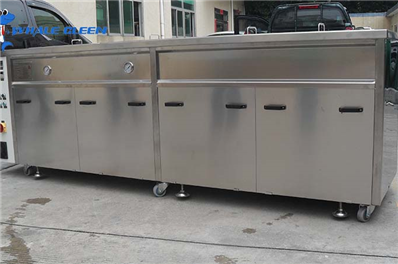
Custom tank design for odd‑sized valve bodies. Off‑the‑shelf ultrasonic tanks rarely accommodate the wide variety of valve body sizes found in a typical hydraulic component facility. Whale Cleen specializes in custom tank dimensions, designing systems that fit the specific workpiece rather than forcing the workpiece to fit a standard tank. From large hydraulic manifolds to compact precision valves, the tank size, transducer layout, and fixturing are all designed around the customer’s parts.
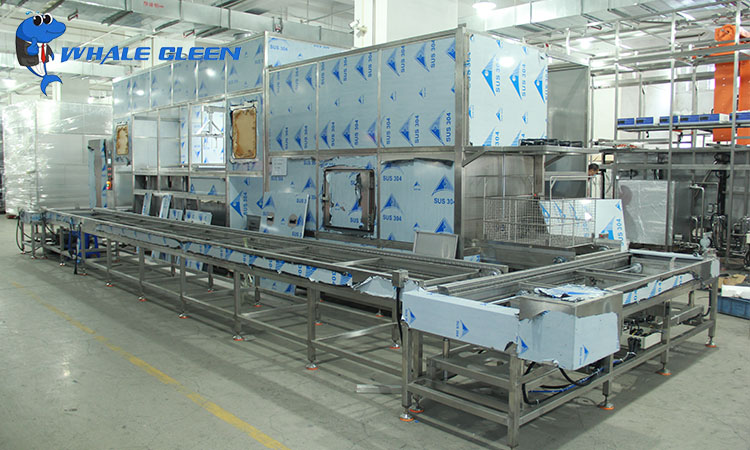
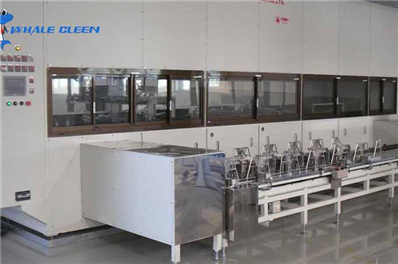
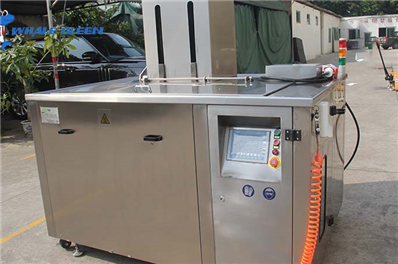
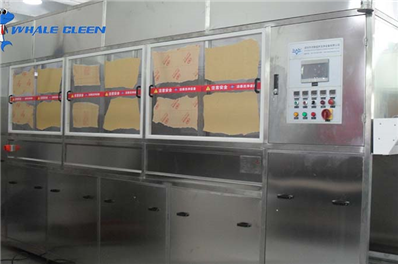
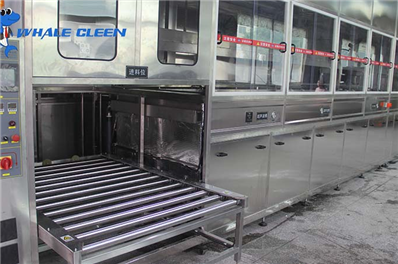
Multi‑stage cleaning lines with integrated filtration. Whale Cleen offers fully automated multi‑stage cleaning lines that integrate pre‑cleaning, ultrasonic cleaning, rinsing, and drying into a single PLC‑controlled system. These lines incorporate high‑efficiency circulation filtration to maintain bath cleanliness across multiple shifts, ensuring consistent results batch after batch. The automated workflow also eliminates operator variability, removing the risk of inconsistent cleaning due to differences in cycle timing or part orientation.
Focus on industrial and mechanical applications. Whale Cleen focuses exclusively on industrial manufacturing sectors—machining, auto parts, hardware, die‑casting, metalworking, and stamping—and does not serve the medical, eyewear, jewelry, or food industries. This concentrated expertise means that when a manufacturer brings a valve body cleaning challenge to Whale Cleen, they are engaging with engineers who understand hydraulic components, the behavior of different contaminants, and the cleaning protocols needed for reliable, repeatable results.
OEM/ODM capability for custom solutions. Beyond direct equipment supply, Whale Cleen offers full OEM/ODM solutions for distributors and equipment brand partners. The company manufactures ultrasonic cleaning machines exactly to customer requirements, and the final product can carry the partner‘s own brand name, logo, packaging, and manuals—allowing partners to bring custom cleaning solutions to market quickly without years of internal R&D and factory setup.
To discuss a specific hydraulic valve body cleaning application or to explore a custom ultrasonic cleaning system, contact Whale Cleen directly.
Contact Whale Cleen
Website: www.bwhalesonic.com
WhatsApp: +86 15007557067
Email: michael@bwhalesonic.com