In an aircraft engine overhaul shop, few components carry more weight—literally and metaphorically—than the turbine disk. Often described as the “backbone” of the engine, the turbine disk is a precision‑engineered component manufactured from nickel‑based superalloys or titanium alloys. Its outer rim features machined slots that hold turbine blades, while its internal structure contains intricate cooling air passages, T‑shaped grooves, blind cavities, and narrow channels. This design enables the disk to withstand extreme temperatures and high centrifugal loads—but it also creates a formidable cleaning challenge.
After extended service, three categories of contaminants accumulate in the disk’s crevices and passages:
Sintered carbon deposits and cured oil films: Bearing lubricants that seep into the disk cavity can partially leak into the combustion zone, where high temperatures cause thermal cracking and coking—forming a dense, asphalt-like layer that ordinary solvents cannot dissolve.
Multi‑layer oxide scales and metal fines: The disk operates in a high‑temperature combustion gas environment where its metal surface continuously generates a thick oxide layer. If the oxide scale is not completely removed, the adhesion of subsequently applied thermal barrier coatings can drop significantly, leading to coating spallation and exposing the bare substrate to thermal stress. Repeated friction on mating surfaces also generates microscopic metal particles that become compacted into crevices and passage corners.
Large debris and chemical residues: Macroscopic particles from bearing wear or external contaminants, if left trapped in crevices, can dislodge during engine vibration and enter the high‑speed bearing system, initiating fatal abrasive wear.
The consequences of incomplete cleaning are not immediate. A turbine disk may pass routine inspection and be reinstalled, only to cause coating failure, cooling inefficiency, or bearing contamination hundreds of operating hours later—at which point the component is already beyond repair. This is why selecting the right ultrasonic cleaning system is not a procurement exercise. It is a direct investment in disk longevity and flight safety.
Here are the key criteria that manufacturers and maintenance organizations should evaluate to extend turbine disk service life through ultrasonic cleaning.
Turbine disk contaminants are rarely uniform. The same component may contain, all at once, thick coked carbon requiring powerful cavitation to break apart, dense oxide scales needing substantial mechanical force to dislodge, and fine metal particles embedded in micro‑gaps that demand gentle, precise cleaning.
In ultrasonic cleaning, frequency directly controls cavitation bubble size and cleaning intensity. Lower frequencies (approximately 25–40 kHz) generate larger cavitation bubbles that release stronger shock waves, making them effective at dislodging dense carbon deposits, baked‑on varnish, and heavy grease. However, these larger bubbles may struggle to penetrate extremely narrow gaps without risking micro‑damage to precision surfaces. Higher frequencies (80 kHz and above) produce smaller, more numerous bubbles that deliver gentle but thorough cleaning, suitable for reaching micro‑scale gaps and fine passages while protecting delicate surfaces.
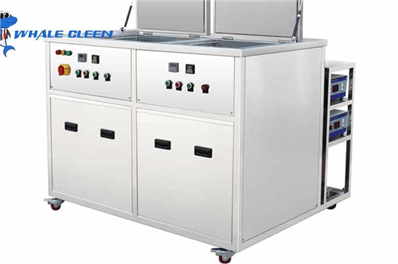
Multi‑frequency systems—equipment that can operate at multiple frequencies—allow operators to apply low‑frequency cavitation to break apart heavy deposits and then switch to high‑frequency cavitation to sweep away residual particles and thin oil films from micro‑features, all within the same cleaning cycle. As frequency versatility has become a recognized strategy for turbine disk cleaning, multi‑frequency systems are now considered the industry’s technical consensus for tackling mixed‑type contamination.
In aerospace applications where disk cleanliness directly impacts coating adhesion and fatigue life, the ability to move between frequency bands is not a luxury—it is a requirement. When selecting a system, buyers should assess whether the equipment offers true multi‑frequency capability (the ability to operate at multiple frequency settings) and can transition between bands either during a single cycle or across sequential cycles without manual intervention.
For maintenance organizations that process turbine disks in volume, batch‑to‑batch consistency is as important as the cleaning result itself. A cleaning process that achieves perfect cleanliness on one disk may produce inadequate results on the next if parameters such as cycle time, temperature, or power output drift—or if the process relies on operator judgment.
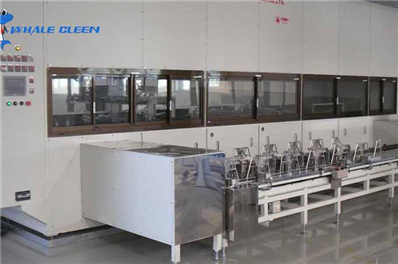
Programmable Logic Controller (PLC) systems address this challenge by storing validated cleaning recipes and executing them automatically. Operators simply select the appropriate program for a specific disk type, and the system runs the complete cleaning cycle—including ultrasonic stages, rinsing, and drying—without further intervention. Each batch receives identical treatment, and process data can be logged for quality traceability.
Vacuum‑assisted ultrasonic cleaning offers another level of certainty. By removing air from the cleaning chamber before introducing cleaning fluid, vacuum technology performs three critical functions: cleaning fluid penetrates deeper into blind holes and internal passages, air pockets that would otherwise block access are eliminated, and ultrasonic cavitation dampening caused by trapped air is reduced. For turbine disks with long, narrow passages or multiple intersecting bores, vacuum assistance is often the only way to ensure complete internal cleaning.
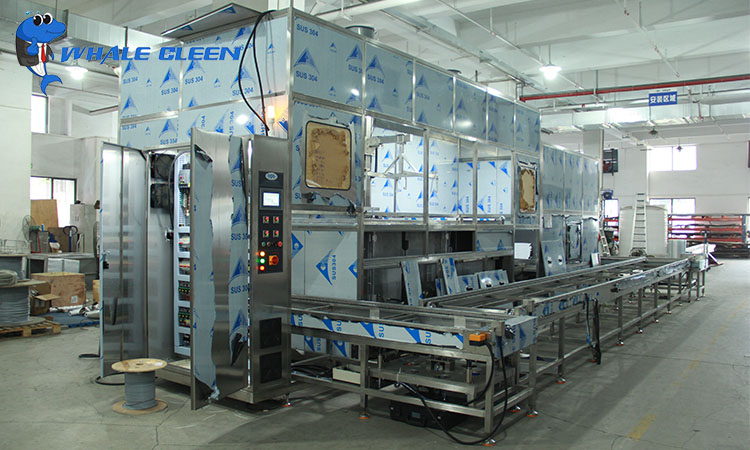
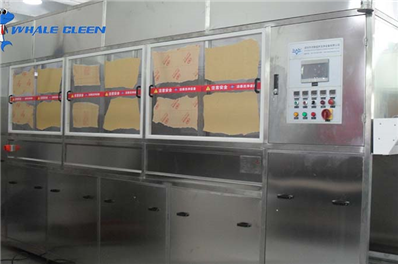
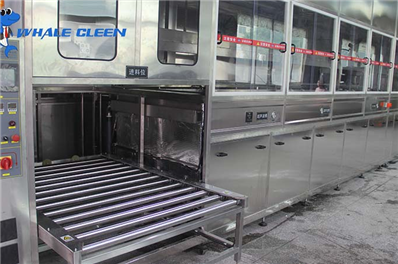
Multi‑stage systems further enhance consistency by integrating the complete cleaning sequence—pre‑cleaning, ultrasonic cleaning, rinsing, and drying—into a single automated line. Components move through each stage without manual transfer, eliminating the risk of contamination between stages or damage from handling.
When evaluating equipment, buyers should look for systems with programmable logic control, data logging capability, and optional vacuum and multi‑stage configurations that can be matched to their specific production volume and cleanliness targets.
Turbine disks come in a range of sizes. A disk for a large high‑bypass turbofan engine may be significantly larger in diameter than a disk for a small gas turbine. Yet many equipment suppliers offer only rigid, one‑size‑fits‑all tanks. As noted in the industry, in a real‑world factory, production conditions are rarely “standard,” and standard tanks often cannot accommodate large‑diameter disks.
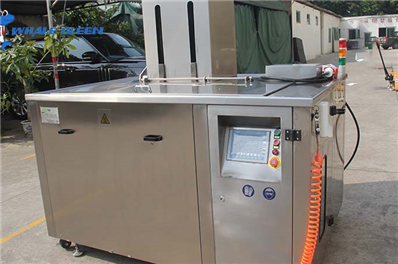
Whale Cleen takes a different approach: every large industrial ultrasonic cleaning machine is purpose‑built for the customer’s unique, non‑standard conditions, rather than being a generic product. Custom tank dimensions are engineered around the workpiece itself—not an arbitrary standard size. Custom transducer arrays are placed to distribute ultrasonic energy evenly across the disk‘s entire surface and into its internal passages. Custom fixturing holds the disk securely during cleaning without contacting sensitive surfaces, preventing damage during the cleaning process.
For the most demanding aerospace applications, Whale Cleen has developed specialized systems with directed transducer positioning designed to drive cavitation through cooling holes, plus precision fixturing that holds components without contact damage. This level of customization ensures that the cleaning system fits the part, rather than forcing the part to fit a system—reducing the risk of damage and improving cleaning effectiveness from the first cycle.
One of the most overlooked factors in turbine disk cleaning is maintaining bath cleanliness across multiple cycles. Once carbon, oxide particles, and metal fines are stripped from a disk, those contaminants remain suspended in the cleaning fluid. Without effective filtration, the same particles can re‑deposit onto the disk during the rinse or dry phases—or onto the next disk processed in the same bath.
For turbine disk applications where cleanliness specifications are extremely stringent, multi‑stage circulation filtration systems are essential. These systems continuously remove suspended oils, particles, and metallic fines from the cleaning solution, ensuring that each disk is cleaned with fresh, clean fluid. The benefits extend beyond quality to include reduced chemical consumption, longer bath life, and lower waste disposal costs—important considerations for high‑volume aerospace maintenance operations.
Whale Cleen has over 20 years of experience in industrial ultrasonic cleaning manufacturing. In collaboration with its sister brand Blue Whale, Whale Cleen brings deep engineering expertise to the most challenging aerospace cleaning applications.
OEM/ODM capability allows distributors and equipment integrators to bring custom ultrasonic cleaning systems to market faster. Whale Cleen offers a full suite of OEM/ODM solutions, eliminating years of internal research and development and factory setup for partners. This partnership model has been built on nearly two decades of OEM/ODM service for brand customers across multiple industries.
Non‑standard customization is central to the company‘s approach. Whether the application involves massive turbine disks measuring over a meter in diameter, delicate titanium components requiring gentle cleaning, or disks with exceptionally fine cooling passages, Whale Cleen designs custom tanks, custom transducer arrays, and custom fixturing to match the specific workpiece. As one industry description puts it, standard “big ultrasonic cleaning machines” cannot accommodate the full range of variables found in real‑world industrial environments. That is why Whale Cleen refuses to push generic products—instead analyzing each customer’s actual non‑standard conditions and designing a machine that fits them precisely.
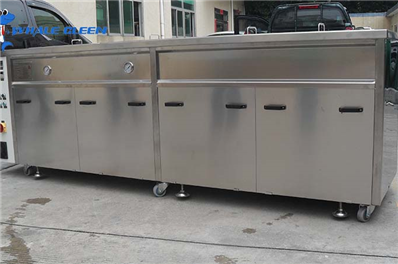
Industrial grade construction means the equipment is built for continuous, reliable operation. Whale Cleen systems feature durable stainless steel tanks, robust transducers, and components rated for demanding production environments.
Extending the service life of a turbine disk begins with one essential step: removing every trace of carbon, oxide scale, and particulate contamination from every internal passage, crevice, and cooling channel.
Conventional cleaning methods cannot meet this requirement. High‑pressure spraying cannot navigate internal bends, manual brushing cannot reach narrow gaps, chemical soaking lacks the mechanical force to dislodge embedded particles, and single‑frequency ultrasonic cleaners cannot address the full spectrum of disk contaminants.
Multi‑frequency ultrasonic cleaning, integrated with automation, vacuum assistance, and effective filtration, provides the complete solution. Systems engineered with these capabilities—and customized to the specific dimensions of the disk—deliver the consistency and completeness that disk longevity requires.
For organizations seeking to reduce scrap rates, extend disk service life, and meet the exacting cleanliness standards of modern aerospace maintenance, Whale Cleen offers the engineering expertise, customization capability, and OEM/ODM flexibility to deliver the right solution.
To discuss your turbine disk cleaning requirements or schedule a free cleaning test, contact Whale Cleen today.
Contact Whale Cleen
Website: www.bwhalesonic.com
WhatsApp: +86 15007557067
Email: michael@bwhalesonic.com