In precision manufacturing, few challenges are as persistent—or as costly—as cleaning micro-fasteners. Screws, bolts, and threaded inserts with diameters under M2 feature intricate geometries: narrow thread valleys, blind holes, and sharp internal corners. These are precisely the features that trap cutting fluids, metal chips, lapping paste, and stamping lubricants. The parts pass visual inspection. They proceed to assembly. And then—rejection. Contamination leads to poor adhesion, inconsistent torque, or premature wear in service.
Thread roots—the V-shaped valleys between each thread crest—are the most challenging cleaning dead zones on any micro-fastener. Machining residues become compacted deep in these narrow grooves. Compressed air blows only surface dust away. Cotton swabs and brushes cannot reach the bottom of the thread form.
Traditional cleaning methods are fundamentally limited. High-pressure spraying travels in straight lines—when a jet hits a thread valley or a blind hole bottom, it forms eddies that push contaminants deeper rather than flushing them out. Chemical soaking alone lacks the mechanical force to dislodge adhered oil films that have been baked onto surfaces during machining. Manual brushing fails to reach the root of a thread or the bottom of a deep blind hole. What looks like “rinsing” often becomes “embedding”.
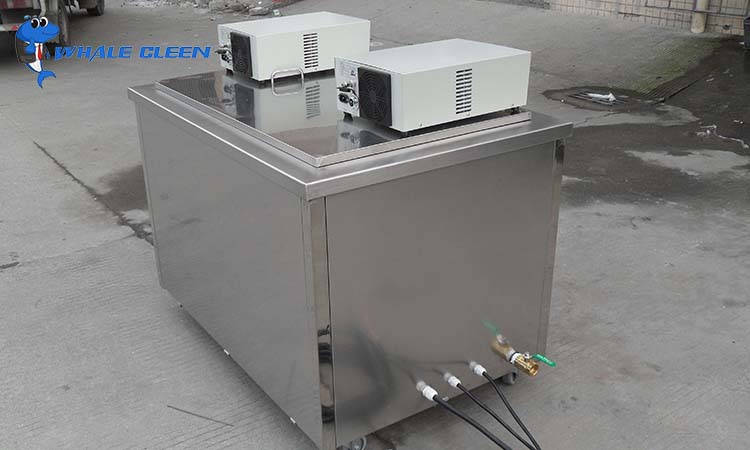
An industrial ultrasonic cleaning machine operates on a physical principle called cavitation. High-frequency sound waves are transmitted through a cleaning solution, generating millions of microscopic vacuum bubbles. These bubbles expand and then implode violently, releasing intense localized shock waves and high-velocity micro-jets.
The most remarkable characteristic is this: cavitation bubbles form and implode everywhere throughout the liquid simultaneously. They do not rely on line-of-sight access. As long as the cleaning solution can reach a threaded root, a blind hole, or a narrow slot, the imploding bubbles will clean it. The mechanical scrubbing action comes from the cavitation itself—not from aggressive chemistry or abrasive contact—so the part surface remains undamaged. Components that emerge from a properly configured ultrasonic system are not “visibly clean.” They are truly clean—down to the deepest blind hole, the farthest intersection, the tightest thread root.
Whale Cleen has established itself as a specialist in industrial ultrasonic cleaning. With over 20 years of experience in ultrasonic equipment research, development, and manufacturing, the company operates a 10,000-square-meter production base and holds over 30 national patents.
What sets Whale Cleen apart is its specialization in non-standard customization. Real-world manufacturing rarely has “standard” cleaning conditions: workpiece sizes vary, contamination levels differ, and production line layouts are unique. Whale Cleen designs and manufactures ultrasonic cleaning systems according to specific customer requirements—whether you are cleaning micro-screws with cutting oil trapped in thread roots or precision turned components with lapping paste embedded in blind holes.
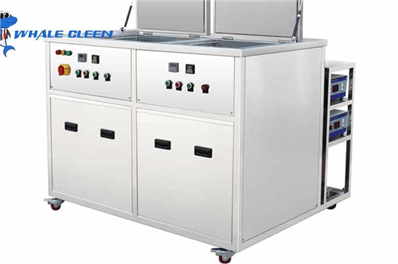
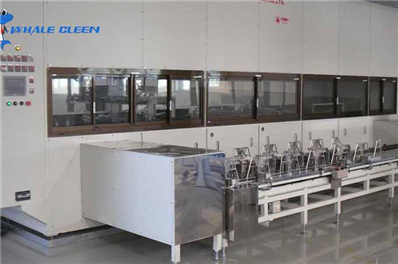
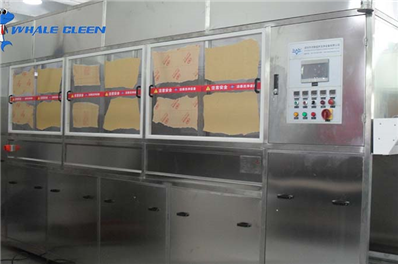
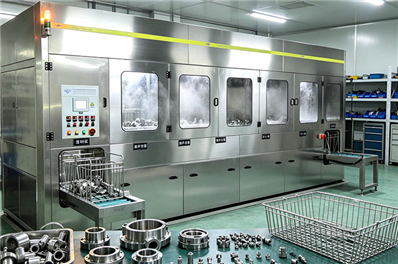
For micro-fasteners, Whale Cleen’s multi-stage systems—such as five-tank configurations—integrate ultrasonic solvent degreasing, rinsing, and drying into a single continuous workflow. Each tank can be independently configured with optimal ultrasonic power, frequency, and temperature. The cavitation effect reaches blind holes, grooves, and complex geometries that manual scrubbing simply cannot access. Every blind hole, every thread, every internal passage emerges perfectly clean.
Another distinguishing advantage is Whale Cleen’s commitment to a strong acid-free degreasing approach. Strong acid soaking carries significant hidden costs—chemical expenses, hazardous waste disposal, worker safety risks, and metallurgical damage such as hydrogen embrittlement in high-strength steel. Whale Cleen’s ultrasonic technology replaces chemical aggression with mechanical precision. The cavitation process removes grease, oil, and chips without exposing parts to harsh acids, delivering cleanliness improvements along with reduced scrap, lower chemical costs, and safer working conditions.
For manufacturers of micro-fasteners, the cleaning of thread roots and blind holes is never a trivial matter. A single contaminated screw can compromise torque values, accelerate wear, or cause adhesion failure in subsequent coating. Industrial ultrasonic cleaning transforms this process from a bottleneck into a quality assurance gateway. When cleaning moves from “judged by experience” to “guaranteed by process engineering,” micro-fasteners are no longer a source of risk—they become a foundation of reliable performance. Whale Cleen delivers the precision, consistency, and engineering depth that precision manufacturing demands.