Walk onto the floor of any PCB assembly shop, and you will see it: boards fresh off the soldering line, covered in flux residues, ionic contaminants, and microscopic debris. The clock is ticking. Production schedules depend on getting these boards clean—fast.
The question every production manager asks is simple: how long does it actually take to transform a dirty multilayer PCB into a reliably clean, production-ready board?
The answer depends entirely on how you clean it.
For decades, the standard approach to PCB cleaning was painfully slow. Workers dipped boards in solvent baths, scrubbed visible flux residues with brushes, and rinsed them under running water. A single batch could take hours—and that was just the cleaning portion. Drying added more time. Inspection added more. Rework added even more.
But the real killer wasn't just the time. It was the inconsistency.
Manual brushing cannot reach underneath low-standing components like BGAs, QFNs, or fine-pitch ICs. The bristles are simply too large to fit into gaps measured in tenths of a millimeter. Chemical dipping alone provides no mechanical agitation to dislodge residues from microscopic crevices. And when the solution becomes saturated, contaminants simply re-deposit onto the boards being processed—undoing whatever cleaning occurred.
The result? Boards that look clean but are not clean enough. In reliability testing, these boards fail at significantly higher rates. According to industry data, improper cleaning causes approximately 35% of PCB failures. That is one in three boards failing—not because of design flaws or component defects, but because the cleaning process itself was inadequate.
Industrial ultrasonic automatic cleaning changes everything—starting with the clock.
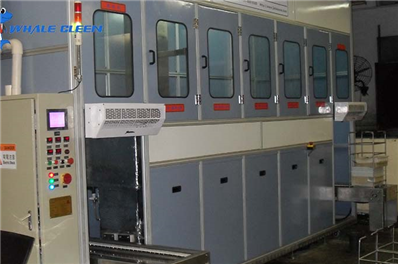
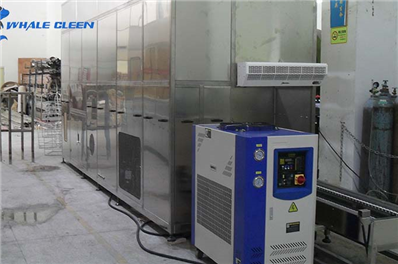
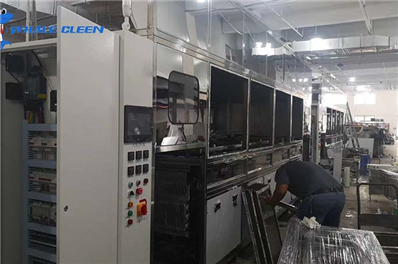
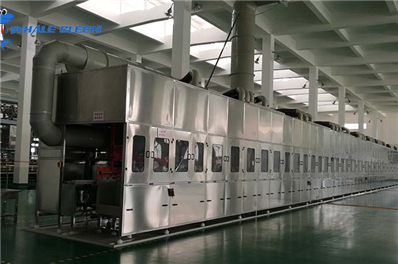
A modern through-type ultrasonic cleaning system moves PCBs through sequential zones—pre-cleaning, ultrasonic cleaning, rinsing, and drying—in a continuous production flow. Boards enter one end dirty and emerge from the other completely clean and dry. The entire process takes minutes.
Not hours. Not shifts. Minutes.
For a typical multilayer PCB, the ultrasonic cleaning stage itself may last only a few minutes—just enough time for cavitation to do its work. Millions of microscopic bubbles implode with tremendous energy, generating intense micro-jets that blast away flux residues, ionic contaminants, and particulates from every surface—including the tight gaps beneath BGAs, the crevices around fine-pitch components, and the walls of plated through-holes.
Manual methods cannot reach these areas. Ultrasonic cavitation reaches them all—simultaneously, consistently, and without physical contact.
But speed alone is not the full story. The real transformation is in what those minutes deliver.
A manually cleaned board may take hours and still show white residue around fine-pitch components under high-magnification inspection. Ionic contamination readings may exceed industry standards. In accelerated reliability testing, intermittent failures appear.
An ultrasonically cleaned board, by contrast, shows no residues, passes all cleanliness specifications, and survives testing without a single failure.
That is the difference between hours of uncertain labor and minutes of guaranteed cleanliness.
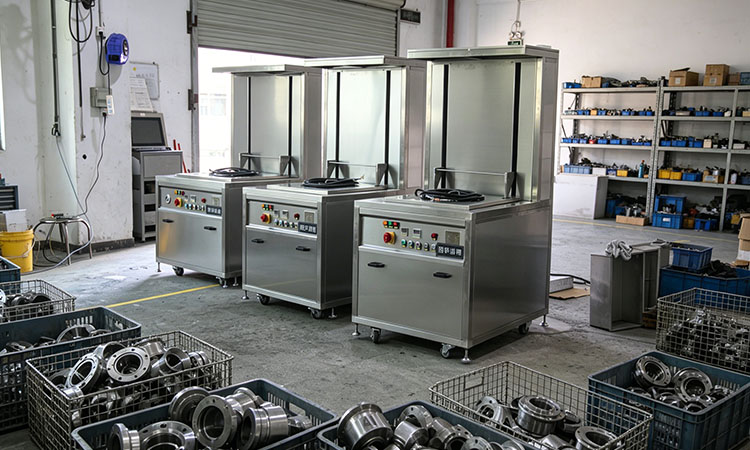
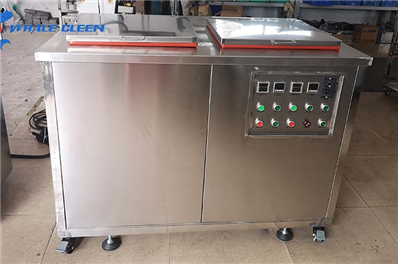
Whale Cleen (website: http://www.bwhalesonic.com/ ) has been focused on providing professional cleaning solutions since 2003. With a 10,000-square-meter production base and over 20 years of experience in ultrasonic equipment research, development, manufacturing, and after-sales service, the company designs the kind of industrial ultrasonic automatic systems that leading electronics manufacturers rely on.
Whale Cleen's through-type industrial ultrasonic cleaning machines are equipped with stainless-steel conveyor belt systems that move workpieces through sequential zones—pre-cleaning, ultrasonic cleaning, rinsing, and drying—in a continuous production flow. Boards move from dirty to spotless without manual intervention, without batch-to-batch variability, and without the hours of labor that manual methods demand.
Key features that set Whale Cleen apart include:
Continuous automated flow — Boards enter dirty and exit clean and dry, all in a single, uninterrupted process.
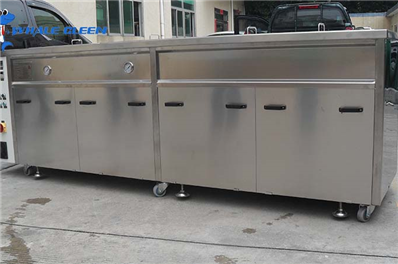
Stainless-steel construction — Robust tanks (SUS304 or SUS316) and industrial-grade components built for shift-after-shift operation.
PLC-controlled consistency — Every batch runs the same recipe. No operator variability. No "good enough" passes.
Customizable configurations — From through-type conveyor systems to mechanical arm designs, Whale Cleen builds solutions tailored to your specific production flow.
And because Whale Cleen focuses exclusively on industrial and electronics manufacturing applications—PCB cleaning, metal parts, automotive components, and precision machining—every system is purpose-built for the demands of real-world production.
So how long does it take to transform a dirty multilayer PCB into a reliably clean, production-ready board?
With manual methods: hours—and even then, the results are uncertain.
With a Whale Cleen industrial ultrasonic automatic cleaning system: minutes—with results that are consistent, repeatable, and verifiably clean.
When one-third of all PCB failures can be traced back to improper cleaning, the choice of cleaning method is not a secondary concern. It is a primary determinant of product quality, manufacturing profitability, and customer trust.
Stop spending hours on uncertain results. Start cleaning in minutes—with certainty.
Ready to see how fast Whale Cleen can clean your PCBs? Visit http://www.bwhalesonic.com/ to explore their range of industrial ultrasonic automatic cleaning solutions—or contact their team directly to discuss your specific application.